by Greg Reynolds
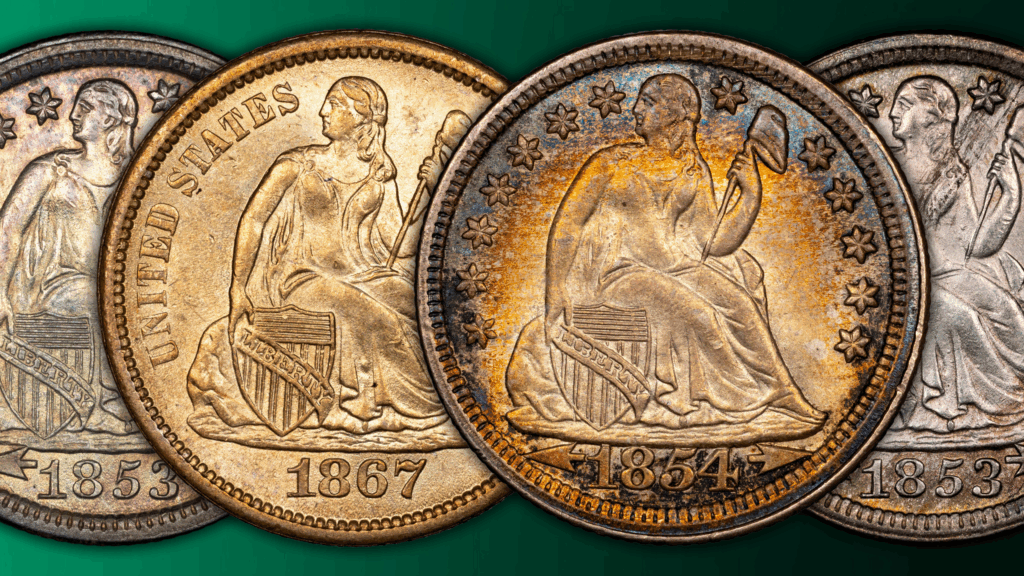
As there are six design types of Liberty Seated dimes, a type set requires six coins. It is very practical for a collector to assemble a really neat set in MS-64 to -66 grades, without spending a fortune or a lot of time. These are attractive and available.
Indeed, MS-64 to -66 grade nineteenth century coins are usually much more attractive and technically more impressive than MS-60 to -63 grade coins. Collectors who are concerned about the costs of MS-64 to -66 grade coins may wish to read my articles on building sets of circulated dimes, which emphasize VF-20 to AU-50 grade coins.
By tradition, MS-64 grade coins are considered to be Choice or Very Choice Uncirculated. MS-65 and -66 grade coins are Gem Uncirculated. Years ago, many coin firms used to insert the word ‘brilliant’ into these names, such as Gem Brilliant Uncirculated, or ‘Gem BU’!
In terms of quality overall, the difference between a MS-65 and MS-64 grade coin is much greater than the difference between MS-63 and MS-62, or even between MS-64 and MS-63. The numbers replaced adjectives in the coin community, though the longstanding belief was that there is a substantial difference between a Gem grade coin and a Choice or Very Choice Uncirculated coin. This is a major reason as to why MS-65 grade classic U.S. coins tend to cost much more than MS-64 grade coins of the same respective types, dates and major varieties.
As for how much more an MS-65 grade coin should be worth than an MS-64 grade coin of the same type, date and variety, there is no right or wrong answer. Collectors must decide for themselves how much they are willing and able to spend on particular coins. The pursuit of coins should and typically does depend in part upon the personality of the buyer.
Collectors must decide for themselves how much they are willing and able to spend on particular coins. The pursuit of coins should and typically does depend in part upon the personality of the buyer.
Collectors learn while collecting, and I suggest beginning with straightforward projects. It is easy to assemble a type set of Liberty Seated dimes or of all U.S. dimes. As part 1 covers the first three types of Liberty Seated dimes, part 2 is about the second three. In several articles, I repeat the list of all thirteen types of silver dimes. This discussion is narrowly focused on just three design types:
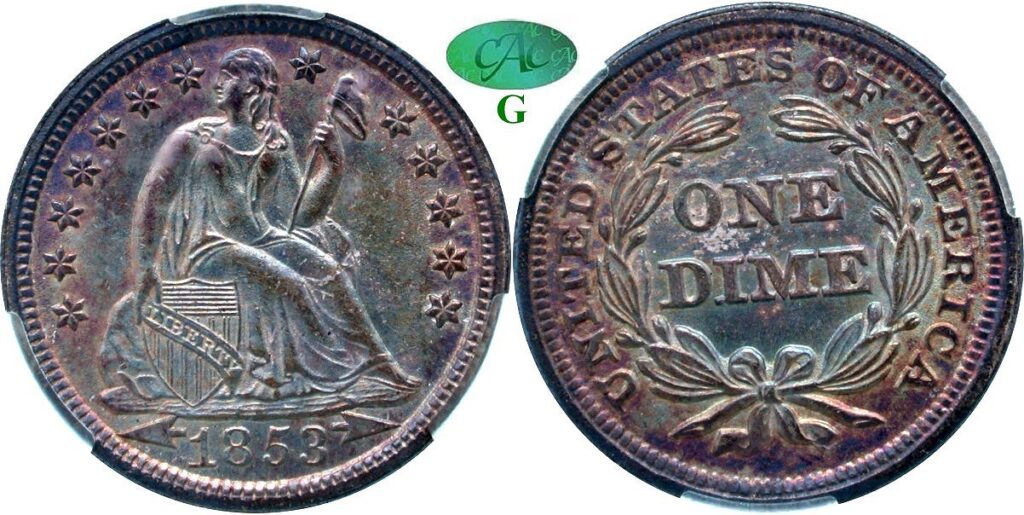
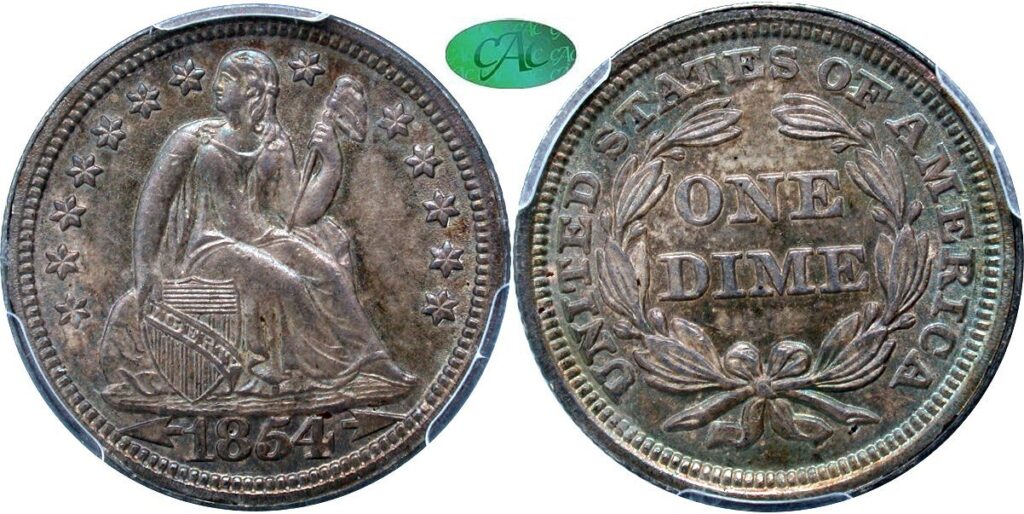
8. Liberty Seated – Arrows & Stars on Obverse (1853-55)
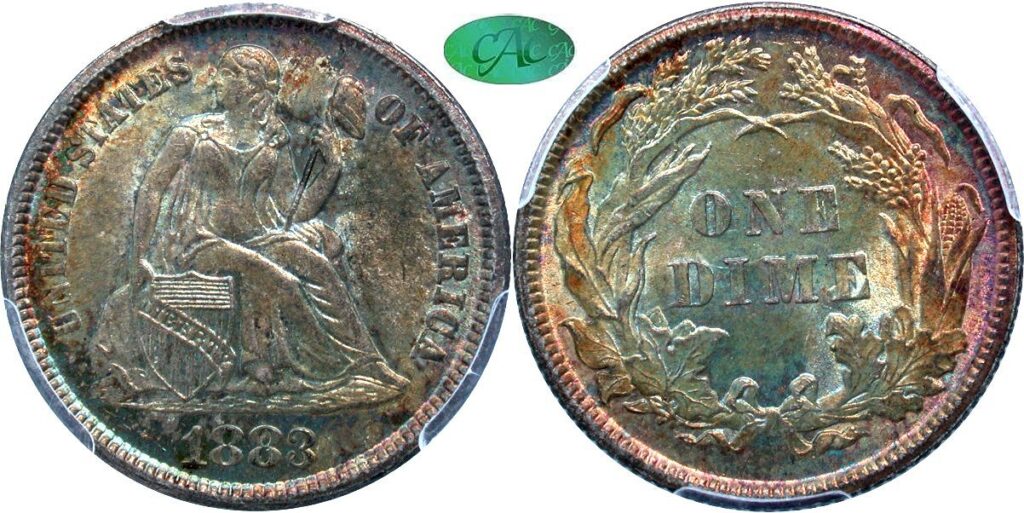
9. Liberty Seated – Legend on Obverse (1860-73, 1875-91)
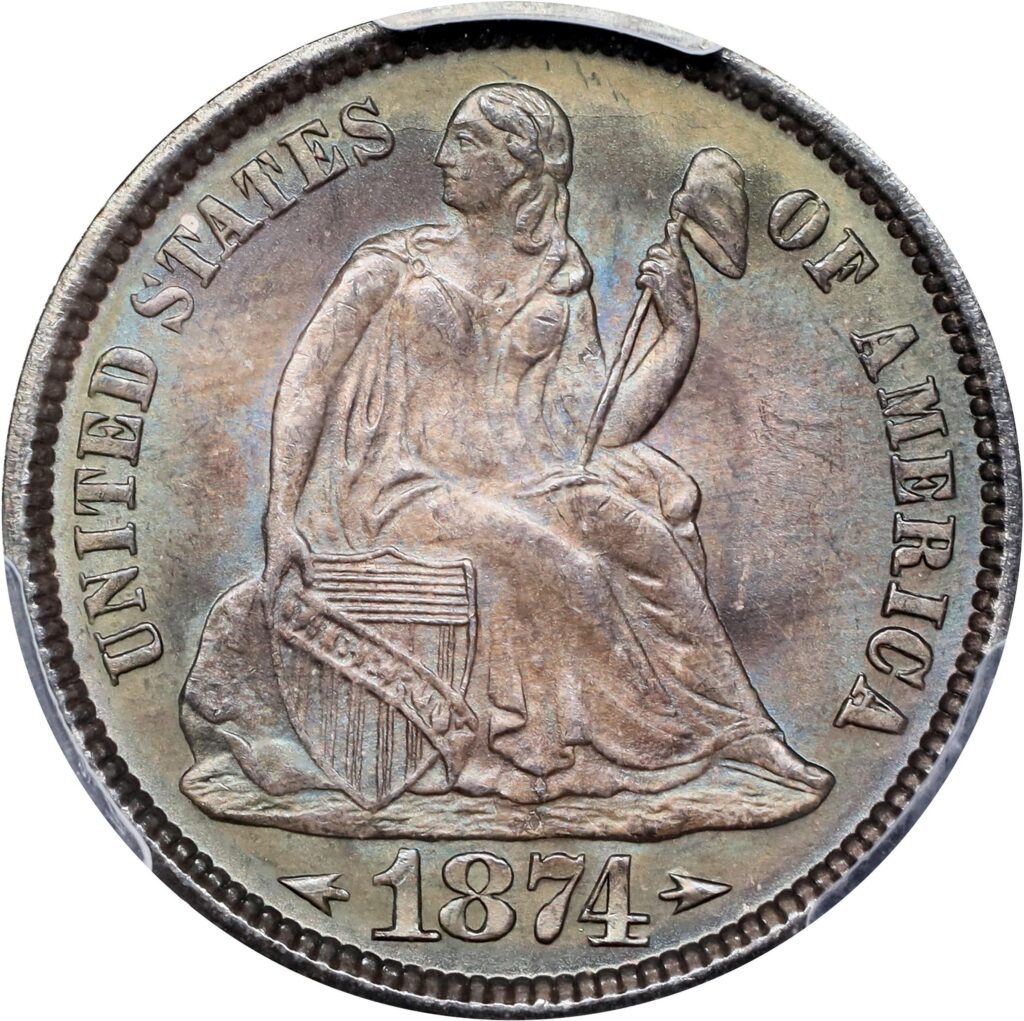
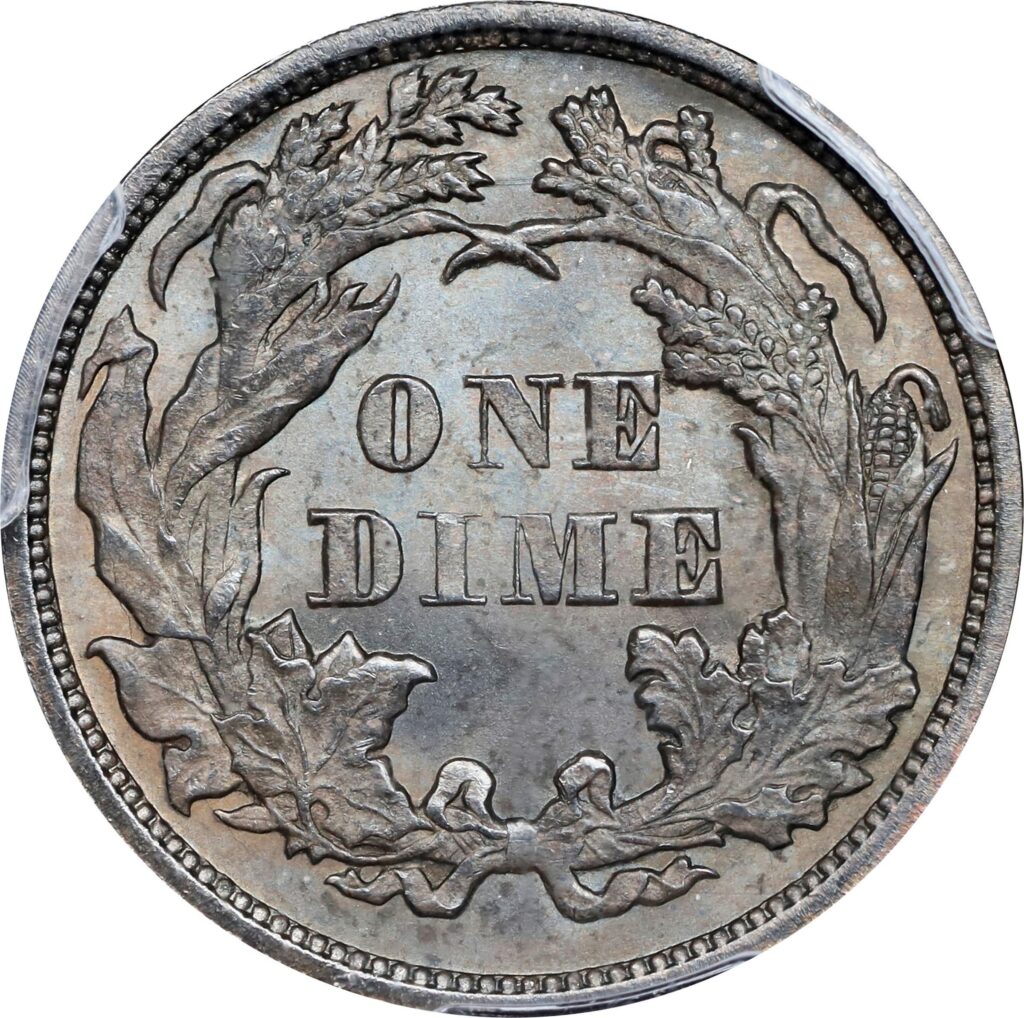
10. Liberty Seated – Legend & Arrows on Obverse (1873-74)
Type #8 – With Arrows & Stars on Obverse (1853-1855)
To understand type #8, there is a need to think about the Coinage Act of 1853. In the monetary history of the United States, the Coinage Act of 1853 was revolutionary. It was the first coinage law that obviously moved the U.S. monetary order away from bimetallism, with silver and gold both being ‘money,’ and toward a gold standard. A U.S. coinage system with both gold and silver coins being legal tender and a fixed silver to gold ratio was firmly established by the Coinage Act of 1792 and slightly modified by law in the 1830s.
In the Coinage Act of 1853, new issues of multiple denominations of silver coins were defined as fiat currency, subsidiary coinage. These were required by law to have face values that were greater than the legal value of their respective silver bullion content.
The value of silver or gold as a metal relates to market levels for bullion. Prices paid by refiners for silver and gold usually relate to markets for bullion, not values to collectors.
The Coinage Act of 1792 defined a U.S. silver dollar as containing 371.25 grains of silver (0.7734 Troy ounce). A half dollar was specified to contain half as much silver as a silver dollar; a quarter had one-fourth as much silver as that in a silver dollar, and a dime contained one-tenth as much, 37.125 grains.
Before the 1850s, each U.S. silver coin contained an amount of silver that had the legal value of the face value of the respective coin. This changed in 1851 when Three Cent Silvers were introduced. At the time, it was peculiar that a Three Cent Silver contained just 2.5 cents worth of silver. As these were of such little value anyway, it was not as revolutionary a change as the 6.91% reduction of the silver content in half dimes, dimes, quarters, and half dollars, in 1853. Silver Dollars continued to contain 371.25 grains of silver, the legal definition of a U.S. dollar in silver.
Market levels for silver clashed with the law, as the market value of silver as a metal (bullion) trended upward during the period from 1849 to 1854. This was largely because massive quantities of gold were discovered in California. The resulting increase in the supply of gold caused the relative value of silver to increase. Gold became less scarce than gold was before.
In the early 1850s, many U.S. citizens began hoarding, bartering, trading or exporting U.S. silver coins, rather than spending them. Although the value of the silver in U.S. silver coins was then only slightly higher than their respective face values, people were concerned about the direction the price of silver was heading and about the stability of the whole U.S. monetary system. If a dime contained more than ten cents worth of silver, and the value of silver trended upward for years, a dime would eventually cease to be a medium of exchange and would become a bullion ‘coin.’
The Three Cent Silver was introduced in 1851 to facilitate the use of small change in commerce. Although a Three Cent Silver contained only 2.5 cents worth of silver (9.28125 grains) in a legal sense, the market value of 9.28125 grains of silver was greater than 2.5 cents, yet certainly less than 3 cents, so people had a motive to spend Three Cent Silvers rather than hoard them.
The reductions in the silver content of multiple denominations in 1853 served a parallel purpose, to facilitate commerce and encourage people to spend silver coins rather than hoarding them. The reduced silver content coins ‘With Arrows,’ however, were only legal tender for amounts up to five dollars. This was perhaps the most revolutionary aspect of the Coinage Act of 1853. U.S. citizens had taken for granted their right to use U.S. silver coins to pay debts and taxes.
In the second edition of The History of Bimetallism (NY: Appleton, 1895), eminent economist J. Laurence Laughlin emphasized that it is “to be kept distinctly in mind that in 1853 the actual use of silver as an unlimited legal tender equally with gold was decisively abandoned.”
To signify the new developments and the reduced silver content, arrows were added to the obverse designs of the half dime, dime, quarter and half dollar. Rays were added to the reverse designs of the quarter and half dollar, though that is a matter covered in discussions of quarters and half dollars.
These arrows were used only until 1855, though the reductions in the silver content of coins of these denominations became permanent until the Coinage Act of 1873, which slightly adjusted the silver content of dimes, quarters and half dollars, really to a trivial extent. In terms of silver content and weight, dimes minted ‘Without Arrows’ from 1856 to 1873 were subject to the same standards as those minted ‘With Arrows’ from 1853 to 1855.
I formulated a theory as to why the arrows were removed from the design of dimes, quarters and halves, by 1856. My theory was recognized with an award from the Numismatic Literary Guild. It is not practical to summarize that theory here, though the original article and subsequent references can be found for free on the Internet.
The Coinage Act of 1853 was required to be implemented by June 2, 1853. U.S. silver coins minted in 1853 under the old standard did not have arrows. An 1853 ‘No Arrows’ dime is of type #7 and was specified to contain more silver, 37.125 grains, than an 1853 ‘With Arrows’ dime, 34.56 grains (0.072 Troy ounce).
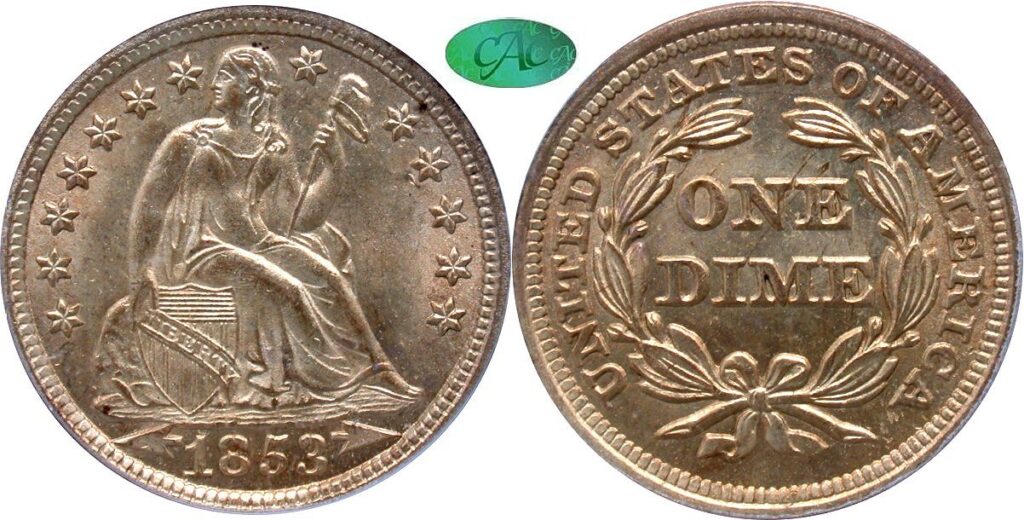
There are just five dates in this whole design type (#8): 1853, 1853-O, 1854, 1854-O and 1855. For a type set of MS-64 to -66 grade coins, collectors tend toward 1853 or 1854 Philadelphia Mint issues, though sometimes an 1855 may be acquired for a modest price.
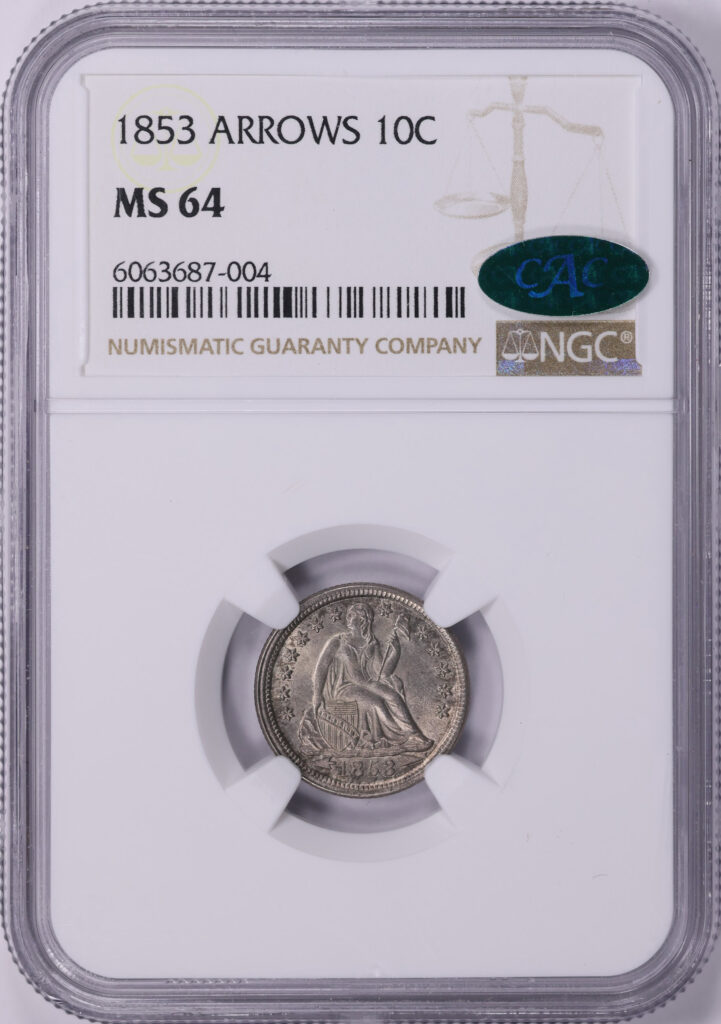
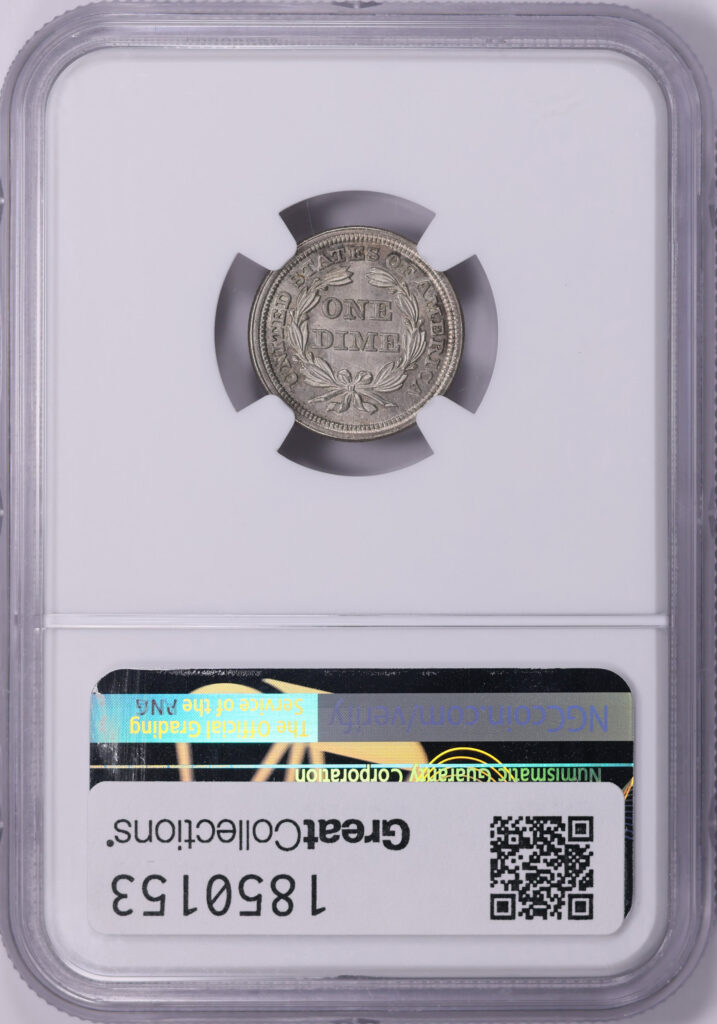
In August 2025, Gerry Fortin Rare Coins sold a CAC approved, PCGS graded MS-64 1854 dime for $985. In late June 2025, GreatCollections sold a CAC approved, NGC graded MS-64 1853 ‘With Arrows’ dime for $919.60. In April 2025, Heritage sold a CAC approved, PCGS graded MS-64 1853 ‘With Arrows’ dime for $900. In December 2024, Gerry Fortin Rare Coins sold a CACG graded MS-64 1853 dime for $1,125.
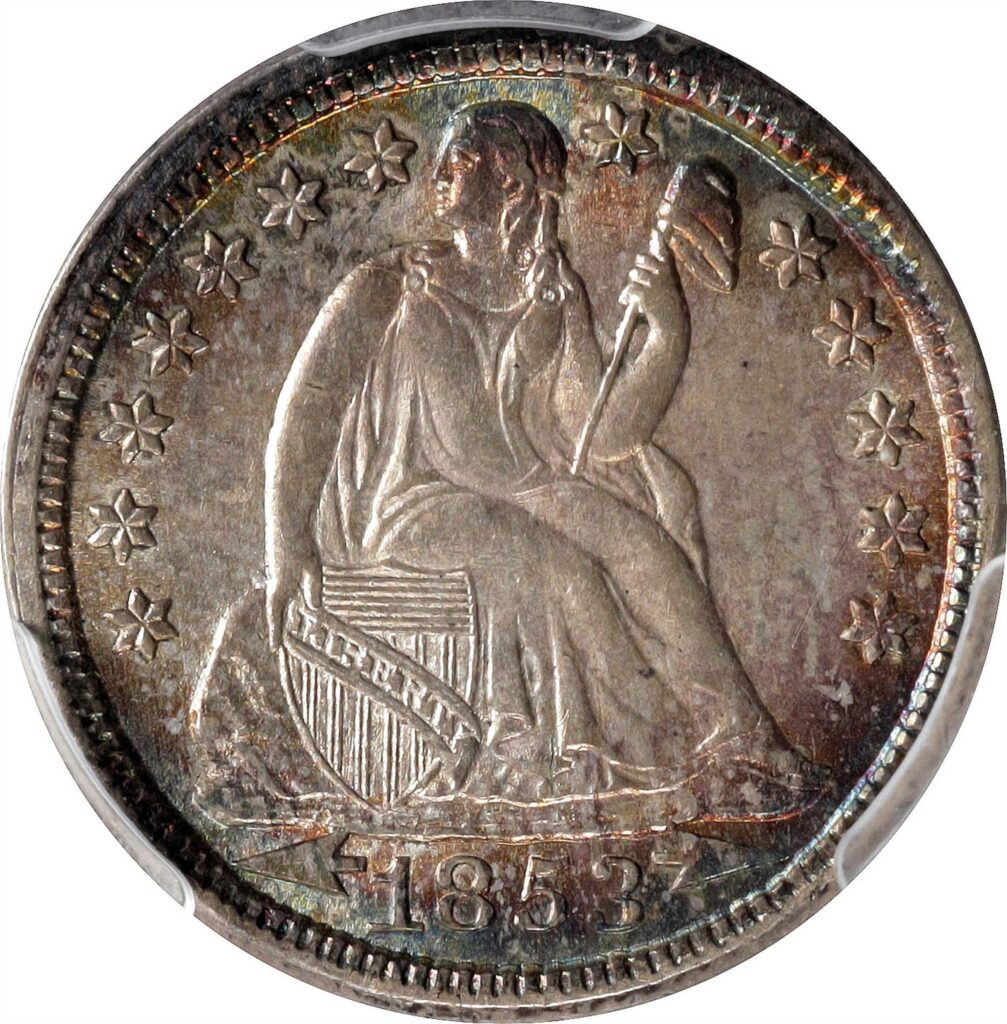
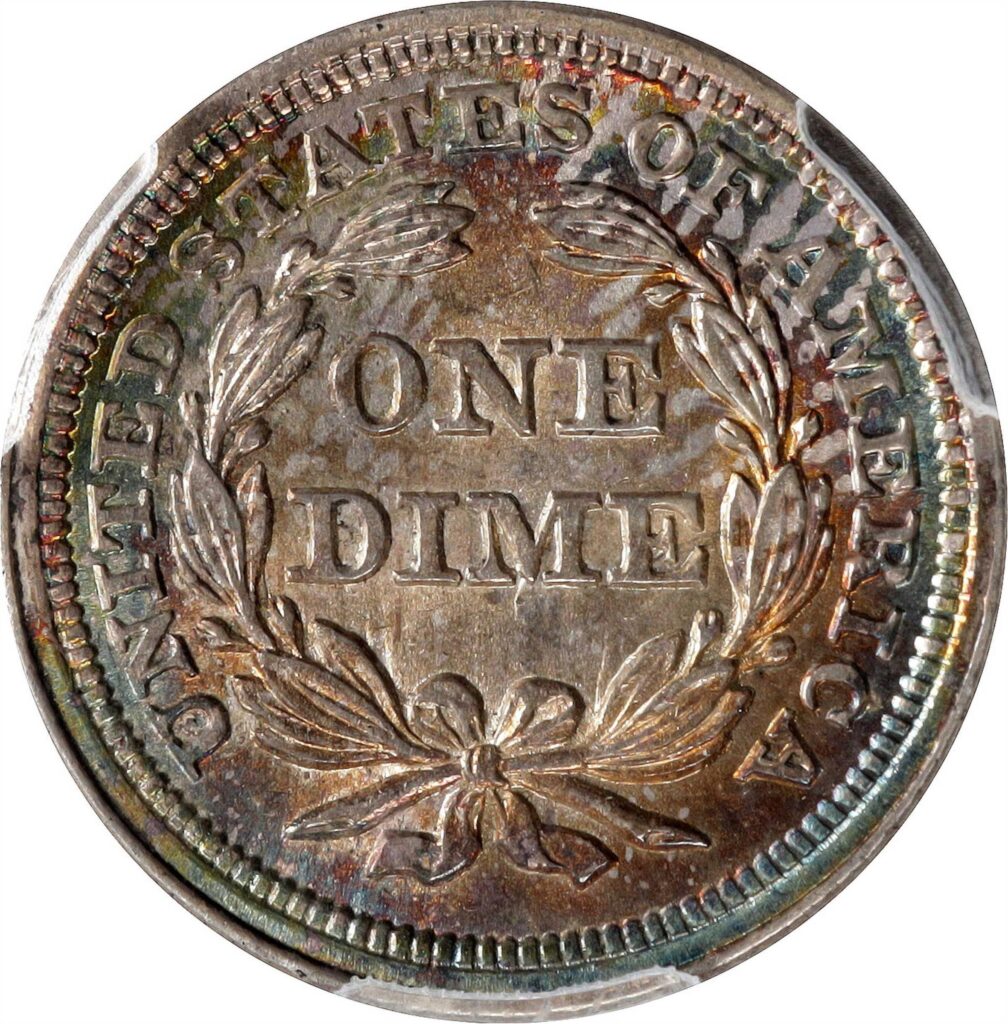
On April 5, 2022, Stack’s Bowers auctioned a CAC approved MS-65 grade 1853 ‘With Arrows’ dime for $1,680. On Aug. 24, 2022, Heritage auctioned a CAC approved MS-65 grade 1854 ‘With Arrows’ dime for $2,280. In MS-65 grade, an 1854 dime usually commands a significant premium over an equivalent 1853.
MS-66 grade 1853 and 1854 ‘With Arrows’ dimes cost considerably more than lower grade coins. In April 2025, Gerry Fortin Rare Coins sold a CAC approved MS-66 grade 1853 dime for $3,150. In January 2025, Heritage sold a CAC approved MS-66 grade 1853 for $3,480.
Type #9 – Legend on Obverse (1860-1873, 1875-1891)
In 1860, the legend, ‘United States of America,’ was moved from the reverse to the obverse in the designs of dimes. The legend is on the reverse of most classic U.S. coins.
Curiously, the legend is on the obverse of Flying Eagle cents (1857-58), Indian cents (1859-1909), Three Cent Nickels (1865-89), Three Cent Silvers (1851-73), and the last type of half dimes (1860-73). The legend is on the obverse of Barber dimes (1892-1916), yet is on the reverse of Barber quarters (1892-1916) and Barber half dollars (1892-1915).
The legend does appear on the obverse of a large number of commemorative coin issues, beginning in 1892. In 1999, the legend was moved to the obverse of Washington quarters and new reverse designs were introduced. To the best of my recollection at the moment, the legend never appeared on the obverse of a regular issue U.S. half dollar. The movement to the obverse of the legend on dimes in 1860 is clearly indicative of a new design type.
Type #9 was interrupted by Type #10 in 1873. For just two years, arrows were added to the obverse designs of dimes, quarters and half dollars, in 1873 and 1874. There was a very slight change in the specified weights of dimes, quarters and half dollars, statistically insignificant and within the allowed tolerance of dimes minted from 1860 to 1872.
In my view, dimes of 1875 to 1891 are of the same design type as dimes of 1860 to 1872, except that the legend remained on the reverse on 1860-S dimes. Some collectors may wish to acquire both a type #9 dime from the early 1860s and one from after 1874 for a type set of Liberty Seated dimes. Type #10 dimes and those type #9 dimes dated after 1874 are related to the Coinage Act of 1873.
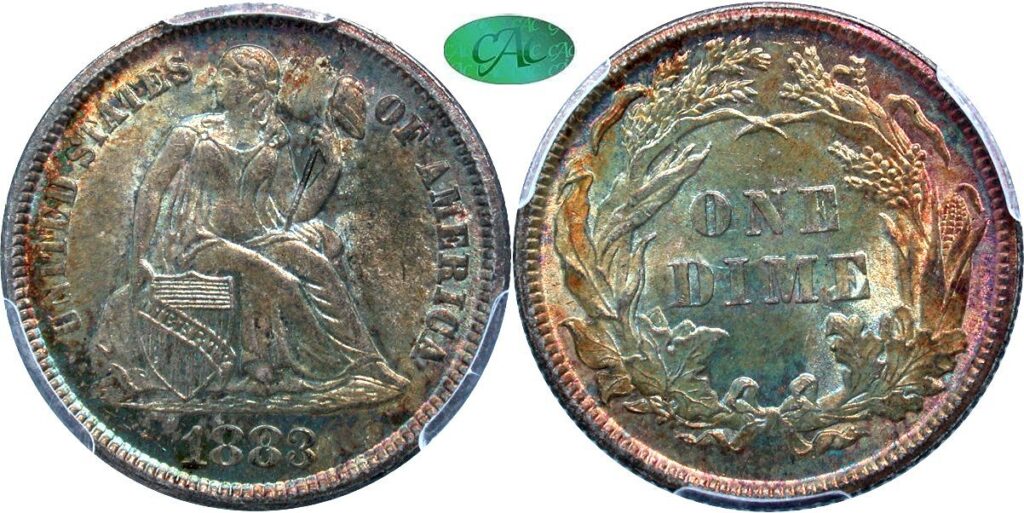
As most collectors of dimes by design type will be satisfied with just one type #9 dime, it is simpler here to focus on the later dates that are not very scarce. Philadelphia Mint dimes from the 1880s and early 1890s are relatively inexpensive.
MS-64 grade dimes of type #9 appear often. The following are examples. In addition to online auctions, many Liberty Seated dimes are sold at coin shows and through mail-order dealers.
In February 2025, Gerry Fortin Rare Coins sold a CACG-graded MS-64+ 1890 dime for $560. In August 2025, Gerry Fortin Rare Coins sold a CAC-approved MS-64 grade 1883 dime for $625. Also in August 2025, GreatCollections sold a CAC-approved MS-64 grade 1888 dime for $547.80. On Nov. 3, 2024, GreatCollections sold a CAC-approved, NGC-graded MS-64 1891 dime for $451. On June 11, 2023, GreatCollections sold a CAC-approved MS-64 grade 1891-O for $495.
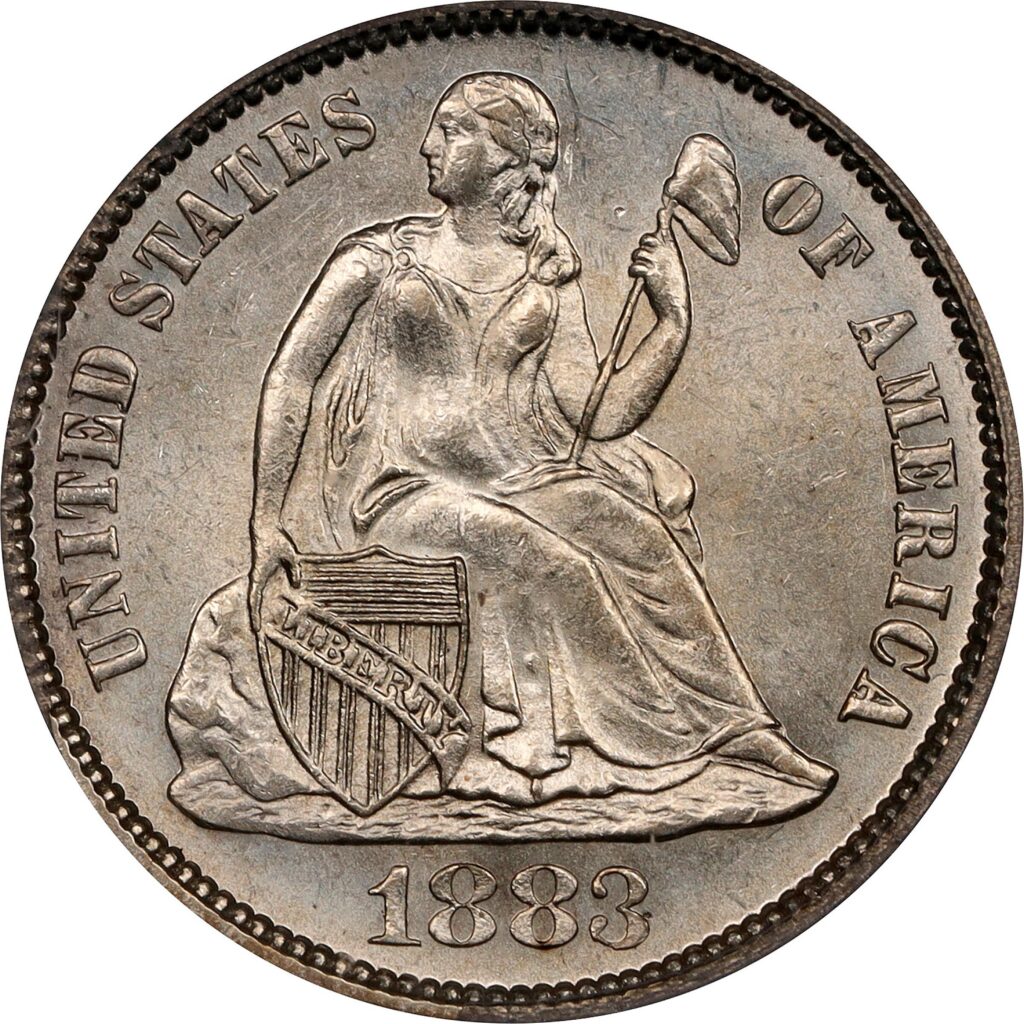
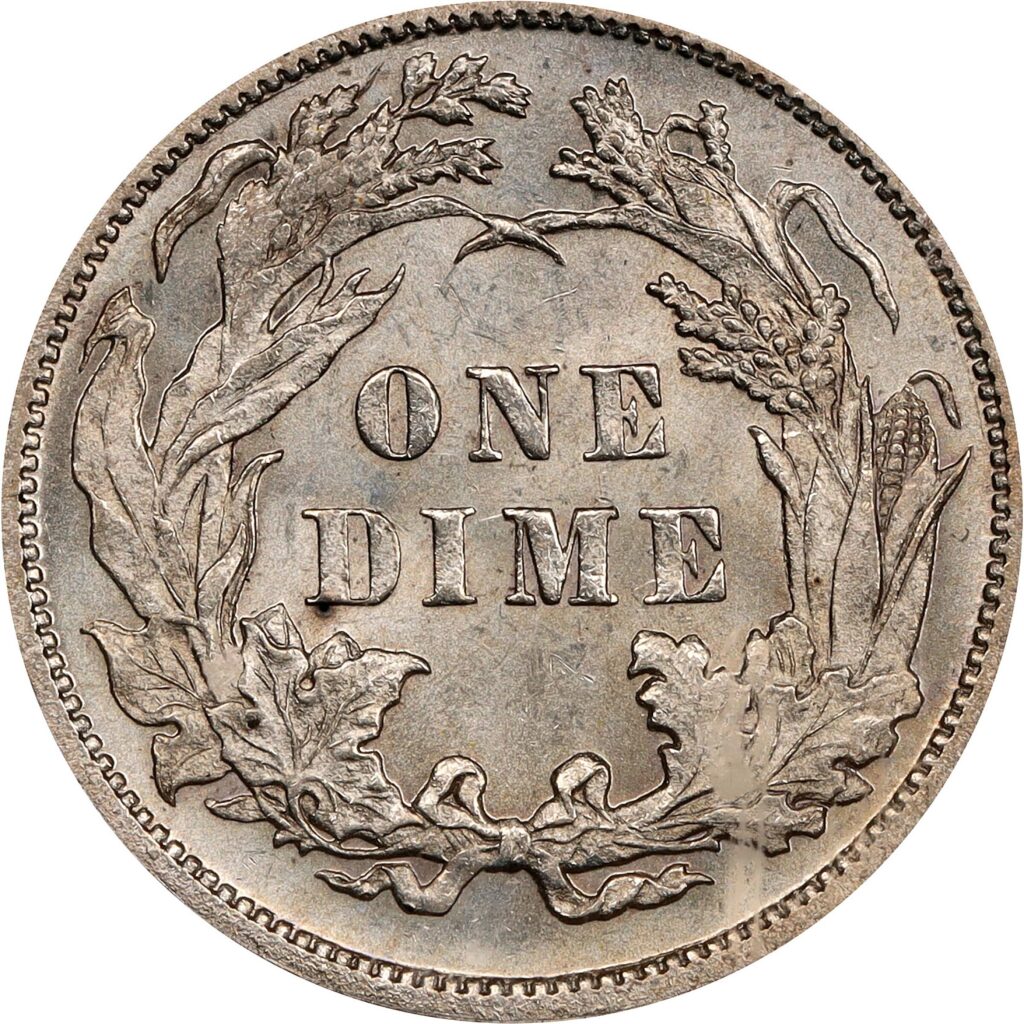
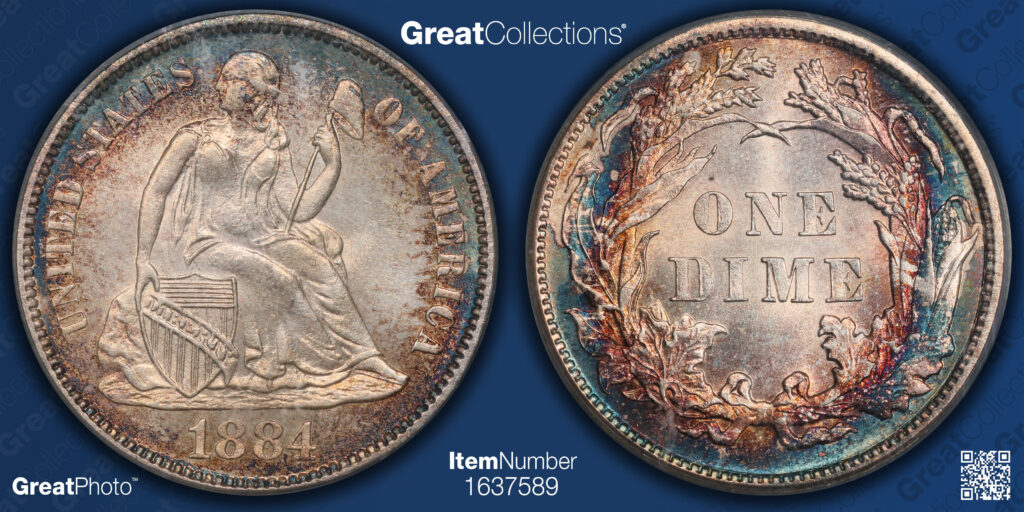
MS-65 grade representatives of type #9 are probably available for less than $985 each. On Sept. 20, 2023, Stack’s Bowers sold a CAC-approved MS-65 grade 1883 for $840. In August 2025, Gerry Fortin sold a CAC-approved MS-65 grade 1884, a very colorfully toned coin, for $975. On Oct. 20, 2024, GreatCollections sold a CAC-approved MS-65 grade 1885 for $687.50. In December 2024, Gerry Fortin Rare Coins sold a CAC-approved MS-65 grade 1885 for $725. This $725 coin is of an unusual die variety, with part of a stray numeral in the dentils.
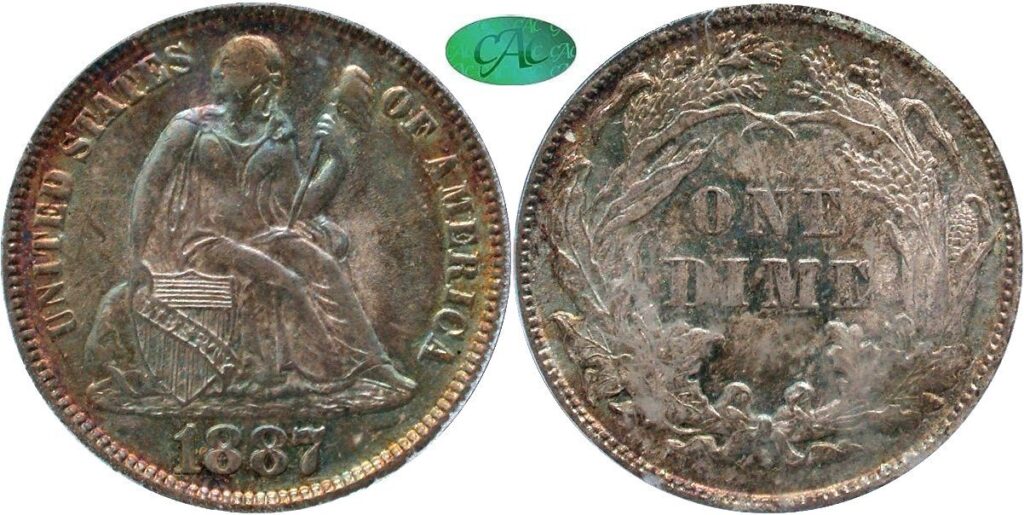
In August 2025, Gerry Fortin sold a CAC-approved MS-65 grade 1889 dime for $900 and an MS-65 grade 1887 dime for $925. Previously, in January 2024, Fortin’s firm had sold this exact same 1887 for $895. Many of the Liberty Seated dimes offered by Gerry Fortin were especially colorful and may command premiums over less colorful dimes with the same certifications.
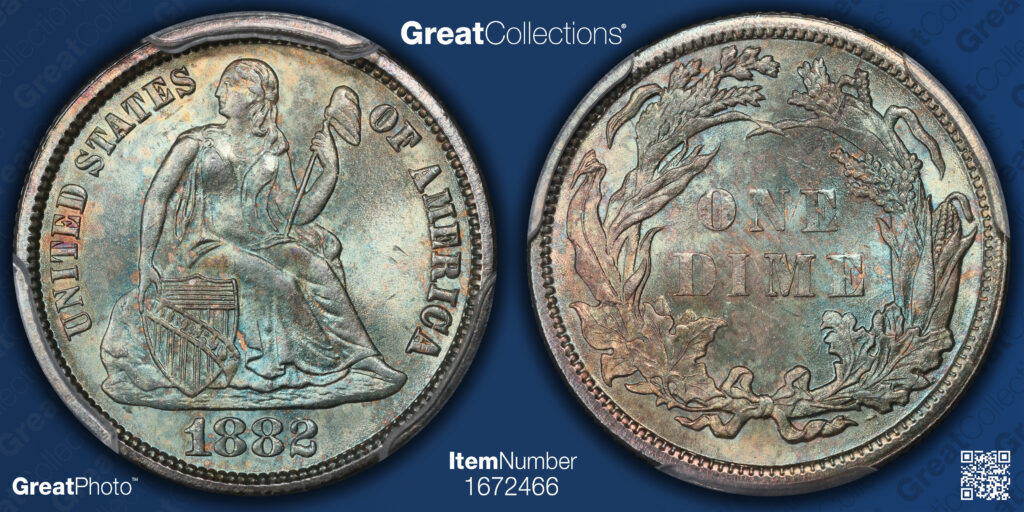
In October 2024, GreatCollections sold two different CAC-approved, PCGS-graded MS-66 1882 dimes, one for $880 and the other for $1,061.50. On Aug. 23, 2024, Stack’s Bowers auctioned a CAC-approved MS-66 grade 1883 for $1,020. On Oct. 6, 2024, GreatCollections sold a CAC-approved MS-66 grade 1884 for $1,106.60. In August 2025, Gerry Fortin Rare Coins sold a CAC-approved MS-66 grade 1888 for $1,200, a CAC-approved MS-66 grade 1889 dime for $1,250 and a CAC-approved MS-66 grade 1891 for $1,000.
The CPG-CAC medium retail estimate for a CAC-approved MS-66 grade, Philadelphia Mint dime from 1882 to 1891 is $1,100. It is important to keep in mind that no price guide will always be accurate and coins often sell for prices below medium-retail levels. Furthermore, coins sometimes sell for prices well above medium retail levels. Prices paid are affected by several variables including the perspective of the seller, the circumstances of the transaction, and the particular physical characteristics of the respective coin.
Type #10 – Arrows & Legend on Obverse (1873-1874)
The Coinage Act of 1873 was sweeping. Two-Cent pieces, Three Cent Silvers, half dimes and regular U.S. silver dollars were terminated. U.S. citizens were no longer allowed to bring silver bullion to the U.S. Mint for it to be freely coined into silver coins at the rate established by the Coinage Act of 1872. Essentially, the legal rule defining a U.S. dollar as being equivalent to 371.25 grains (0.7734 Troy ounce) of silver was erased, though it was partly resurrected with the introduction of Morgan silver dollars in 1878.
Economist J. Laurence Laughlin maintained that it was the Coinage Act of 1853, not 1873, that established a gold standard and demonetized U.S. silver coins. In my opinion, this is not entirely true. A schism was created between pre-1853 silver coins and those minted under the requirements of the Coinage Act of 1853, which mandated a 6.91% reduction in the silver content of half dimes, dimes, quarters and half dollars.
As the bullion market values of silver and gold fluctuate, it was never unusual for one or the other to move somewhat from its legal definition in the framework of the U.S. dollar, 371.25 grains for silver and about 23.2 grains for gold. The law authorizing Three Cent Silvers in 1851 and the Coinage Act of 1853 could have been intended by many Congressmen to be stopgap measures needed to address a crisis, the severe lack of silver coins in circulation.
It is true that the average annual value of the silver in a U.S. silver dollar was $1.04 or higher during several years from 1853 to 1864. Market levels for silver during this time period, however, were anomalies. The value of the silver in a U.S. silver dollar was $1.025 in 1852, $1.031 in 1861, $1.024 in 1869 and below $1 from 1874 onward.
From the 1850s to the 1880s, bimetallism had yet to be abandoned in the hearts and minds of a large number of Americans. Indeed, millions of U.S. citizens remained focused on it as a longstanding policy that would make a comeback.
The market value of the silver content of dimes minted after June 2, 1853 was well under ten cents. There was no logical motive to hoard them, though many people did anyway, especially while being frightened by the U.S. Civil War (1861-65) and political unrest later.
New coin denominations were introduced to facilitate commerce: small cents in 1857, Two-Cent pieces in 1864, Three Cent Nickels in 1865, and five cent nickels in 1866. The monetary order was viable and the economy functioned. The Coinage Act of 1873, however, was often regarded as counter-productive and harmful. Additionally, this law along with a companion law that was passed soon afterward really established a gold standard, implicitly.
In the Coinage Act of 1873, the prescribed weight of a dime was changed from 38.4 grains (2.48 grams) to 2.5 grams. As all U.S. silver coins minted from 1837 to 1964 were standard (90%) silver, the increase in silver content of a dime was 90% of 0.02 grams, practically nothing.
The use of straightforward metric measurements for the weights of dimes, quarters and half dollars had very little, if anything, to do with silver. It was not reflective of public support for the metric system either.
In the 1870s, there was no serious plan for the United States to adopt the metric system, and I maintain that this was not even a consideration in the minds of most all influential politicians and private citizens. Other than the weights of dimes, quarters and half dollars, all the other specifications mandated by the Coinage Act of 1873 were stated in terms of the British-American system of measures, not the metric system.
For example, the weight requirements for Three Cent Nickels and five cent nickels were stated in grains, not grams. The allowed deviations in the weights of dimes, quarters and half dollars in large deliveries was specified in ounces, not grams or kilograms. A Troy ounce is equivalent to 480 grains.
The main reason why the gross weights of dimes, quarters and half dollars were specified in grams was to appease special interest groups who demanded that U.S. coinage conform better with coins in Western Europe. During the second half of the nineteenth century, the French were leaders in attempts to bring about international coinage standards. The U.S. dime was mandated to weigh 2.5 grams because the French Fifty-Centimes silver coin of the time period was already specified to weigh 2.5 grams. The French Franc weighed five grams.
In 1865, a few European nations formed the Latin Monetary Union (LMU) and several other nations followed suit without actually joining. The LMU set specifications for silver and gold coins. There were a few politicians and businesspeople in the U.S. who advocated that U.S. coins somehow fit into the LMU framework.
U.S. dimes, quarters and half dollars never did become smoothly interchangeable with French or other LMU member coins. The Coinage Act of 1873 included a small step, or the illusion of such a step, in the direction of international coin standardization, in the context of weights and silver content. This was a step, though, that few people in the United States cared about.
I theorize that the arrows on dimes, quarters and half dollars in 1873 and 1874 were announcements of the Coinage Act of 1873. The changes in coinage were largely political measures, changes in the representation of U.S. coinage. There was not a significant change in the silver content of dimes.
Philadelphia Mint Issues
There are six dates in this ‘With Arrows’ design type, 1873, 1873-CC, 1873-S, 1874, 1874-CC and 1874-S. In MS-64 to -66 grades, the two Philadelphia Mint issues are much less expensive than the others.
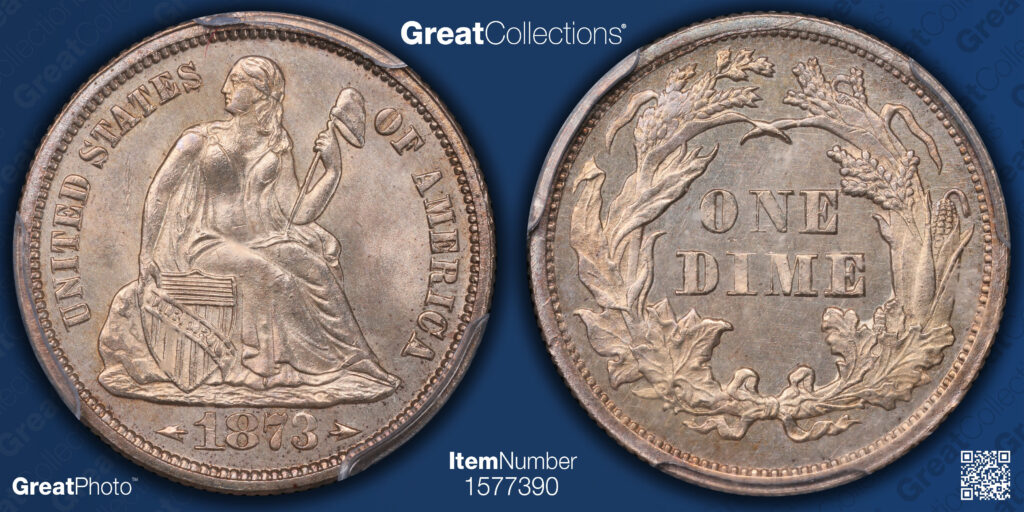
On April 28, 2024, GreatCollections sold a CAC approved MS-64 grade 1873 for $962.50. On Oct. 19, 2025, GreatCollections sold a CAC approved MS-64 grade 1874 for $1,547.70. On April 21, 2025, Heritage sold two CAC approved MS-64 grade 1874 dimes, each for $1,440. On Jan. 28, 2024, GreatCollections sold a CAC approved MS-65 grade 1874 ‘With Arrows’ dime for $2,475.
On Aug. 15, 2024, in consecutive lots, Stack’s Bowers auctioned two CAC approved, PCGS graded MS-66 1874 dimes, one for $3,120 and one for $5,280. As I did not see these two coins and I do not know who were the leading bidders, I am not even hypothesizing about the reasons for this substantial difference in prices realized. There are several variables that often affect auction results. It is important for each bidder to thoughtfully figure the amount that he or she is willing and able to pay. Collectors who are unsure may wish to consult an expert.
The CPG-CAC medium retail estimate for an MS-64 grade 1873 or 1874 ‘With Arrows’ dime is $1,800. It is likely that one could be acquired for less than this amount in 2026.
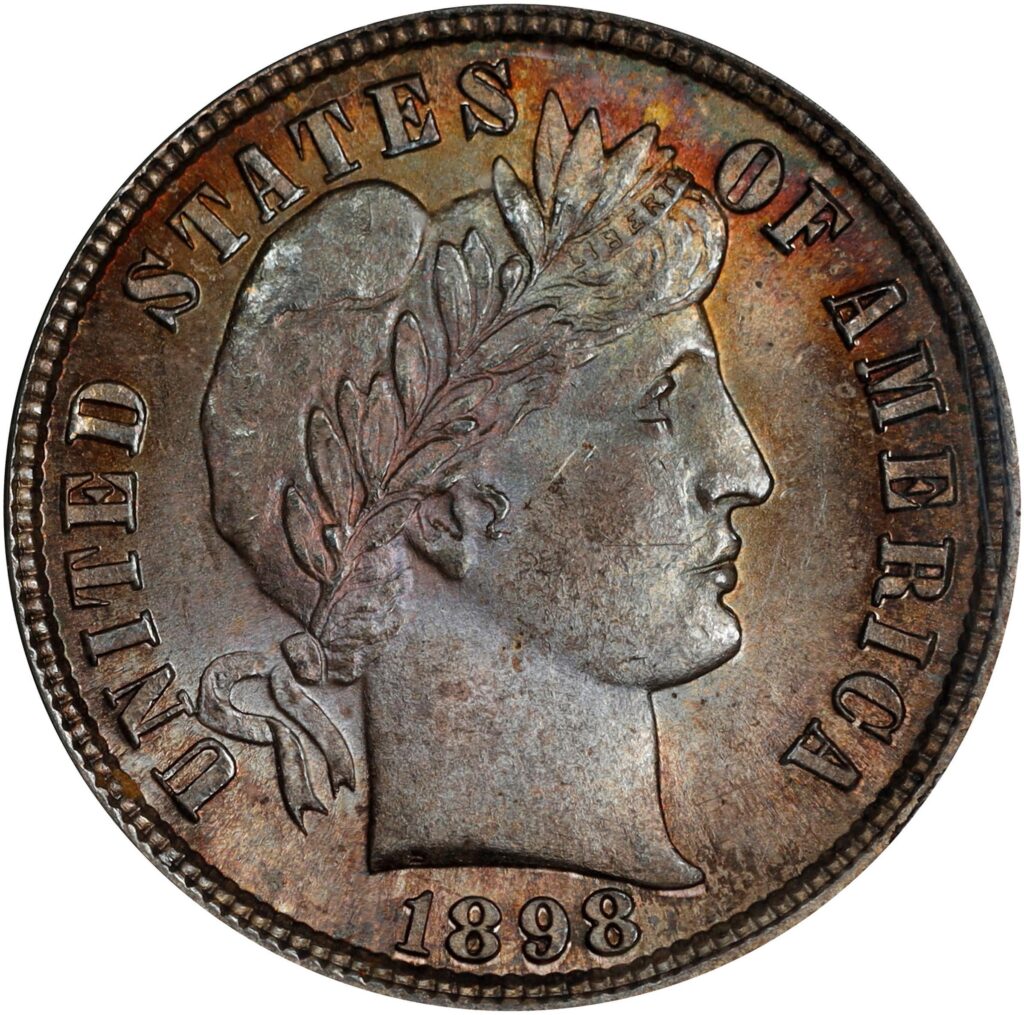
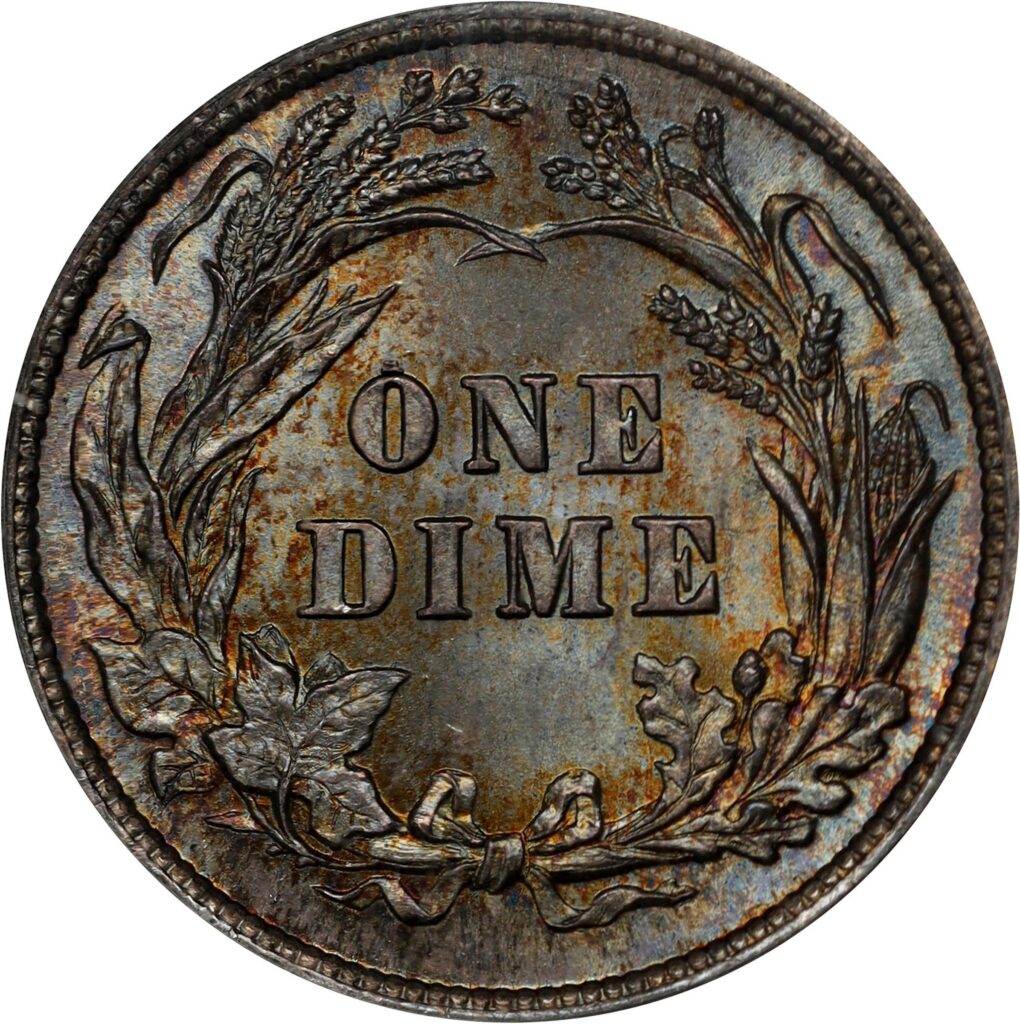
Generally, a type set of all six Liberty Seated dimes in MS-64 to -66 grades is a very realistic objective. A next step may be to add a nineteenth century Barber dime. On May 25, 2025, GreatCollections sold a CAC approved MS-64 grade 1892 dime for $276.
On April 23, 2025, Stack’s Bowers sold a CAC approved MS-64 grade 1898 dime for $312. In August 2024, Stack’s Bowers auctioned a CACG graded MS-66 1893 dime for $1,200.
A type set of Liberty Dimes may easily be expanded into a type set of all nineteenth-century dimes. Some collectors seek representatives of all thirteen types of silver dimes. Other collectors decide to collect a particular type ‘by date.’ While traditional objectives are central to the history of coin collecting, the selection of paths to take largely depends upon the personality, budget and interests of the individual collector.
Photos courtesy of Great Collections (Irvine, CA) and Gerry Fortin Rare Coins (Raymond, ME).
Copyright © 2025 Greg Reynolds
About the Author
Greg is a professional numismatist and researcher, having written more than 775 articles published in ten different publications relating to coins, patterns, and medals. He has won awards for analyses, interpretation of rarity, historical research, and critiques. In 2002 and again in 2023, Reynolds was the sole winner of the Numismatic Literary Guild (NLG) award for “Best All-Around Portfolio”.
Greg has carefully examined thousands of truly rare and conditionally rare classic U.S. coins, including a majority of the most famous rarities. He is also an expert in British coins. He is available for private consultations.
Email: Insightful10@gmail.com
Suggested Articles