by Greg Reynolds
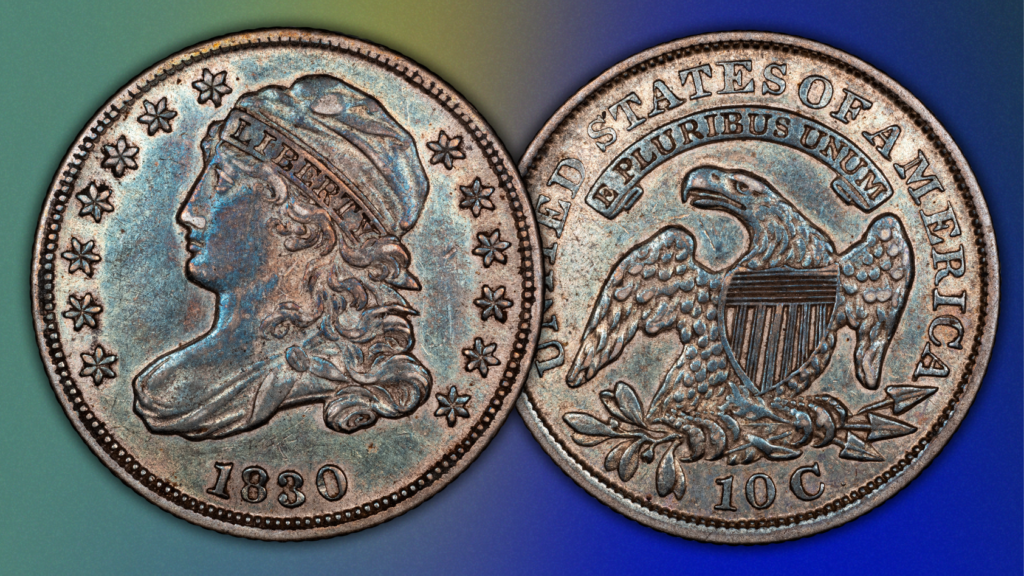
It is not difficult to assemble a type set of bust dimes. The term bust, though, should be addressed. In the field of sculpture, a bust is an artistic rendition of a person or human concept that must include the head, the neck, and at least one shoulder. Generally, a bust includes part or all of the subject’s chest, too. Busts on pre-1840 U.S. coinage are of female personifications of the concept of Liberty.
Bust dimes were struck from 1796 to 1837. A complete type set of dimes is a practical quest. Circulated representatives of all types are available. It is important to keep in mind that one of the least scarce dates of a design type is sufficient for a type set.
This discussion is part of a series on completing a type set of regular issue, silver U.S. dimes. I remind everyone that the front of a coin is called the obverse, and the back is the reverse.
1. Draped Bust Obverse, Small Eagle Reverse (1796-97)
2. Draped Bust, Heraldic Eagle (1798-1807) — Also called ‘Large Eagle’
3. Capped Bust, “Large” (1809-28) – design credited to John Reich
4. Capped Bust, “Small” (1828-37) – modified design & new minting technology
5. Liberty Seated, No Stars (1837-38)
6. Liberty Seated with Stars and No Drapery (1838-40)
7. Liberty Seated with Stars and Drapery (1840-1853, 1856-60)
8. Liberty Seated – Arrows & Stars on Obverse (1853-55)
9. Liberty Seated – Legend on Obverse (1860-73, 1875-91)
10. Liberty Seated – Arrows & Legend on Obverse (1873-74)
11. Barber (1892-1916)
12. Mercury (1916-45)
13. Roosevelt (1946-64) silver business strikes; silver Proofs from 1992 to the present
Since these are easy to acquire and are relatively inexpensive, Capped Bust dimes are covered before Draped Bust dimes.
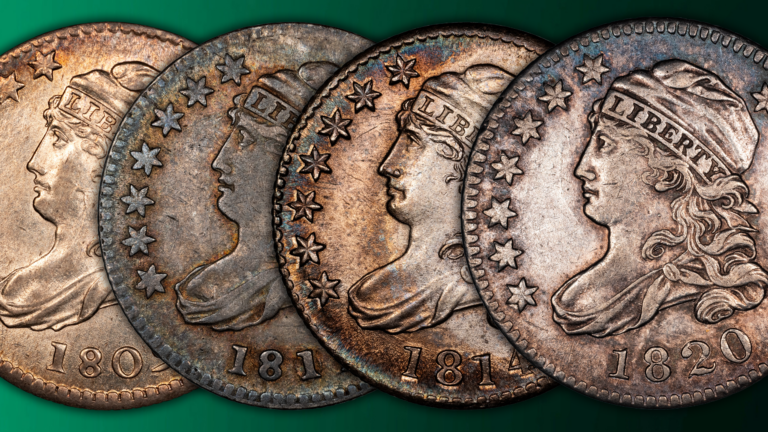
Type #3 – Reich Capped Bust Dimes (1809-1828)
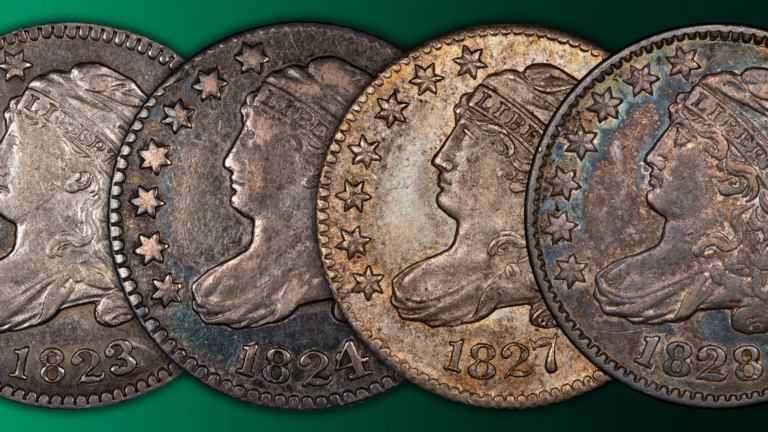
Yes, type #3 Capped Bust Dimes (1809-28) and type #4 (1828-37) dimes are very similar. Nonetheless, they are different enough to constitute two separate design types.
New designs of silver and gold coin denominations introduced during the period from 1807 to 1809, and the quarter in 1815, are credited to John Reich, including the Capped Bust dime of 1809 to 1828 (dime type #3). William Kneass became the chief engraver in 1824.
Kneass effected changes in multiple denominations, and was extremely likely to have been responsible for the Capped Bust quarters of 1831 to 1838. The changes in the design of Capped Bust dimes were not as stark or blatant as the changes in the design of Capped Bust quarters in 1831. Nevertheless, there are important distinctions. While diameters of Capped Bust dimes vary, those of 1828 to 1837 are generally smaller than the Reich dimes of 1809 to 1828. The facial features of Miss Liberty are slightly different, two females. The dentils, rims and edges are different in significant ways that are hard to explain.
In addition to examining rims and edges, collectors can appreciate the differences by viewing type #3 (Reich) and type #4 (Kneass) dimes side-by-side with a magnifying glass. The artistic style and workmanship are not the same.
A circulated Reich Capped Bust dime (type #3) is not hard to find and purchase. In some cases, the sale of a Capped Bust dime for an apparently extremely strong or surprisingly high price is due to the superior surface quality or eye appeal of the particular coin. In many instances, though, an apparently very high price for a bust dime is not as high as it seems because the coin in question is of an extremely rare die pairing. Each combination of an obverse die and a reverse die that was used to mint coins is a die pairing.
There are dedicated collectors who seek more than just one example of each date; they demand a representative of every known die pairing as well. Each U.S. coin is struck in a machine with an obverse (head) die and a reverse (tail) die, which impart design elements on a prepared blank (planchet) as force is applied. Coins of some die pairings are extremely rare and command large premiums.
Except for collectors who are very interested in die pairings, it is best to collect by type or by date. In some cases, major varieties are collected as additional dates of given years.
In regard to classic U.S. coins, I am really a believer in collecting many series ‘by type’ and a small number of series ‘by date.’ A series includes all the dates of a design type.
If a collector is very enthusiastic about a particular series then he or she should consider collecting coins of that series by date (and mint location if more than one mint was utilized). It may be a good idea for a collector to buy a few coins of different types and grades as a learning experience.
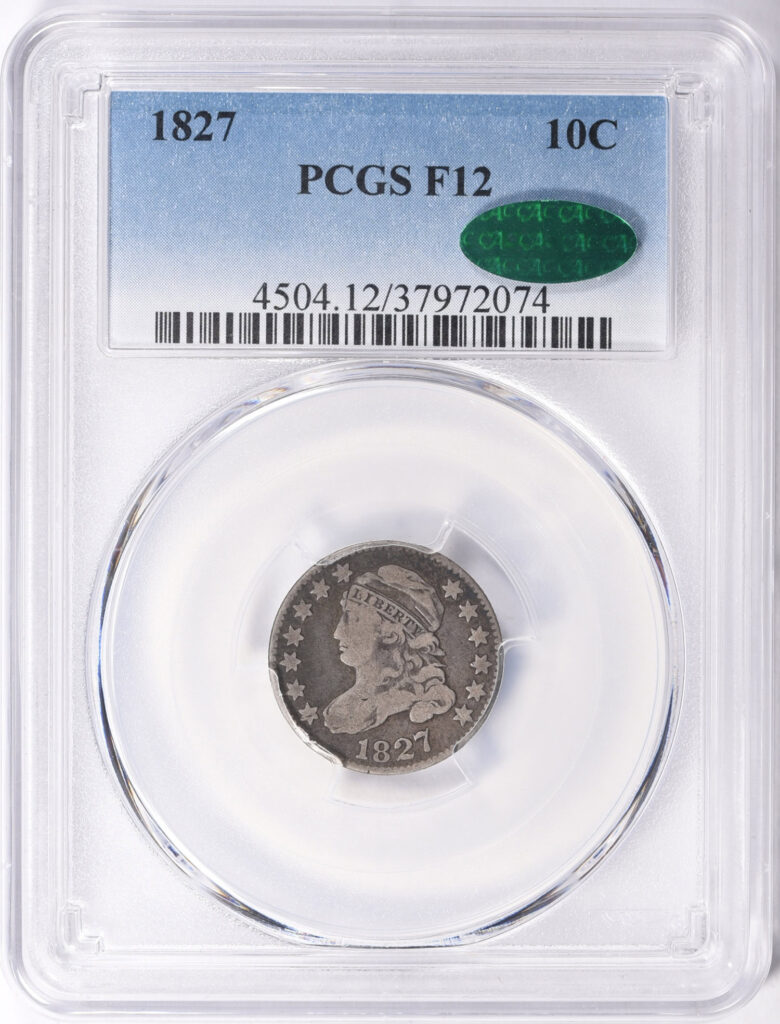
The 1827 is probably the least scarce of the Reich Capped Bust dimes. Here are three examples of Internet sales of 1827 dimes. Capped Bust dimes also trade in coin stores, at coin shows and through mail order dealers. On Nov. 20, 2022, GreatCollections sold a CAC approved VG-10 grade 1827 dime for $156.31. On Jan. 19, 2025, GreatCollections sold a CAC approved Fine-12 grade 1827 for $225.50. On June 11, 2023, GreatCollections sold a CAC approved VF-25 grade 1827 for $302.50.
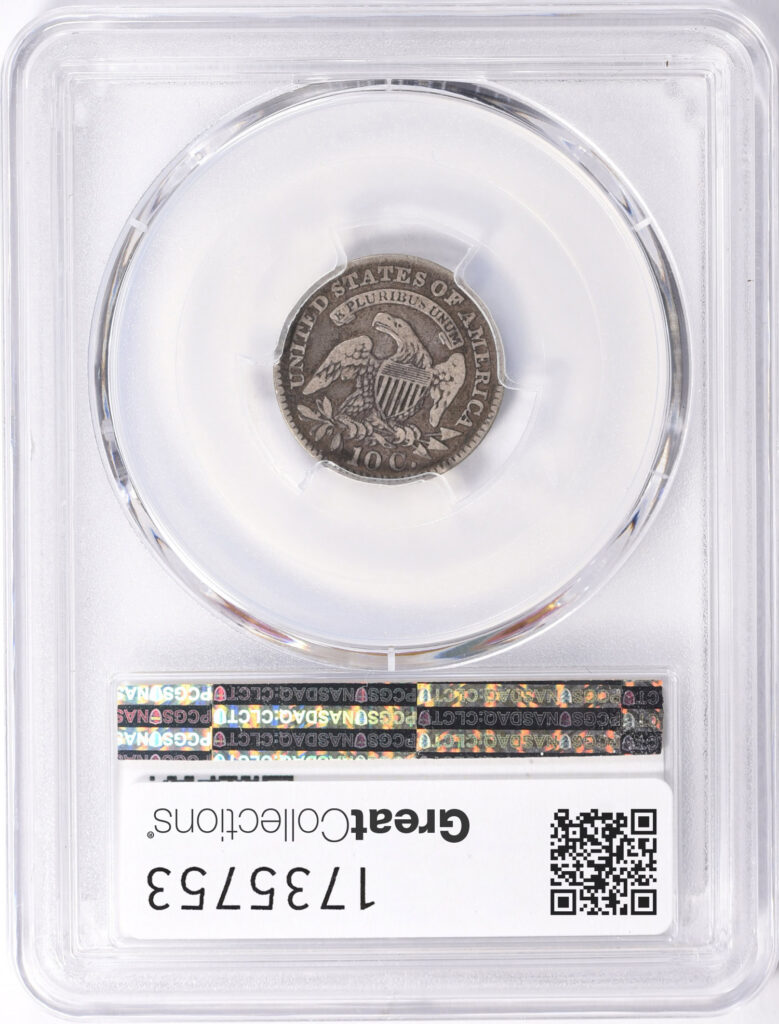
On April 13, 2025, GreatCollections sold a CAC approved VF-25 grade 1820 ‘Large 0’ dime for $401.50. I will forever remember my first and only 1820 dime, which I purchased when I was eight or nine years old. The proprietor of my local coin store did not have any Reich (type #3) Capped Bust dimes that I could possibly afford, if he had any at all.
As I sought many types of coins, I talked my father into taking me to New York City. While there, we visited more than a dozen coin stores, some of which offered both coins and stamps. In one incredibly small store, barely the size of the interior of a van, there was a worn and cleaned 1820 dime in a display case. The price, which escapes me at the moment, was very reasonable, almost too good to be true. Now, if I still had it, experts at CACG would regard it as ungradable and put it in a ‘Details’ holder.
Even so, all the design elements were clear enough, and I liked it. This 1820 dime was very important to me. Also, my friends and schoolmates were astonished that I had a dime from 1820. When I was in fifth grade, I gave a presentation to my class on rare coins, and that 1820 dime was mentioned loudly. It was definitely a conversation piece.
There are gradable 1820 dimes that cost much less than the already cited Very Fine grade 1820 that brought $401.50. GreatCollections sold a CAC approved VG-10 grade 1820 ‘Small 0’ dime on Dec. 15, 2024, for $212.30. Of course, an 1820 dime in a Details holder could be purchased for a lower price.
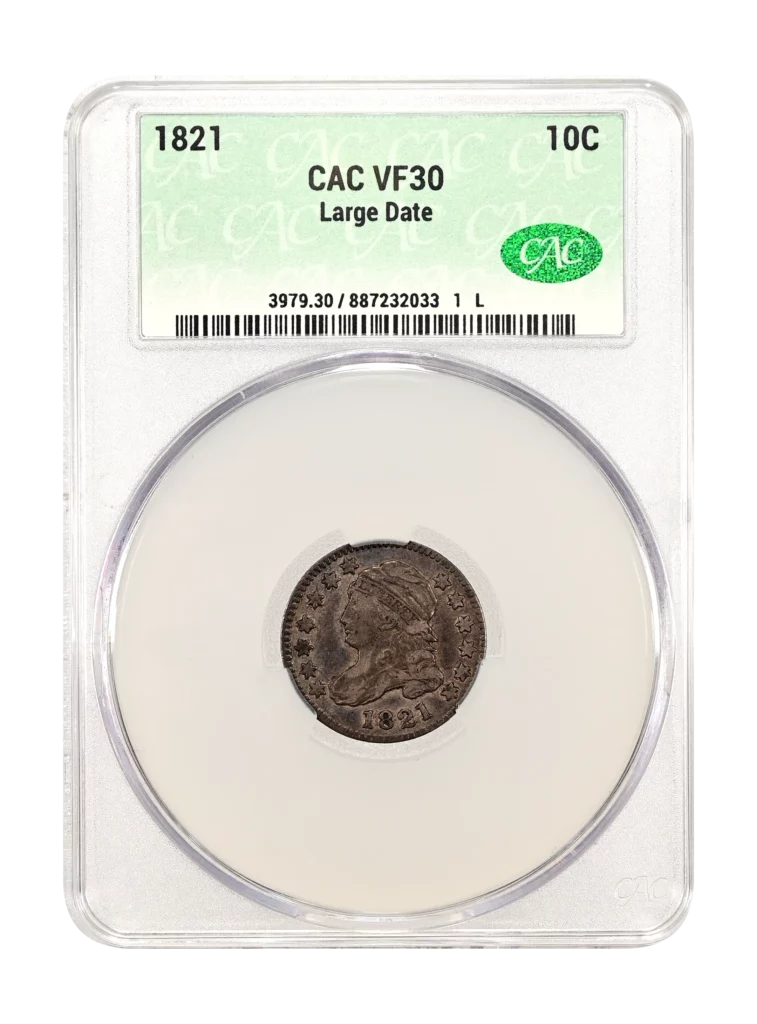
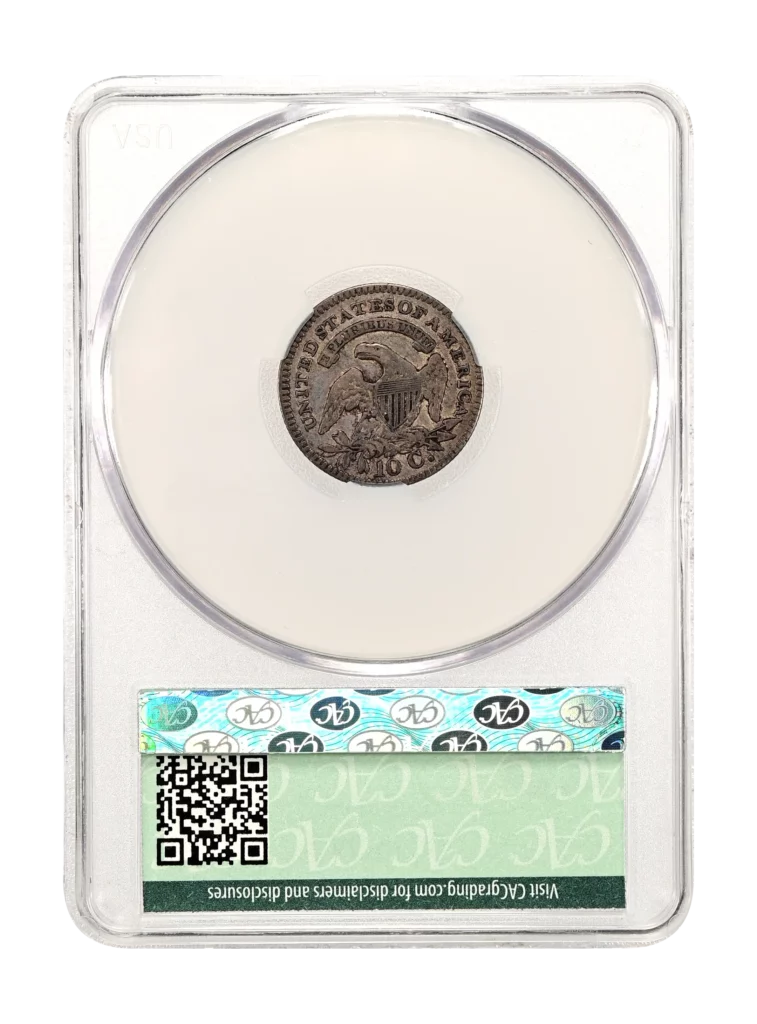
Curiously, 1821 dimes are relatively inexpensive. Both the 1821 ‘Small Date’ and the 1821 ‘Large Date’ are available fairly often. On April 13, 2025, GreatCollections sold a CACG graded VF-30 1821 ‘Large Date’ for $357.50.
Though a somewhat better date, the 1823/2 overdate is not especially expensive. On Oct. 30, 2022, GreatCollections sold a CAC approved VF-20 grade 1823/2 with “Small E’s” for $426.
For those who wish to make the jump from collecting type coins to collecting by date, a complete set by date of Reich Capped Bust dimes (1809-28) in circulated grades is not especially costly in the grand scheme of classic U.S. coins. Also, these are from an early period of U.S. history.
An 1809 might cost more than $1,000 and a low grade 1822 could easily cost more than $2,000. Most of the other dates could be obtained for less than $110 each in Good-04 grade or less than $300 each in Fine-12 grade.
Type #4 – Kneass Capped Bust Dimes (1828-1837)
Millions of Kneass Capped Bust dimes were minted. A significant number survive. There are no rare dates of type #4, unless the 1829 ‘Curl Base 2’ is granted the status of being a distinct date.
The 1831, 1835 and 1836 may be the least scarce, though it is impossible to know for sure. It is difficult to sensibly estimate the number of uncertified dimes from the 1830s that survive. There are many low grade and ungradable Capped Bust dimes around that have never been sent to leading grading services, or were ‘broken out’ of holders by collectors who prefer to place raw coins in albums or folders.
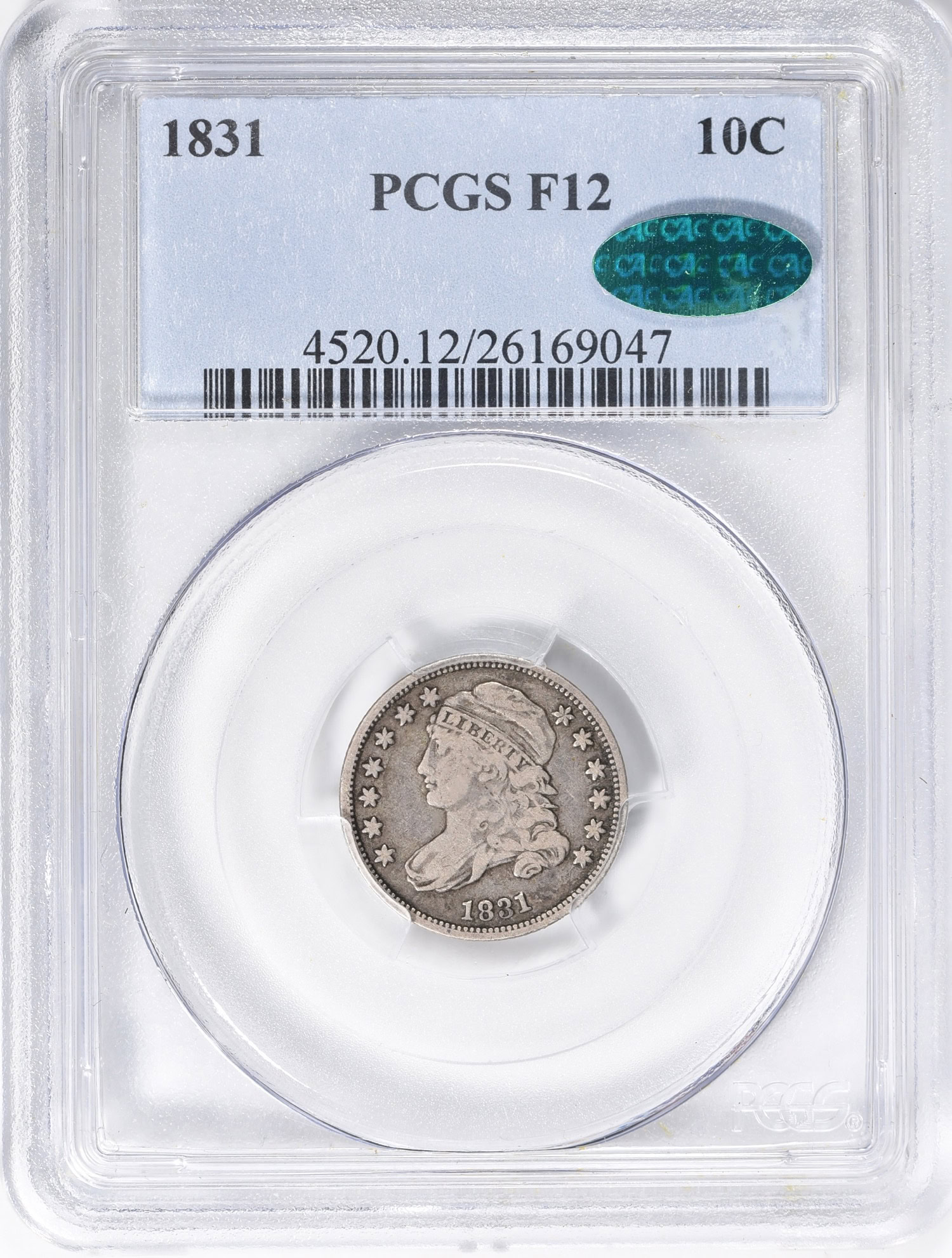
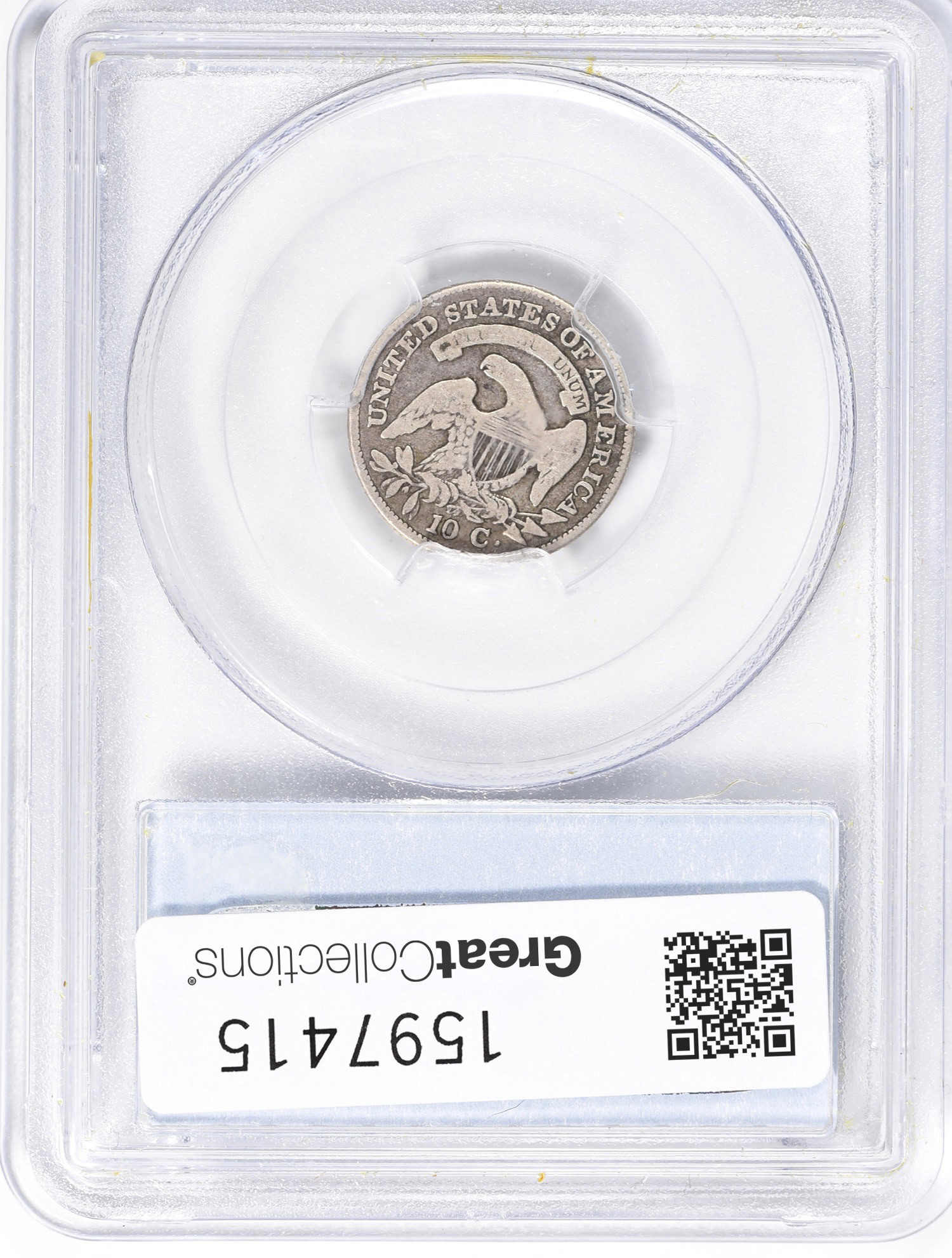
On June 16, 2024, GreatCollections sold a CAC approved Fine-12 1831 dime for $150.70. In a GreatCollections auction, the price realized is the hammer price plus ten percent. In a sale where the top bidder in a competitive environment is the buyer, a fee relating to the use of credit cards or particular financial instruments is an addition to the price realized, not part of the price realized.
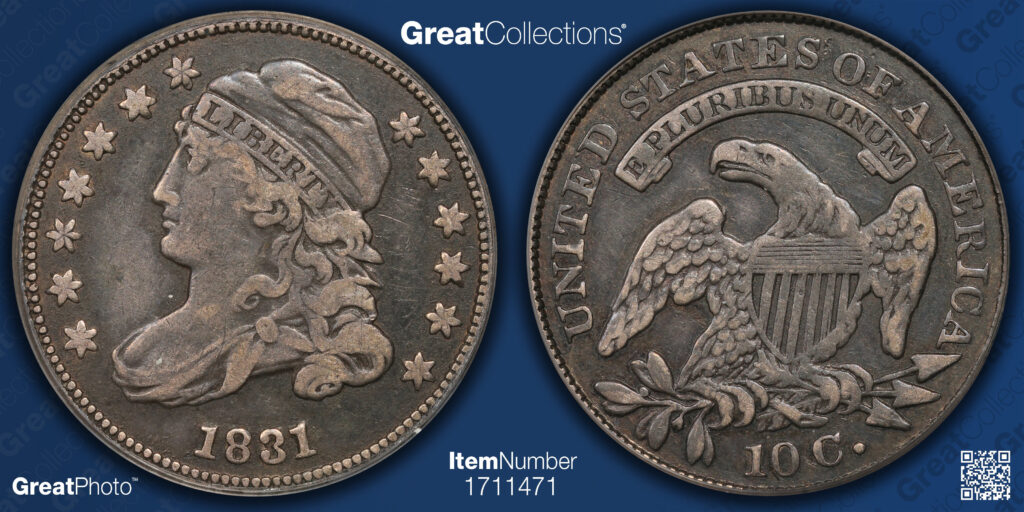
On Feb. 6, 2022, Heritage sold a CAC approved VG-10 grade 1834 dime for $149. On Dec. 8, 2024, GreatCollections sold a CAC approved VF-25 1831 dime for $176. On March 27, 2023, Stack’s Bowers auctioned a CAC approved VF-35 grade 1835 dime for $336. On June 29, 2025, GreatCollections sold a CAC approved XF-45 grade 1835 dime for $412.50.
For a collector on a tight budget, a Fine to Very Fine grade Kneass Capped Bust dime is suitable for a type set. A VF grade Capped Bust dime usually has plenty of design detail.
Type #1 – Draped Bust, Small Eagle (1796-1797)
In the early days of the U.S. Mint, dimes were not priorities. There were innumerable silver coins of the Spanish Empire in circulation in the United States. The U.S. silver dollar was based upon the Spanish Milled Dollar, which was the Eight Reales silver coin of the Spanish Empire.
Before 1800, very few U.S. citizens were accustomed to the decimal system of U.S. coinage, and most were still thinking in terms of the Spanish monetary system, which was based on eighths and multiples of eight. U.S. silver dollars, half dollars and quarters, were consistent with Spanish denominations of eight reales, four reales and two reales, respectively.
The Half-Real coin of the Spanish Empire was not usually seen in North America, though was needed as a low silver denomination. Generally, merchants preferred a silver coin to a handful of Coppers, which were the lowest valued coins and tokens used in the United States. Coppers included a mix of suitable copper items that were accepted as if they were British halfpennies, though British halfpennies themselves were rarely seen in North America.
A Half-Real equaled one-sixteenth of a Spanish Milled Dollar, thus around 6.25 U.S. cents. As a silver U.S. half dime had a face value of five cents, a half dime was realistically close to the face value of a Half-Real, and a U.S. half dime was close enough to fitting into the Spanish system to be used along with Spanish coins by a large number of businesses, though not by everyone. I argue that this is the primary reason why there was more demand for half dimes in the United States, during the 1790s, than there was for dimes.
The Draped Bust, Small Eagle dime (type #1) lasted for just two years, 1796 and 1797. Uncirculated 1797 dimes are much scarcer than uncirculated 1796 dimes. In circulated grades, there are a substantial number of survivors from both years.
On Jan. 15, 2025, Heritage auctioned a PCGS graded Good-04 1796 dime for $5,040. On Dec. 29, 2024, GreatCollections sold a CAC approved Fine-15 grade 1796 dime for $8,801.22. This result is a little above the current CPG-CAC retail estimate of $8,500.
There are two major varieties of 1797 dimes that are often collected as if they were two distinct dates of the same year. In circulated grades, however, the 1797 with thirteen stars on the obverse is only slightly more expensive, on average, than the 1797 with sixteen stars. Any appealing, properly graded, circulated 1796 or 1797 dime is suitable for a type set.
On May 4, 2025, GreatCollections sold a CAC approved VG-08 grade 1797 sixteen obverse stars dime for $6,330.50. On Jan. 14, 2022, Heritage auctioned a CAC approved, NGC graded VF-25 1797 thirteen obverse stars dime for $16,800, a very strong price. The CPG-CAC medium retail estimate for this coin is $11,000 and the JR2 die pairing is not especially rare.
It is possible that the strength of this $16,800 auction result is partly a function of the surface quality or aesthetics of this specific coin. It is also possible that the CPG-CAC value estimate for this coin is too low. There are additional, possible explanations for the price realized of $16,800 for this 1797 dime.
There are multiple variables that substantially affect auction results in many instances. In regard to expensive coins, it frequently makes sense for collectors to discuss auction results with experts.
Type #2 – Draped Bust, Large Eagle (1798-1807)
I prefer to call these ‘Heraldic Eagle’ reverse dimes, mostly because of the remarkable similarity of the ‘Large Eagle’ motif to the Great Seal of the United States. Nevertheless, most authors refer to these as “Large Eagle” dimes, as the eagle is larger than the eagle on 1796-97 dimes. There were parallel design changes concerning all other silver and gold denominations. Bust quarter eagles (U.S. $2.5 gold coins) are an exception, as they featured an ‘Heraldic Eagle’ from 1796 onward and never had a ‘Small Eagle’!
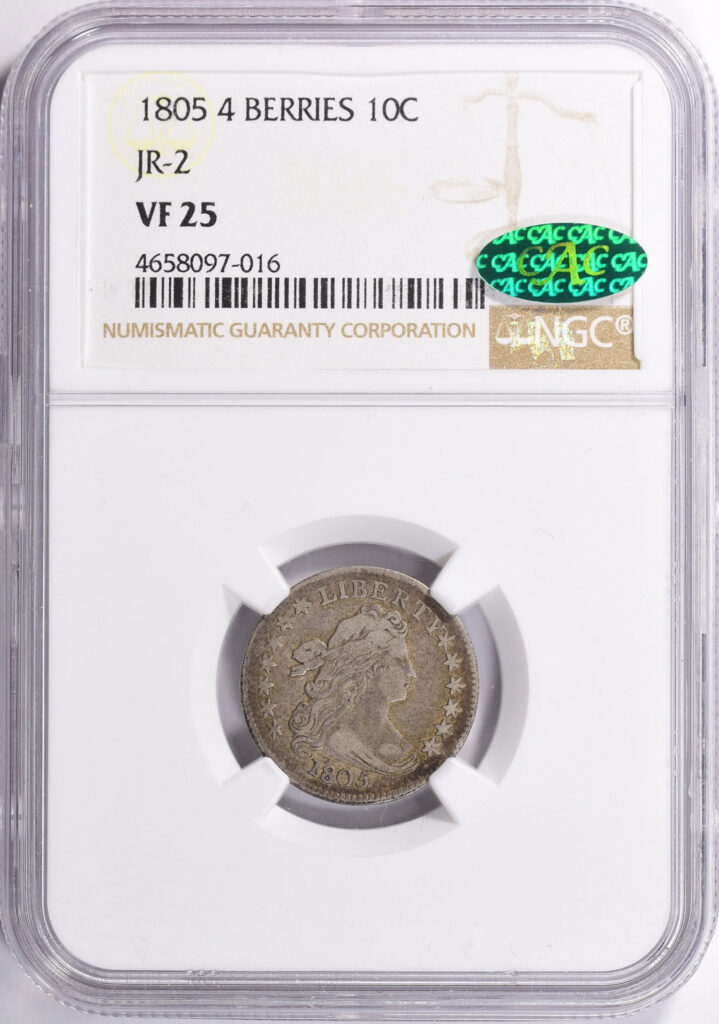
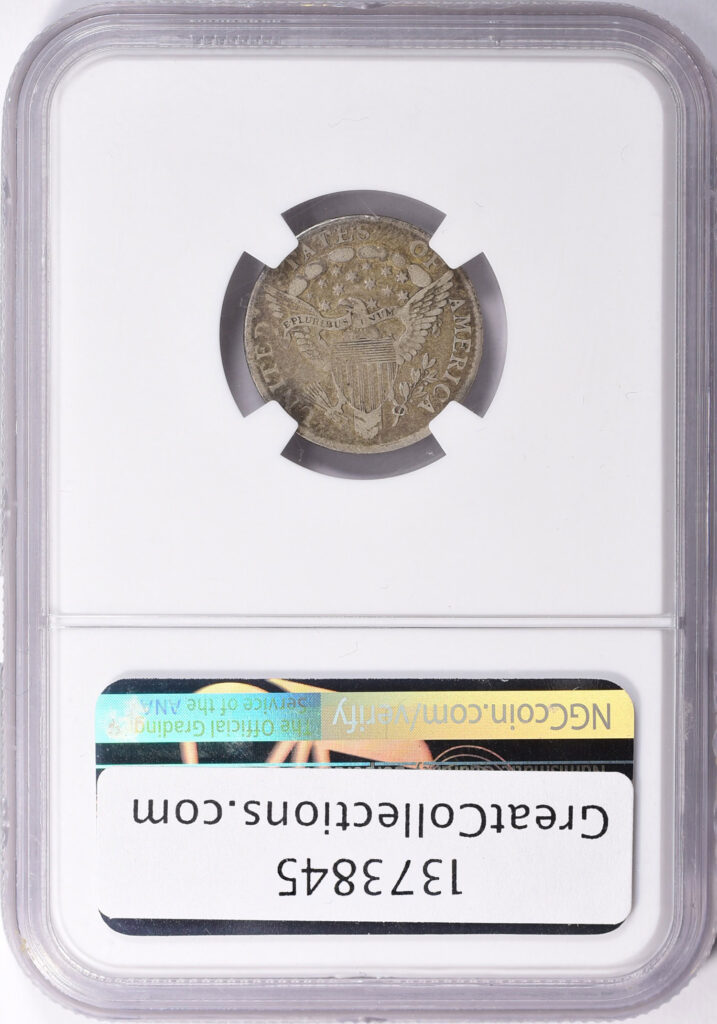
The 1805 and 1807 dimes are the least scarce dates of this ‘Heraldic Eagle’ design type (#2). Heavily worn examples are not difficult to find and are dramatically less expensive than high grade circulated 1805 and 1807 dimes.
On Feb. 7, 2024, Stack’s Bowers sold a CAC approved Fair-02 grade 1805 for $432. On April 14, 2024, GreatCollections sold a CAC approved Fair-02 grade 1807 for $352.
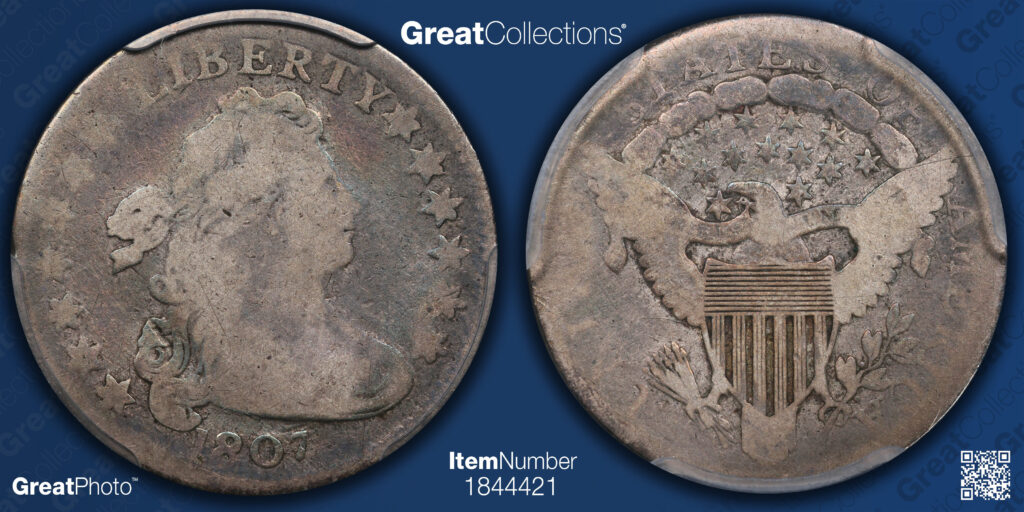
On March 14, 2022, Heritage sold a CAC approved, NGC graded AG-03 1805 dime for $600. On June 15, 2025, GreatCollections sold a CAC approved Good-04 grade 1807 for $924. On April 10, 2023, Heritage sold a CAC approved, PCGS graded Good-06 1805 dime for $990.
On Sept. 25, 2022, GreatCollections sold a CAC approved Fine-12 grade 1807 for $1,650. On May 28, 2023, GreatCollections sold a CAC approved, NGC graded VF-25 1805 dime for $2,535.62.
Clearly, in terms of acquiring type coins, Draped Bust dimes of both the ‘Small Eagle’ and ‘Large Eagle’ design types are much more expensive than representative dimes of other types. A collector on a budget could skip these and start his or her set with the two Capped Bust types. Please see a separate discussion on collecting circulated Liberty Seated dimes by design type, and a guide to silver dime types of the twentieth century. A type set of business strikes including all design types of dimes covering the period from 1809 (type #3) to 1964 (type #13) may cost a modest amount, in the context of classic U.S. coins.
After a type set is assembled, a collector may wish to upgrade by replacing some of his or her type coins with superior type coins. A collector may instead decide to focus on one series of dimes and collect those by date. Another option is to begin a type set of a related denomination, like quarters or half dollars, which would nicely complement a type set of dimes. There are many practical ways to expand collecting quests that are consistent with the culture and traditions of coin collecting in the United States.
Copyright © 2025 Greg Reynolds
About the Author
Greg is a professional numismatist and researcher, having written more than 775 articles published in ten different publications relating to coins, patterns, and medals. He has won awards for analyses, interpretation of rarity, historical research, and critiques. In 2002 and again in 2023, Reynolds was the sole winner of the Numismatic Literary Guild (NLG) award for “Best All-Around Portfolio”.
Greg has carefully examined thousands of truly rare and conditionally rare classic U.S. coins, including a majority of the most famous rarities. He is also an expert in British coins. He is available for private consultations.
Email: Insightful10@gmail.com
Suggested Articles