by Greg Reynolds
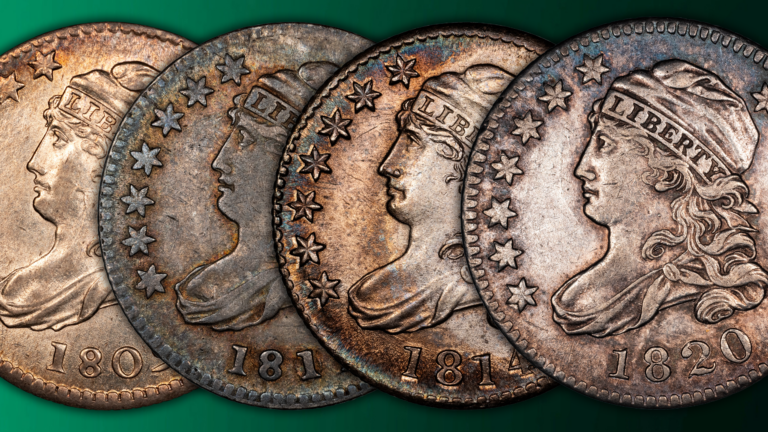
The third type of U.S. dimes was designed by John Reich and minted from 1809 to 1828. In part 1, dates through 1821 were covered. Before 1815, Capped Bust dimes were minted just in 1809, 1811 and 1814, and then none from 1815 to 1819. From 1820 to 1828, however, substantial quantities were minted every year except 1826.
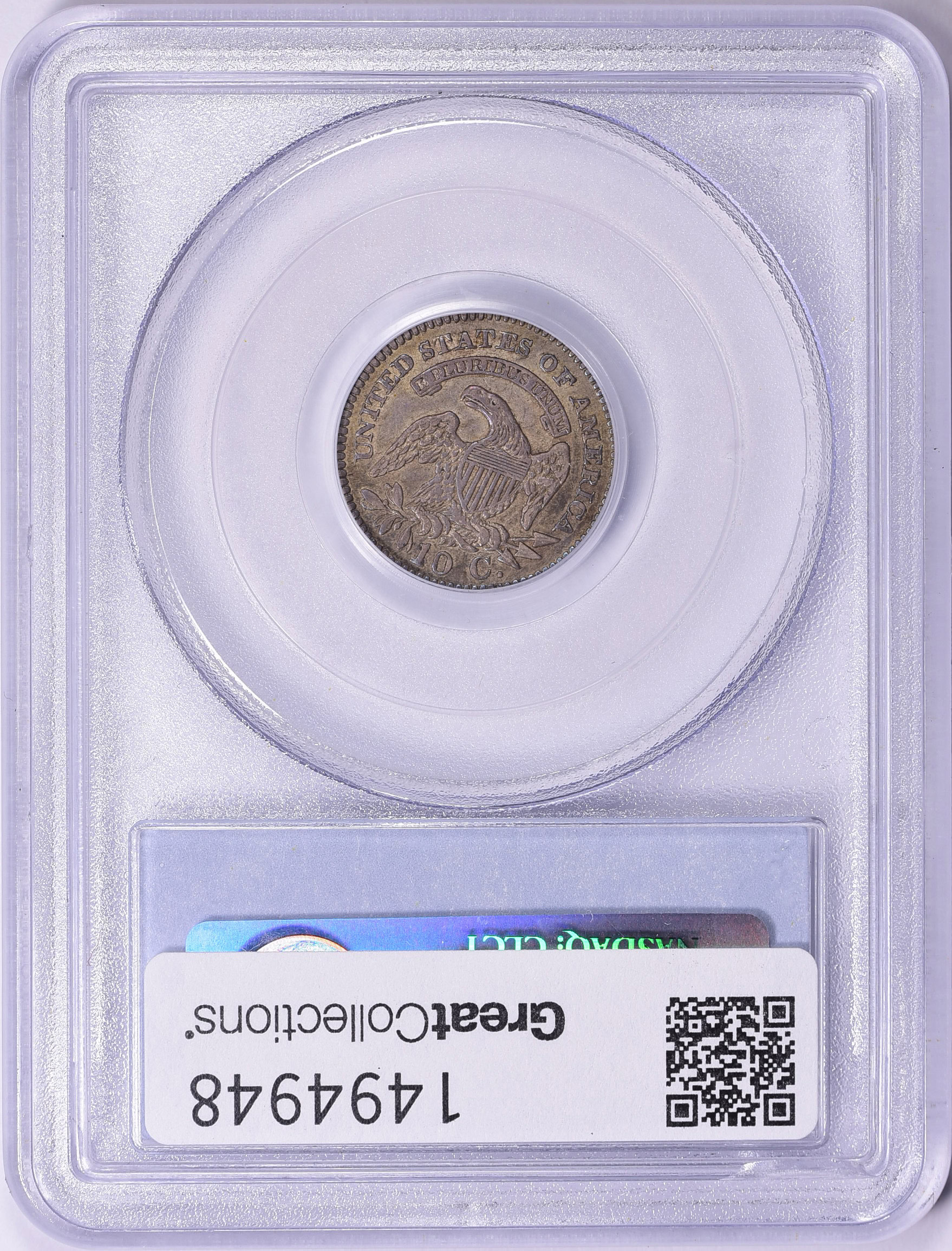
As the 1822 is a key and is the most expensive date of dime type #3, it is best for collectors to acquire representatives of a few of the other dates before honing in on an 1822. Collectors tend to learn while collecting. It is a good idea to learn at least a little about a series before acquiring a representative of the rarest date in that series.
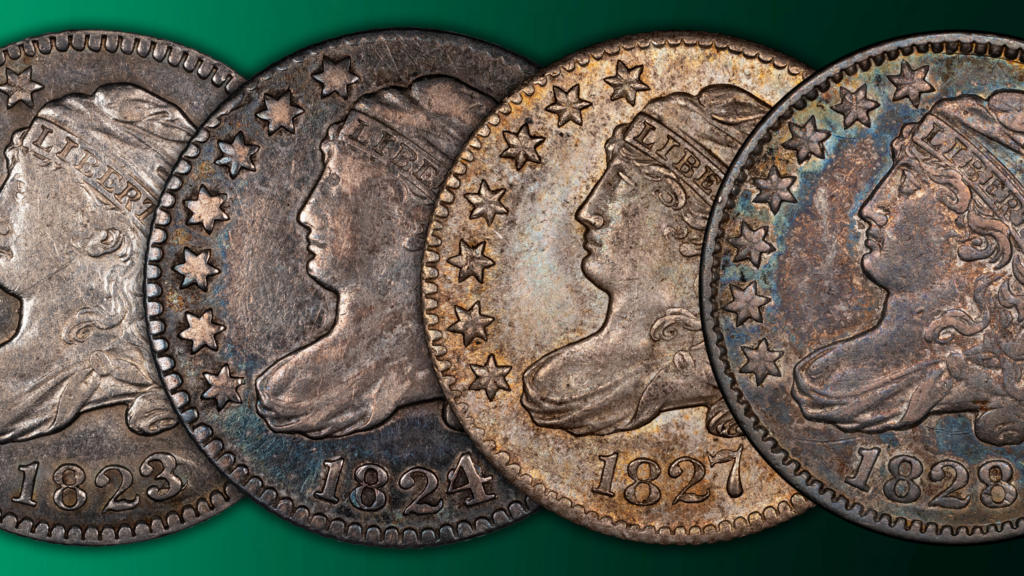
The reported mintage of the 1822 was 100,000 and the mintage of the 1823 was more than four times as much, 440,000. ‘Normal’ or regular date 1823 dimes are not known. All are 1823/2 overdates.
Of 1823/2 dimes, there are two widely recognized varieties, which pertain to the size of the letter ‘E’ on the reverse. On the ‘Small E’ 1823/2 dimes, the three ‘E’s’ in the legend, United States of America, tend to be consistent in size with nearby letters, like those on Capped Bust dimes minted from 1809 to 1822. On the ‘Large E’ 1823/2 dimes, the ‘E’ in UNITED tends to be taller than the ‘T’ and noticeably taller than the ‘D’ at the end. The ‘E’ in STATES is much larger than the ‘S.’ The ‘E’ in AMERICA is noticeably larger than the ‘R’ that follows. The relatively large ‘E’ could fairly be regarded as a minor mint error, not as a defining characteristic of a major variety to be collected as a second 1823/2 date.
In most grades, there is only a slight difference in market value between the 1823/2 ‘Large E’s’ and the 1823/2 ‘Small E’s’! These dimes are not particularly expensive. Some collectors are satisfied with one or the other, while other collectors seek representatives of both. I suggest that one or the other is sufficient to represent the 1823/2 in a credible set by date.
The CAC population of the ‘Small E’s’ is thirty-eight. The CAC pop of the 1823/2 ‘Large E’s’ is forty-five.
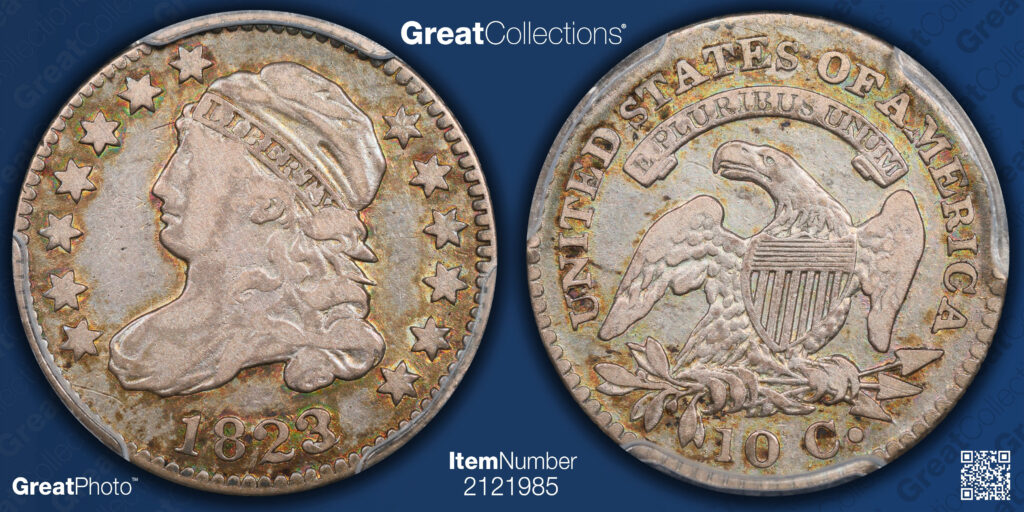
On Oct. 20, 2022, GreatCollections sold a CAC approved VF-20 grade 1823/2 ‘Small E’s’ dime for $426. On May 3, 2026, GreatCollections sold a CAC approved VF-20 grade 1823/2 ‘Large E’s’ dime for $529.10. On April 14, 2025, Heritage sold a CAC approved XF-40 grade 1823/2 ‘Large E’s’ dime for $900.
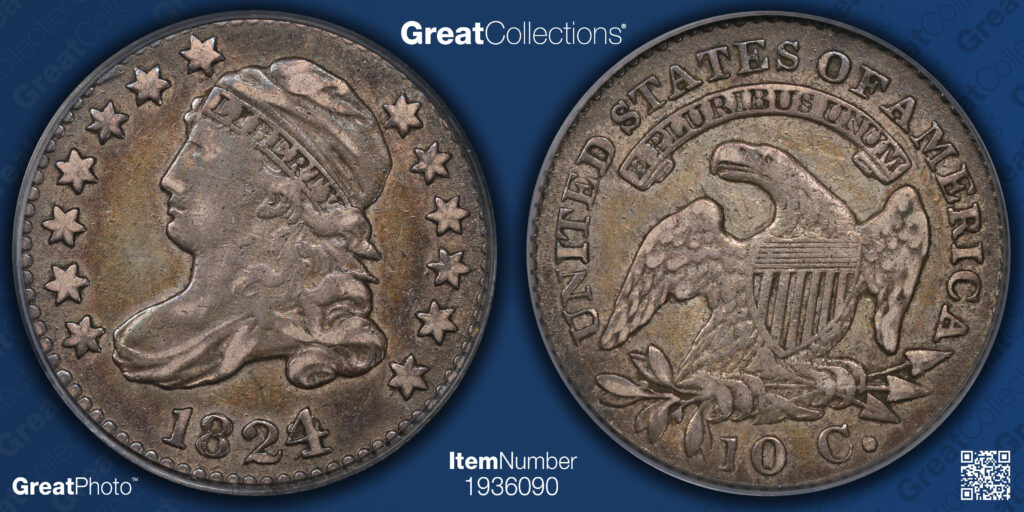
All dimes from the year 1824 are 1824/2 overdates; there are no regular or ‘normal dates.’ These are not rare, though they are very scarce. Curiously, the mintage of the 1824 is the same as that of the 1822, 100,000. I find it hard to believe that this is a coincidence, yet I was unable to find evidence of a connection. Of course, I asked the foremost historian of the U.S. Mint. He asserts that the same mintage numbers of dimes in 1822 and in 1824 is “just a coincidence.”
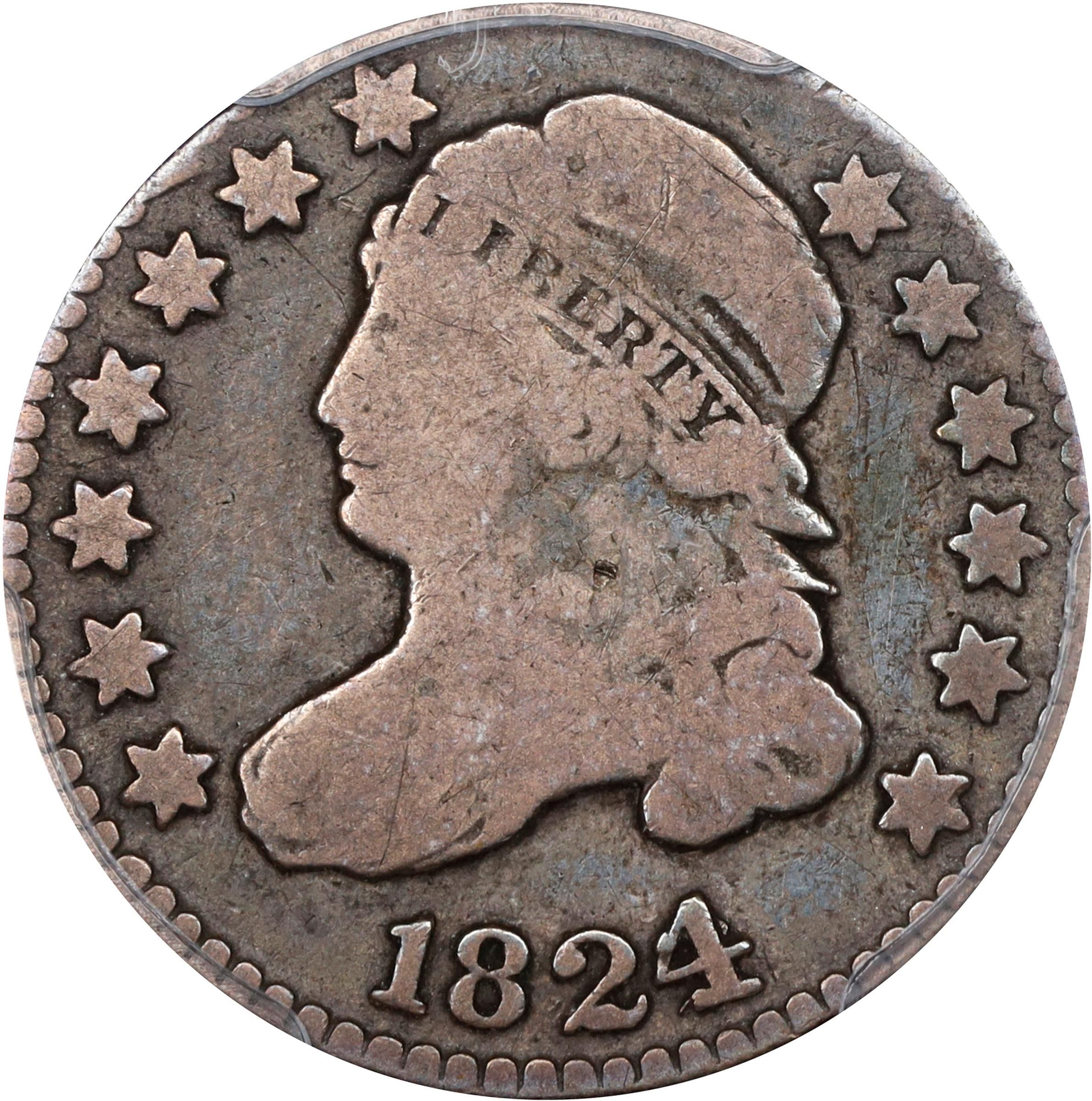
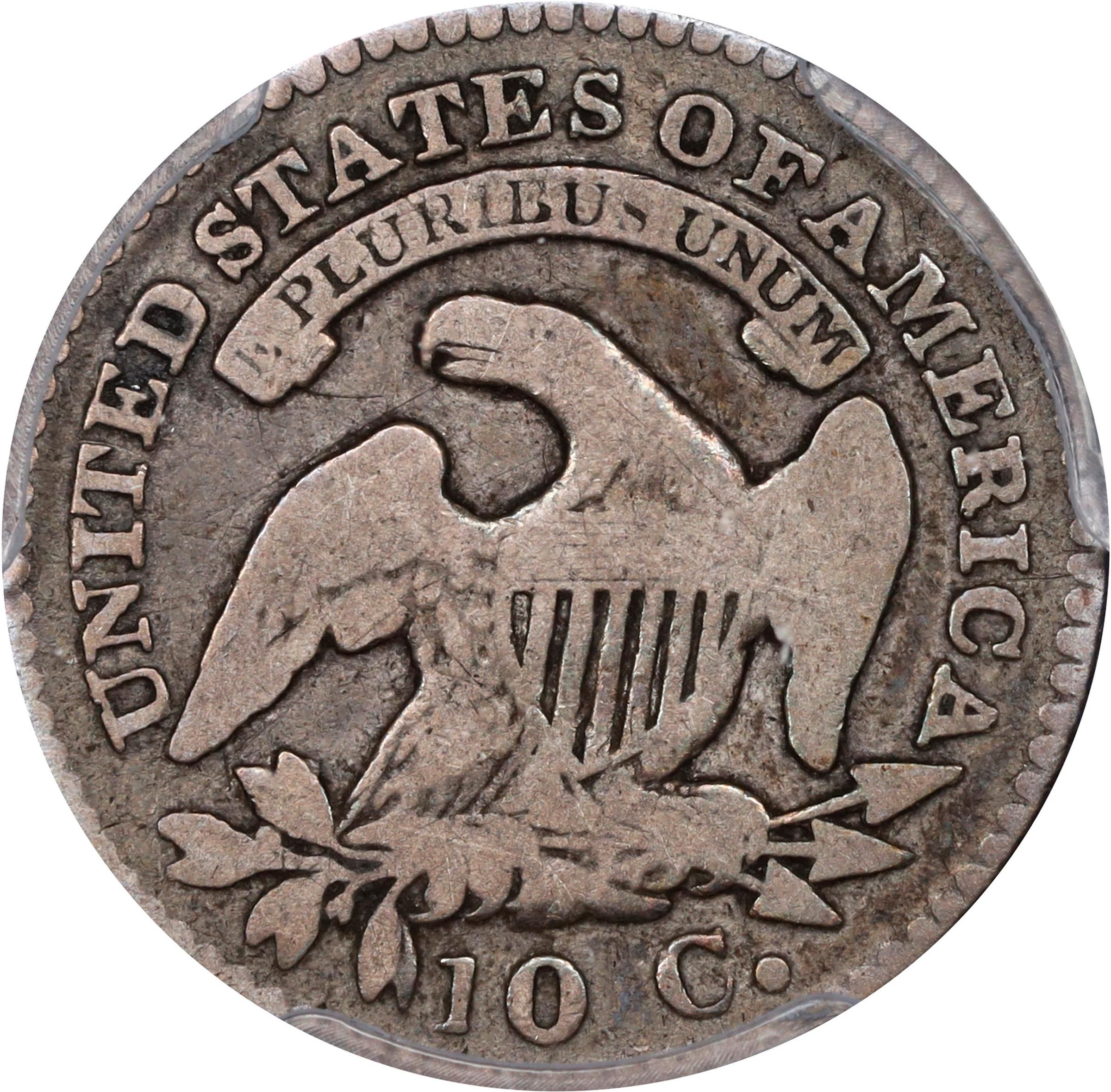
There are probably fewer than one thousand survivors in all states of preservation, certainly less than 1250. For such a scarce coin, market levels for circulated 1824/2 dimes are reasonable, from a logical perspective.
On Nov. 13, 2022, GreatCollections sold a CAC approved AG-03 grade 1824/2 dime for $105.60. On Aug. 13, 2025, Stack’s Bowers sold a CAC approved Good-06 grade 1824/2 for $168. On Sept. 28, 2025, GreatCollections sold a CAC approved VF-35 grade 1824/2 dime for $1017.50.
The mintage in 1825, 410,000, was more than four times the mintage of dimes in 1824, 100,000, though slightly less than the mintage in 1823, 440,000. The U.S. Mint Report for 1825 was sent to Congress by the office of the President of the United States on March 1, 1826, after having been mostly written by Samuel Moore in January 1826.
The mintage of nearly three million 1825 half dollars overshadowed the mintages of dimes and quarters, which were relatively negligible, yet more than expected. Moore emphasized that the mint finally caught up with silver deposits late in 1825 and thus was under less “pressure” to furnish silver coins to depositors (Washington: 19th Congress, 1st session, Doc. No. 107, … A Report of the Director of the Mint showing the Operation of that Institution, for the year 1825, March 1, 1826, pp. 5-6).
“This relaxation of pressure was very usefully” transformed “to effect an emission, frequently [requested], of some of the smaller denominations of our silver coin,” Moore revealed. In other words, as the U.S. Mint was keeping up with the minting of deposited silver bullion and sharply reduced the backlog during 1825, the Mint was under diminishing pressure to coin large quantities of silver. As each half dollar contains more silver than each dime or quarter, half dollars were the best option in situations where the mint had a backlog of deposited silver bullion. As the backlog was reduced, the mint was under less pressure to immediately process quantities of bullion and could then devote more resources to minting dimes.
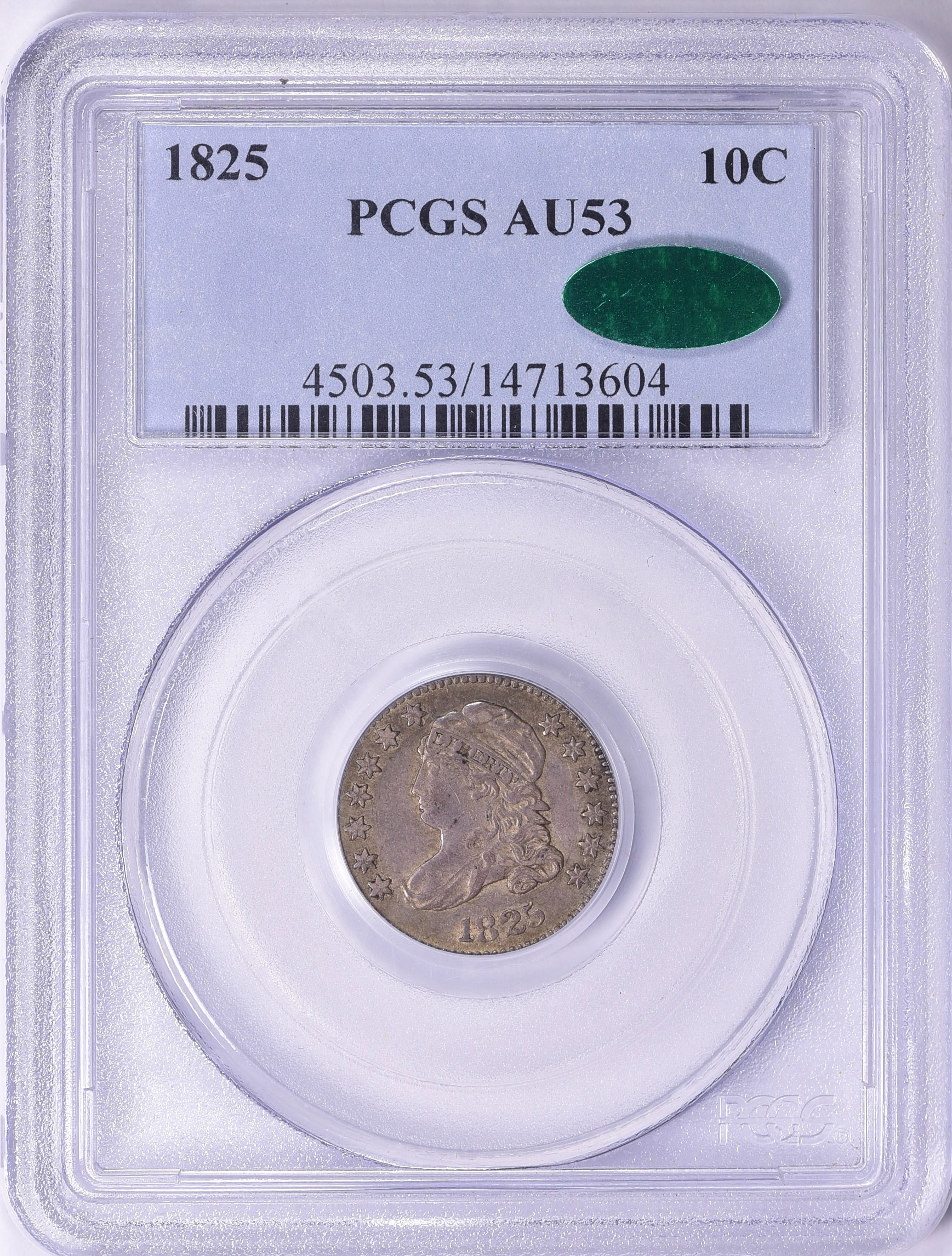
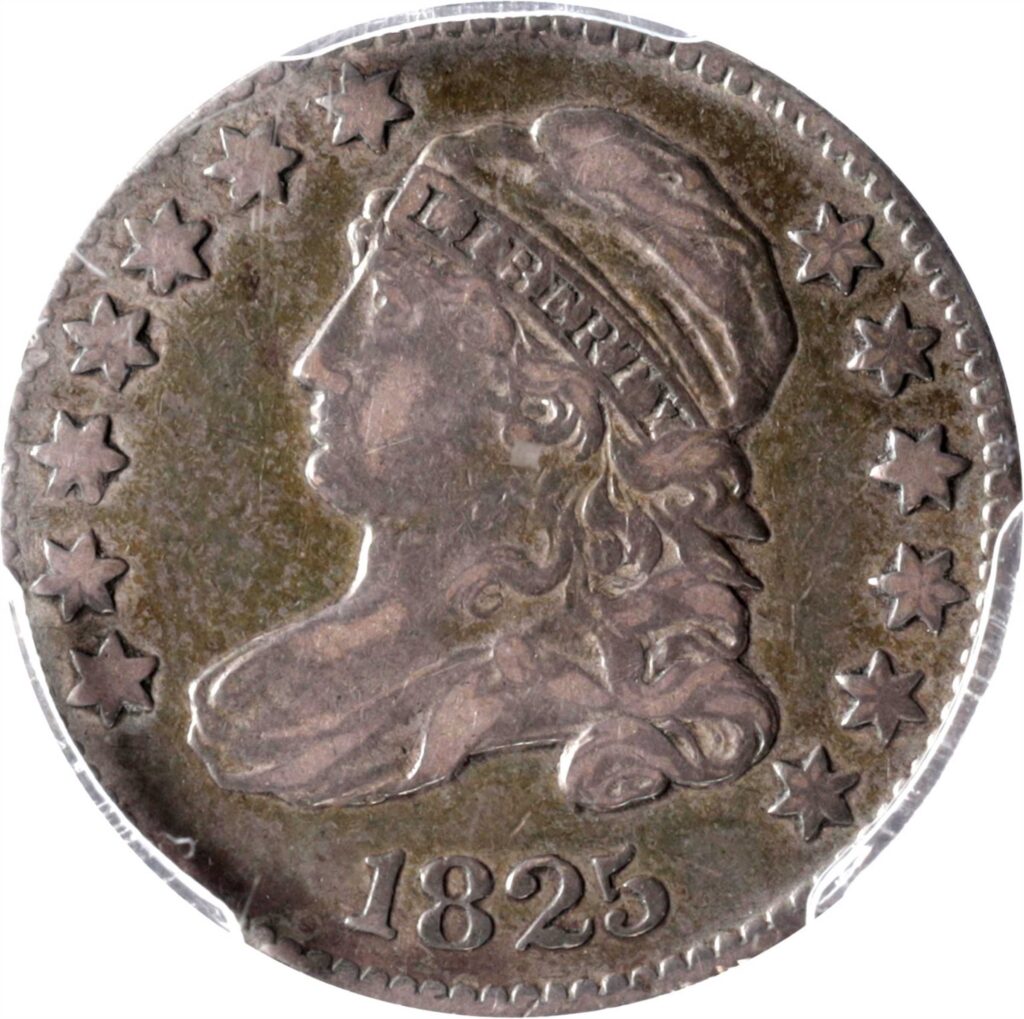
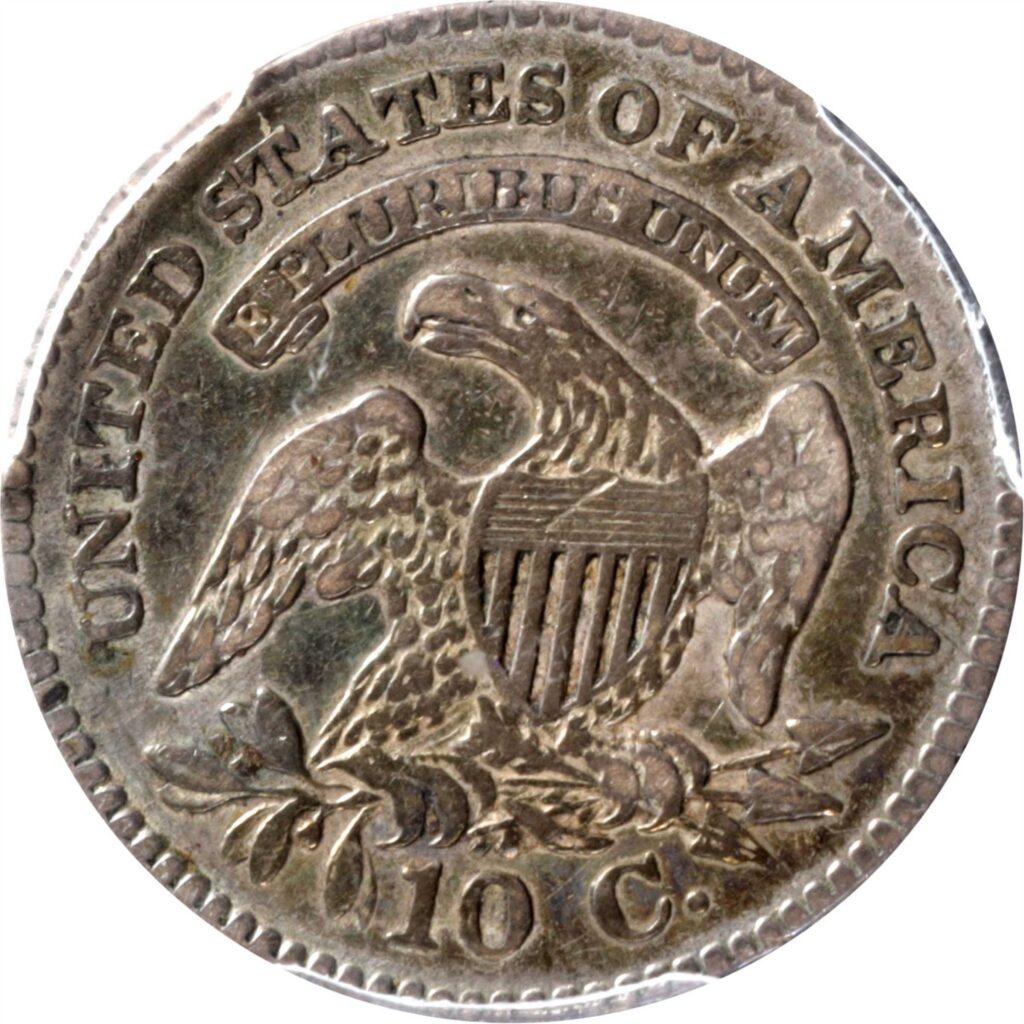
Importantly, a growing number of U.S. citizens were becoming accustomed to dimes as a coin denomination, thus 1825 dimes very actively circulated. Although the 1825 is not now rare overall, many of the survivors should not receive or should not have received numerical grades from grading services. These tend to be characterized by serious problems, including severe scratches, much corrosion, harmful cleanings, polishings, gouges, and infections.
The CAC population of 1825 dimes is sixty-six. I am surprised that there are even that many instances of 1825 dimes qualifying for numerical grades from CAC.
A collector seeking a CAC-approved 1825 dime may need some patience. During February 2022, Stack’s Bowers sold a CAC-approved VF-20 grade 1825 dime for $312. In May 2023, the firm of Gerry Fortin sold a CAC-approved VF-30 grade 1825 dime for $425. At the end of December 2023, GreatCollections sold a CAC-approved AU-53 grade 1825 dime for $996.60.
There are no 1826 dimes or quarters. There are 1826 half cents, large cents and half dollars. Indeed, 1826 half dollars are relatively common. The 1826 quarter eagle ($2.5 gold coin), however, is extremely rare. The 1826 half eagle ($5 coin) is even rarer than the 1826 quarter eagle, yet the 1826 is not as rare as several of the other dates in the series of Capped Head half eagles. Silver dollars and eagles (U.S. $10 gold coins) were not minted during the 1820s. It is a mystery as to why there are no 1826 dimes or quarters.
In his annual report to Congress regarding the U.S. Mint in 1826, the director, Samuel Moore, noted he was aware that the “subject of small silver coins” attracted much attention during the latter part of 1826. The matter of insufficient quantities in circulation was investigated and the “result has been a strong [conclusion] that a deficiency of” small silver coins had an impact to an “embarrassing degree, chiefly in” regions where coins of larger denominations were “not abundant,” he explained.
Moore then admitted that “it is believed” that the “power of the U.S. Mint” better serves “the public good” if the coin denominations requested by the depositors are minted rather than those most needed at the time by consumers. This acknowledgement by him was extremely honest, though difficult to understand. Was it really the position of the U.S. Mint that turning all the silver deposited during 1826 into half dollars and producing zero dimes served “the public good”? (Washington: 19th U.S. Congress, 2nd session, Report – Director of The Mint, February 24, 1827, pp. 5-6).
In 1827, the U.S. Mint produced 1,215,000 dimes, a record for the denomination, narrowly surpassing the mintage of 1,186,512 dimes in 1821. Both those totals were unusually high for the first third of the nineteenth century. An annual mintage of dimes did not surpass one million again until 1835.
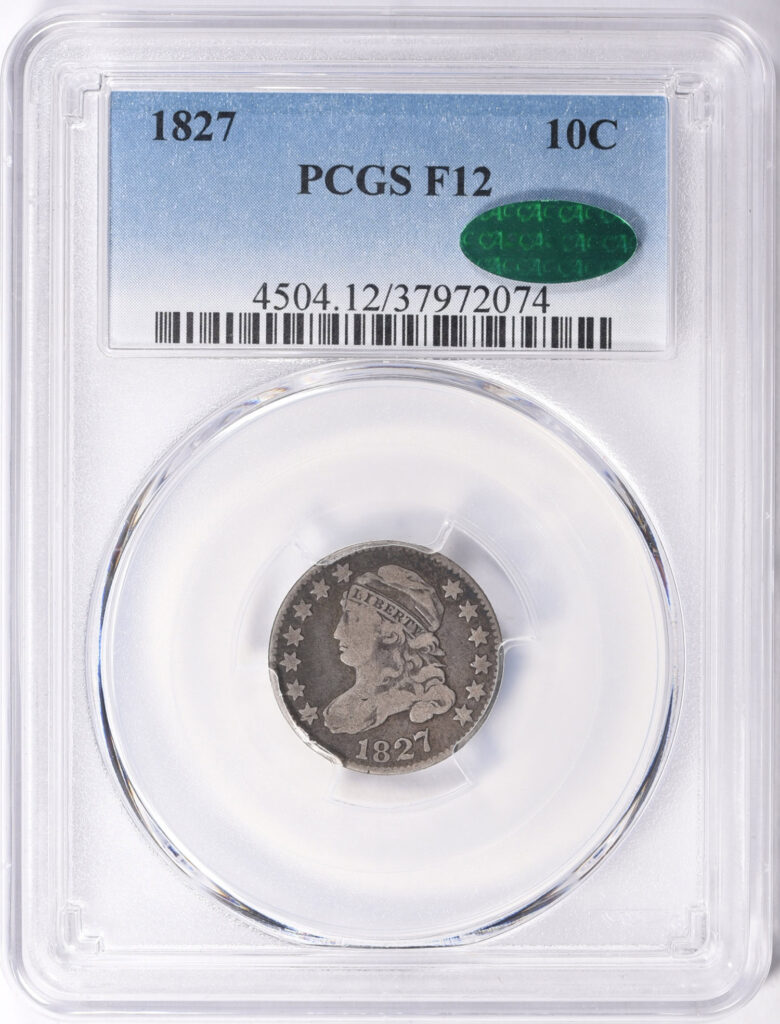
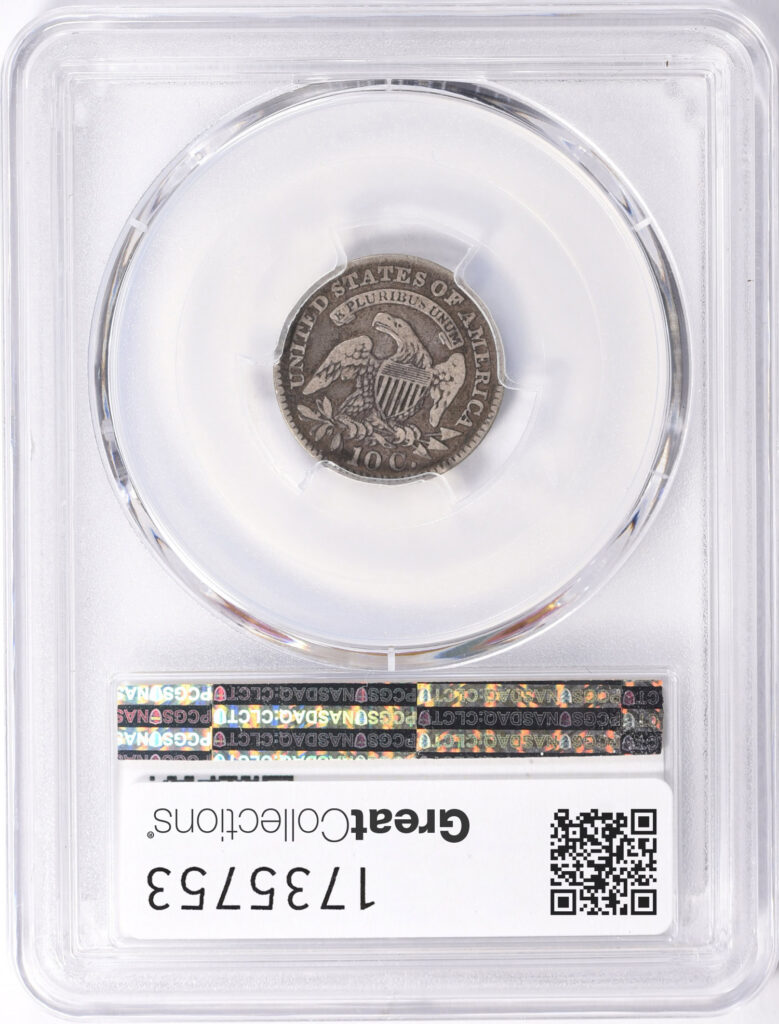
Though 1827 dimes are not as easy to find now as their especially high mintage might suggest, quite a few 1827 dimes have traded during the last three years. A collector who is willing to wait as much as five years could probably focus on finding a pleasant 1827 dime in a narrow grade range, such as Good to Very Good, VF to XF, or AU-50 to -55.
In November 2022, GreatCollections sold a CAC-approved VG-10 grade 1827 dime for $171.94. In January 2025, GreatCollections sold a CAC-approved Fine-12 grade 1827 dime for $255.50. In July 2023, GreatCollections sold a CAC-approved VF-25 grade 1827 dime for $302.50. During June 2025, GreatCollections sold two CAC-approved XF-40 grade 1827 dimes, of different die varieties, for $566.50 and $601.70, respectively.
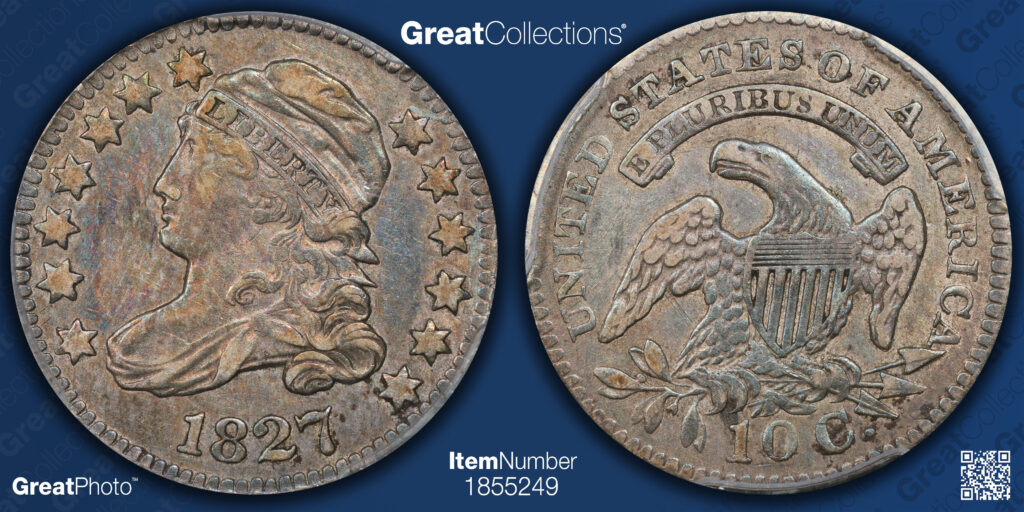
In May 2023, the firm of Gerry Fortin sold a CAC approved AU-50 grade 1827 dime for $900. In July 2023, the firm of Gerry Fortin sold a CAC approved AU-55 grade 1827 dime for $985. These are both of the same die pairing, known as JR-11, which is not one of the rarer die pairings of 1827 dimes.
The Reich 1828
In my view, dime type #3 should be referred to as Reich Capped Bust rather than as “Large” Capped Bust dimes. William Kneass modified John Reich’s design to a large extent, and the production process of dimes was changed. Type #4 (1828-37) is best termed Kneass Capped Bust Dimes, not “Small” or “Reduced Size” Capped Bust Dimes.
During the year 1828, dimes of both types were minted. The fact that Reich 1828 dimes have a ‘Square Base 2’ in the date and the Kneass 1828 dimes each have a ‘Curl Base 2’ is not a reason for these to be classified as distinct design types. This relates to the date, not the type.
The distinctions between type #3 and type #4 dimes are hard to explain, though they are particularly important. Moreover, there is no one distinction that is overwhelming. It is a combination of differences that distinguish Reich Capped Bust from Kneass Capped Bust dimes.
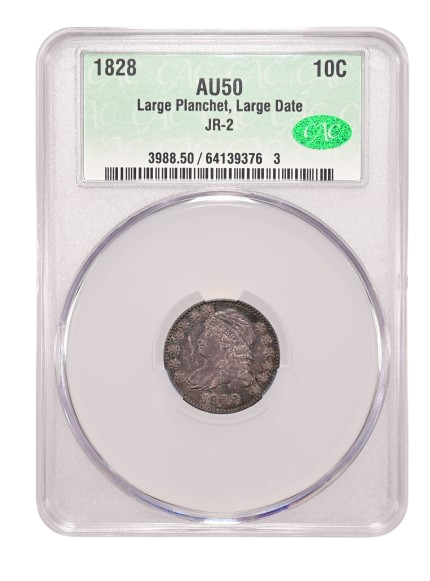
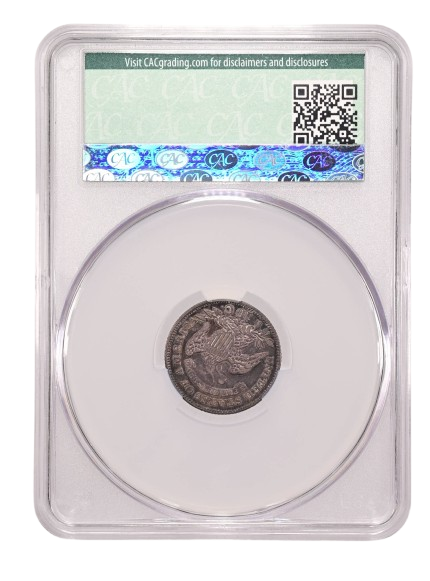
On Dec. 25, 2016, Heritage sold a CAC-approved Fine-12 grade 1828 Reich (“Large”) Capped Bust dime for $223.25. Market levels were lower in 2016 than they were in the years that followed. In April 2026, the CPG-CAC medium retail estimate for a F-12 grade 1828 dime was $375.
On April 14, 2025, Heritage sold a CAC-approved XF-45 grade 1828 Reich (“Large”) Capped Bust dime for $1,620. On Aug. 18, 2024, GreatCollections sold a CACG-graded AU-50 1828 dime for $3,036.
The 1822
For a complete set by date of Reich Capped Bust dimes, a 1822 cannot be avoided by budget-minded collectors. It is certainly possible, though, to buy one for less than $1,500.
On June 14, 2022 and again on Jan. 10, 2024, Stack’s Bowers sold the same CAC-approved AG-03 grade 1822 dime for the same price, $1440. All known 1822 dimes were struck from the same pair of dies.
On Dec. 15, 2024, GreatCollections sold a CAC-approved Good-06 grade 1822 dime for $4235. On April 3, 2022, GreatCollections sold a CAC-approved VG-08 grade 1822 dime for $4,082.71.
A set of Reich Capped Bust dimes ‘by date’ is not difficult to complete, while paying fair prices for relatively pleasant coins. Though rare and costly, circulated 1809 and 1822 dimes tend to be available. A collector should not feel compelled to acquire the first 1809 or the first 1822 that is available to him or her. Over a five year period, several of each are likely to appear.
After considering the scarcity and historical importance of this early series, market levels are not high from a logical perspective. Appealing representatives of each date are rare enough for the quest to be challenging, yet available often enough for the completion of a set by date to be a very realistic objective.
Copyright © 2026 Greg Reynolds
About the Author
Greg is a professional numismatist and researcher, having written more than 775 articles published in ten different publications relating to coins, patterns, and medals. He has won awards for analyses, interpretation of rarity, historical research, and critiques. In 2002 and again in 2023, Reynolds was the sole winner of the Numismatic Literary Guild (NLG) award for “Best All-Around Portfolio”.
Greg has carefully examined thousands of truly rare and conditionally rare classic U.S. coins, including a majority of the most famous rarities. He is also an expert in British coins. He is available for private consultations.
Email: Insightful10@gmail.com
Suggested Articles