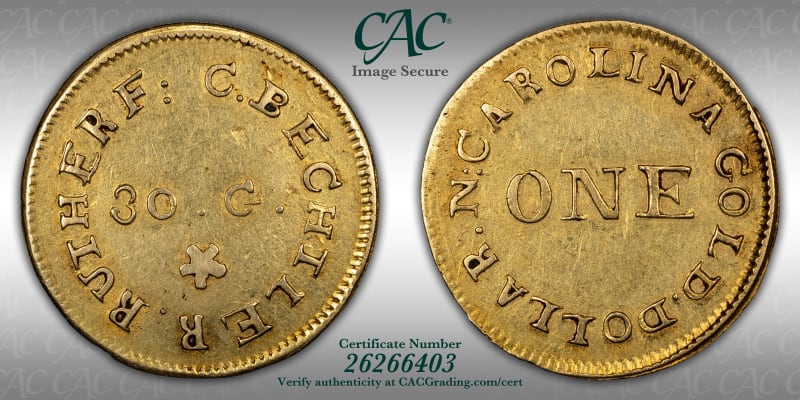
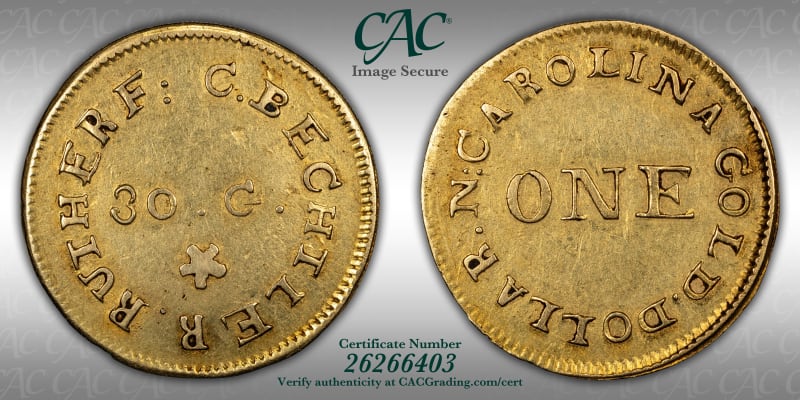
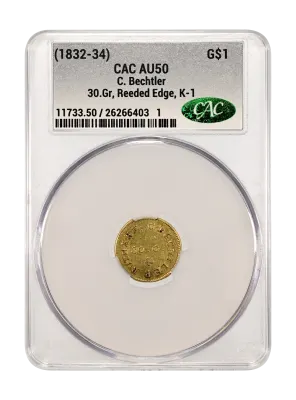
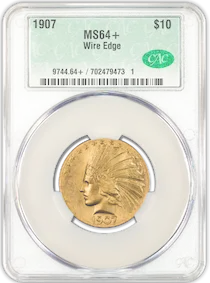
Struck sometime in late 1832 or early 1833 and on through the middle of 1834, the Kagin-1 is popularly collected because of its status as the first gold dollar struck in the United States. The dies are different from earlier Bechtler issues, with a neat, serrated border, allowing more room for the legends. Like the early beaded border issues, the K-1 dollar is struck to the pre-August 1834, U.S. standard: 30-grains of 20-carat gold to the dollar. The relatively high survival rate of the Kagin-1 gold dollar suggests that Bechtler’s new, convenient denomination met with wide acceptance. It is the only Bechtler conforming to the pre-1834 U.S. standard that is generally available, with approximately 150 pieces extant. Grades vary from VF-BU, with three or four choice mint state examples vying for finest known status. A single plain edge example (Kagin-1a) is known from a late state of the dies.
Catalog details are provided by greysheet.com with copyright owned CDN Publishing, LLC. CAC Grading, LLC is not responsible for typographical or database-related errors and assumes no liability for such. Your use of this site indicates full acceptance of these and other applicable terms.
DON'T MISS OUT!
Sign up for our newsletter for exclusive updates and offers from CAC.
You get lots of emails... understood... we promise not to overdo it.