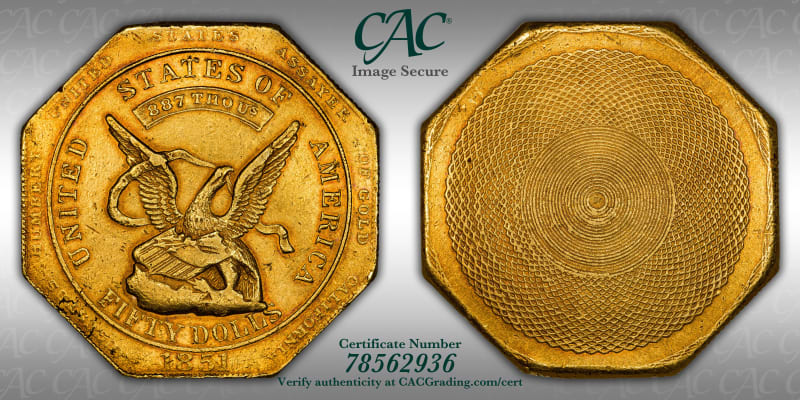
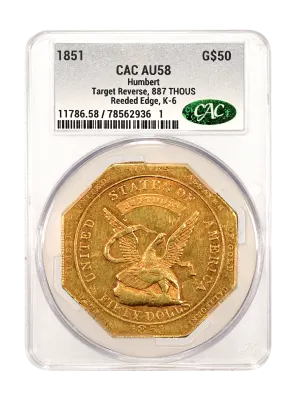
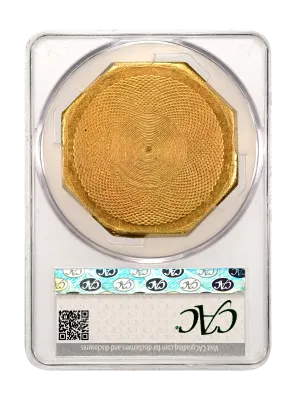
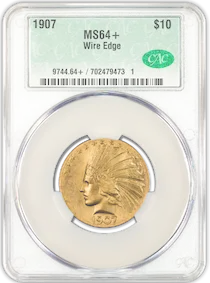
Approximately 75 K-6 slugs exist in private hands, around ten of which grade mint state. The K-6 obverse die is known to exhibit die rust in later states. The 887 Obverse die is paired with two reverse dies, and it is the reverse die that determines whether an 1851 Humbert 887-Thousandths $50 is a K-6 or K-7. The K-6 reverse die has a large “target” at its center and has outer engine turning that often extends beyond the edge of the coin. Two were found on the S.S. Central America. A pair of Kagin-6 slugs are known in proof format. The first of these was owned by Augustus Humbert. The second was sent to the U.S. Mint, and is now in the collection of the Smithsonian Institution.
Catalog details are provided by greysheet.com with copyright owned CDN Publishing, LLC. CAC Grading, LLC is not responsible for typographical or database-related errors and assumes no liability for such. Your use of this site indicates full acceptance of these and other applicable terms.
DON'T MISS OUT!
Sign up for our newsletter for exclusive updates and offers from CAC.
You get lots of emails... understood... we promise not to overdo it.