by Greg Reynolds
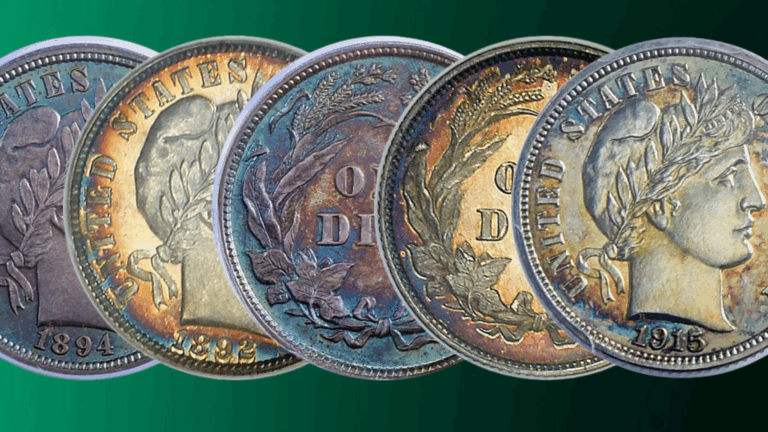
Like Barber quarters, business strike Barber dimes were minted from 1892 to 1916, and Proofs were not produced in 1916. A set of all Philadelphia Mint Proof Barber dimes from 1892 to 1915 is easy to assemble.


For all dates in this series, except the 1914, the CPG-CAC medium retail estimate for a Proof-64 dime is $775. In some cases, such a coin might cost more than $775. In other cases, these can be purchased for less than $775 each, though $775 is a fair reference point to provide an idea of the costs of completing a CAC-only set of Proof Barber dimes. There are twenty-four Philadelphia Mint dates in the set.
On June 27, 2025, Stack’s Bowers sold a CAC approved Proof-64 1908 dime for $660. On Aug. 22, 2024, Stack’s Bowers sold a CAC approved Proof-64 1903 for $840.


Of the more than 1500 Proof Barber dimes that have been CAC approved, only three grade 60 and just thirteen were certified as Proof-61. Thirty have been certified as Proof-62 and one hundred and two have been certified as Proof-63, including twenty-three with a ‘Cameo’ (CAM) designation and two that have been designated as having a ‘Deep Cameo’ (DCAM) contrast. Cameo and DCAM are terms covered herein.
An immediate point is that only a small percentage of CAC approved, Proof Barber dimes were certified at a level below Proof-64, and Proof-67 Barber dimes tend to cost dramatically more than Proof-66 coins. People who assemble sets usually focus on those that have been certified in the Proof-64 to -66 range.
Besides, Proof silver coins that grade below 64 tend to have a large number of hairlines, be off-color and/or have annoying imperfections. Of course, there are some very appealing, Proof Barber dimes that have been certified as Proof-62 or even Proof-61. These, though, are exceptions.
A beginning to intermediate-level collector planning to build a CAC-only set of Proof Barber dimes should focus on those that are certified in the Proof-64 to Proof-66 range. A collector building a set should plan on spending more than $650 for each coin, and more than $1200 on some coins. Personally, I find naturally colorful Proof Barber dimes to be good values, especially those without a ‘Cameo’ designation. A complete set of commensurable quality, Proof Indian Cents, Proof Barber halves, Proof Liberty Head quarter eagles, or ‘With Motto’ Liberty Head half eagles (1866-1908) would cost far more. A CAC approved Proof-64 1909 VDB Lincoln cent, just one coin, would be likely to cost more than $20,000!

Branch Mint Proofs
Branch Mint Proof 1894-S dimes are a different matter, and will be discussed separately, eventually. Before an article of mine was published in 2013, most references listed ten to twelve 1894-S dimes. I pointed out that only nine are known. All are Proofs or are nearly Proofs; 1894-S dimes are not business strikes. An 1894-S dime is not really, however, part of a set of mainstream Proof Barber dimes, which were distributed to collectors and other consumers along with other Proof coins minted in Philadelphia.
Before 1968, almost all Proof U.S. coins were struck at the headquarters mint in Philadelphia. Branch Mint Proofs were unusual cases and were always rare. These are sought by a small, devoted group of collectors.
There exist 1892-O and 1893-O dimes that have been said to be Branch Mint Proofs. I have never seen the famous CAC approved MS-68-Prooflike 1893-O, which some experts maintain is a Proof. I have seen an 1892-S dime that is not a business strike.
Specially struck Branch Mint dimes are beside the topic here, and beginners should not acquire them. These are coins that interested, advanced collectors should discuss with coin experts.
Philadelphia Mint Proofs of the late nineteenth and early twentieth centuries are accessible and are not particularly expensive. As there are no very rare Proof Barber quarters, Philadelphia Mint Proof Barber dimes are not very rare either. It is extremely likely that more than two hundred and fifty Proof Barber dimes of each Philadelphia Mint date survive, far more of several dates.
Equal Rarity?
Leading price guides suggest that all Proof Barbers dimes are worth about the same, thus implying that they are about equally rare or that they are primarily demanded as type coins rather than as separate dates. Someone building a pertinent type set would need only one Proof Barber dime as all Barber dimes are of the same design type.
For every date except the 1914 and the 1915, the CPG-CAC medium retail value estimate for a Proof-65 Barber dime is $1150 and the CPG-CAC retail value estimate for a CAC approved Proof-66 Barber dime is $1500. The CPG-CAC value estimates for the 1914 and the 1915 are not much higher.
Is it really true that all Philadelphia Mint Proof Barber dimes, other than the 1914 and the 1915, are about equally scarce? Are there some unidentified better dates? If so, it may be fun to discover them.
The 1892 has the largest mintage of any Philadelphia Mint Proof Barber dime, 1245. The 1894 has the second highest mintage, 972. As Proof 1900 dimes are not relatively easy to find, it is surprising that the 1900 has the third highest mintage, 912.
Besides these three, mintages of Proof Barber dimes before 1907 ranged from 670 to 880 per year. There does not, however, seem to be much of a correlation between the number of survivors and the mintages. From 1907 to 1913, mintages were generally lower than they were before 1907, yet these dates are not thought of as being particularly scarce. Of Proof Barber dimes, the lowest mintages were 425 in 1914 and 450 in 1915, yet these two dates are not as scarce as their relatively low mintages might suggest.
The 1892 is not as common as its mintage, 1245, indicates to some beginners. The combined CACG, PCGS and NGC population is nearly eight hundred Proof 1892 dimes. I theorize, though, that many of those are resubmissions of some of the same coins. I estimate that less than five hundred Proof 1892 dimes survive, eighty-five of which have been CAC approved. For many other dates, 285 to 440 survive, in my estimation.


In the past, some researchers were taking PCGS and NGC population data far too literally. For decades, there have been dealers making all or a substantial part of their respective livelihoods by ‘cracking out’ classic U.S. coins, removing them from PCGS or NGC holders, and then resubmitting them. While some such dealers diligently returned the printed labels, often called ‘inserts’ or ‘tags,’ many did not return these and still do not return them to PCGS and NGC.
PCGS and NGC reports should be interpreted by experts who have decades of experience in the coin business. I knew and still know many of the crackout artists. I believe that CAC is more consistent than PCGS or NGC, and thus less likely to receive resubmissions of the same individual coins.
Beginners who focus on CAC approved Proof Barber dimes need not think much about the crackout game and should relax while enjoying the process of completing sets. Some collectors may like to keep track of asking prices and auction records while forming their own opinions in regard to the relative rarity of Proof Barber dimes.
Indeed, relative rarities in the Proof-64 to -66 range remain unclear, an area ripe for further research. As one coin could have been submitted a dozen times or more, NGC and PCGS population reports should not be the sole or even the primary sources of information for such research. In regard to Barber coins, it will be especially interesting to follow the evolution of the CAC population report over time.


Proof Barber Dimes of the 1890s
It is not possible to cover all aspects of 1892 to 1899 Proof Barber dimes. I mention noteworthy aspects of some of the dates.
Although the 1892 has the highest mintage and the highest certified population numbers, the Stack’s Bowers auction archive does not list any CAC approved Proof-64 1892 dimes. The last one sold by Heritage realized $552 on May 26, 2020.
GreatCollections has sold just one CAC approved Proof-64 1892 dime and that was an NGC graded coin that brought $830.50 in April 2017. On Sept. 17, 2023, GreatCollections sold a CAC approved Proof-66 1892 for $1221.


Gem Proof 1894 dimes have been very much available. On Oct. 15, 2023, GreatCollections sold a CAC approved Proof-65 1894 dime for $920.22. On March 27, 2024, Stack’s Bowers sold two CAC approved, PCGS certified Proof-66 1894 dimes for $1200 and for $1560, respectively.
Although the 1895 is one of the least scarce Barber dimes in Proof format, it is interesting because the business strike 1895 dime is a semi-key. On May 9, 2023, Heritage sold a CAC approved Proof-64 1895 dime for $780. On Feb. 2, 2025, GreatCollections sold a CAC approved Proof-62-Cameo 1895 for $635.80.

[Dime1896_Proof_GC_or.jpg]The CAC pop of Proof 1896 dimes is sixty-three, including eleven with CAC stickers and one CACG certified Proof-66-Cameo 1896 dime. On Feb. 25, 2024, GreatCollections sold a CAC approved Proof-65 1896 for $1100. The images are colorful. I have not seen this coin in actuality. On May 4, 2025, Heritage sold a CAC approved Proof-66 1896 for $1500.
CAC approved or CACG certified Proof Barber dimes from the late 1890s tend to be obtainable with a mild amount of patience. Many have ‘Cameo’ contrasts, including quite a few that have colorful toning as well. I often admire naturally toned coins with Cameo contrasts that were not induced or enhanced by ‘dipping’ in acidic solutions.

Cameo Designations
The concept and value of ‘Cameo’ designations are discussed in my Proof Barber quarter guide for beginners. I hope that collectors who are unfamiliar with ‘Cameo’ designations on Proof coins refers to that article or to other articles that I have written on Proof coins. Briefly, I address this topic again here.
Before Cameo Proof coins were struck, the metal inside recessed areas of the dies was subject to a sophisticated process at the mint, which changed the texture of the metal relating to central or all design elements, resulting in elements having an apparently creamy or frostlike, whitish finish. Curiously, this treatment of the dies sometimes leads to an illusion that design elements were painted or coated white. There was no painting or white-coating on the dies or on genuine Proof coins.
Additionally, it was common for the fields (blank areas) of the dies used to make Brilliant Proof coins to be heavily polished to the point that the fields on the resulting coins were ultra-smooth and extremely reflective, almost like true mirrors in some cases. For some classic U.S. Proof coins, the planchets (prepared blanks) were polished as well.
On many Proof coins, smooth and reflective fields contrast with whitish design elements in a way that is referred to as ‘Cameo.’ It may be impossible to explain the minimum degree of ‘Cameo’ contrast that is or should be required for a given coin to qualify for a ‘Cameo’ (CAM) or ‘Deep Cameo’ (DCAM) designation. A ‘Deep Cameo’ contrast is greater in magnitude and completeness than a not so deep ‘Cameo’ contrast. Also, it is not unusual for a classic U.S. Proof coin to have a partial-Cameo contrast without qualifying for a Cameo (CAM) designation.
The premiums realized for ‘Cameo’ or ‘Deep Cameo’ designations vary. For the 1903, a CAC approved Proof Barber dime with a ‘Cameo’ designation would be worth more than twice as much as a coin that is otherwise equivalent yet does not have such a Cameo contrast.
The premiums for Cameo designated Proof 1911 dimes are not as high as those for 1903 dimes. The CPG-CAC retail estimate for a Proof-65 1911 is $1150 and the retail estimate for a Proof-65-Cameo 1911 is $1350, not a large premium. In Proof-66, the CPG-CAC medium retail estimate is $1500 and is $1650 for a Proof-66 1911 with a Cameo designation, 10% more. In Proof-67 grade, the CPG-CAC estimate is $2750 and $3050 with a Cameo designation, a premium of about 11%.
CAC has certified zero 1911 dimes with a ‘Deep Cameo’ designation. If one is so certified, it would probably bring a gigantic premium and I would advise against paying a large premium for it. In my opinion, a ‘Cameo’ or ‘Deep Cameo’ designation should not be worth a tremendous premium. It makes more sense to focus on toning, technical factors, striking detail, and the overall personality of a coin.

Undoubtedly, serious buyers consider several factors while pursuing Proof Barber dimes, not just ‘Cameo’ or ‘Deep Cameo’ designations. It is apparent, though, that ‘Cameo’ and ‘Deep Cameo’ designations have significant financial value.

Cameo Proof 1895 Dimes
On May 22, 2023, Heritage auctioned a CAC approved Proof-67 1895 for $2400. On June 14, 2024, Heritage sold a CAC approved Proof-67-Cameo 1895 for $3960, more than a 50% premium above the price realized for the just mentioned coin without a Cameo designation.
On Nov. 19, 2023, GreatCollections sold a CAC approved Proof-67 DCAM 1895 dime for $14,835.70, more than six times as much as the CAC approved Proof-67 1895 that Heritage sold for $2400 on May 22, 2023. This $14,835.70 coin is not very colorful. Would it make more sense to pay $2400 for a Proof-67 1895 with entertaining colors than $14,835.70 for a Proof-67 DCAM 1895 dime?
Deep Cameo Barber Dimes
Very few twentieth century Barber dimes are judged by experts at CAC to qualify for ‘Deep Cameo’ (DCAM) designations. For the 1900, the CAC pops are thirty-nine without a designation, thirty-one with a Cameo designation and just two with a DCAM designation.
For the dates from 1901 to 1915, CAC has certified just two Barber dimes as qualifying for a DCAM designation, one 1906 received a CAC sticker and a 1910 is CACG certified Proof-66+ DCAM. A CACG certified Proof-67 1910, without a designation, is estimated to retail for $2750. A CACG certified Proof-66+ Cameo 1910 was auctioned by Stack’s Bowers on June 24, 2025, for $2400. If the CACG certified Proof-66+ DCAM 1910 dime became available in 2025, it would probably have a retail value above $6750.


Curiously, 1902 and 1903 dimes are rarely found with any significant degree of cameo contrast. The CAC population of 1906 dimes with a ‘Cameo’ designation is just eighteen, and only one is CAC approved with a ‘Deep Cameo’ designation. On July 6, 2025, a CAC approved, NGC certified Proof-64-Cameo 1906 dime was auctioned for $918.50 by GreatCollections.


The 1914 & The 1915
As already stated, the CPG-CAC guide estimates that both the 1914 and the 1915 bring a premium in Proof-65, though just the 1914 is estimated to bring a premium in Proof-64, $900 vs. $775. The Numismedia guide estimates that both the 1914 and the 1915 bring substantial premiums in Proof-64, but only the 1915 brings a substantial premium in Proof-65.
On Feb. 16, 2025, GreatCollections sold a CAC approved Proof-67 1914 dime for $3246.10. It is not clear to me whether this amount includes a premium for the 1914 date. It is plausible that this coin would have brought the same if it was a 1913, 1912, 1911 or 1910. On Jan. 16, 2022, GreatCollections sold a CAC approved Proof-66 1914 for $1607.10.


On May 1, 2022, GreatCollections sold a CAC approved Proof-64+ 1915, with a CAC sticker, for $761.10. This result does not provide evidence that the 1915 is worth a premium as a date. Any one auction price, however, does not demonstrate a market value. There are variables in addition to market levels that influence auction results.
On April 5, 2022, Stack’s Bowers auctioned a CAC approved Proof-66 1915 for $3360. That auction in April 2022, though, went extremely well overall, with many coins bringing very strong prices. On Nov. 19, 2023, GreatCollections sold a CAC approved Proof-67 1915 for $4182.20.
There is no need to include Proof-67 or even Proof-66 Barber dimes in a set. A collector on a budget could practically focus on Proof-64 to -65 Barber dimes, sometimes with Cameo designations, and include one to three Proof-63 pieces in cases where these are appealing and suitable, given the personality and objectives of the respective collector.
Coins that thrill one collector may not impress another. There will always be subjective aspects to selecting and collecting coins. It is important for collectors to acquire coins that they enjoy pursuing and owning.
Copyright © 2025 Greg Reynolds
About the Author
Greg is a professional numismatist and researcher, having written more than 775 articles published in ten different publications relating to coins, patterns, and medals. He has won awards for analyses, interpretation of rarity, historical research, and critiques. In 2002 and again in 2023, Reynolds was the sole winner of the Numismatic Literary Guild (NLG) award for “Best All-Around Portfolio”.
Greg has carefully examined thousands of truly rare and conditionally rare classic U.S. coins, including a majority of the most famous rarities. He is also an expert in British coins. He is available for private consultations.
Email: Insightful10@gmail.com
Suggested Articles