by Greg Reynolds
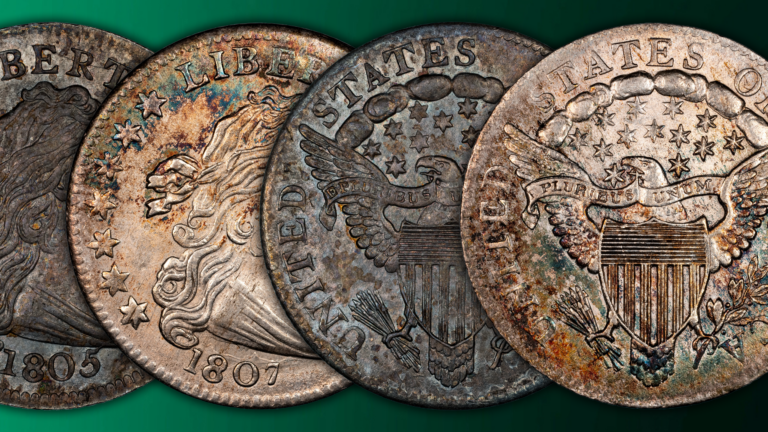
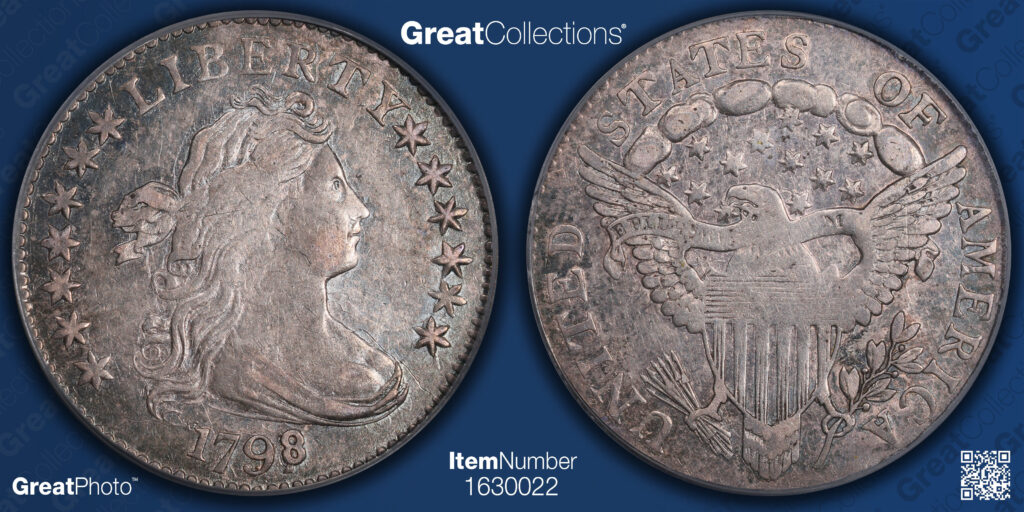
Draped Bust, Heraldic Eagle dimes were minted from 1798 to 1807. As noted in my companion article on VF to AU grade half dollars from 1801 to 1807, it is best to refer to the reverse design of these as ‘Heraldic Eagle’ rather than as ‘Large Eagle.’ The depiction of an eagle is not especially or even relatively large. It is an enhanced eagle with heraldic symbols.
The ‘Heraldic Eagle’ reverse design on half dimes (1800-05), dimes (1798-1807), quarters (1804-07), half dollars (1801-07) and silver dollars (1798-“1804”) stems from the national bird on The Great Seal of the United States. A ‘Bald Eagle’ actually has white feathers on his or her head and neck. An eagle is the national bird of at least five European nations. Furthermore, there are dozens of species of eagles. The ‘Bald Eagle’ is the only species of eagles found exclusively in North America.
Since ancient times, symbols and emblems on official seals, coins and flags have been related to nations or political alliances. They reflected cultural, historical and military concepts. In the twenty-first century, symbols and emblems are not emphasized or discussed as much as they were for thousands of years. Symbols and emblems, though, played a role in the development and foundations of the United States of America. The ‘Heraldic Eagle’ reverse design on coins contributes to the education of people about the nation.
In the 1700s and early 1800s, much was communicated through symbols, emblems and other kinds of illustrations. Flags, banners, fliers and seals for documents featured symbols. Before 1850, many U.S. citizens did not have access to books and newspapers. Indeed, a large number of people were illiterate or barely literate. Radio and cinema were not viable until the twentieth century. Coins and medals often conveyed concepts or other messages from the government to the citizens.
On several denominations of U.S. coins, the ‘Heraldic Eagle’ reverse motif replaced the so-called ‘Small Eagle,’ which is not really small. Please see my articles on collecting bust dimes by design type for a discussion of Draped Bust, Small Eagle dimes, which were minted in 1796 and 1797. Here, the focus is on the coins needed for a set by date of Draped Bust, Heraldic Eagle dimes (1798-1807).
1798/7 Overdate
The 1798/7 overdate is blatant. The numeral eight that was overpunched on a seven is much smaller than the seven it was overruling, and parts of the underlying seven are very much visible. This overdate can easily be seen without magnification on most or all examples that grade above VG-10. Undoubtedly, the 1798/7 constitutes an additional date of the year 1798.
There were thirteen star and sixteen star obverse varieties of 1797 dimes, and there are thirteen star and sixteen star reverse varieties of 1798/7 dimes. The sixteen star varieties of coins relate to the admission of Tennessee to the Union on June 1, 1796. Kentucky became the fifteenth state on June 1, 1792.
In 1776, representatives of thirteen British colonies banded together and declared independence. These thirteen colonies became the original thirteen states. Eventually, the number of states increased to fifty as Alaska and Hawaii were admitted in 1959. Sixteen stars, however, was considered too many for the obverse or for the reverse of a coin. The number of stars on one side of a coin in the design was thus limited to thirteen, though the new policy was gradually implemented.
One reason why a new thirteen star policy did not take effect right away is that dies were often used until they wore down or fractured severely. An obverse die and a reverse die are used in a coining press to impart designs on a planchet (prepared blank) to make each coin.
The whole process of manufacturing a die was labor-intensive and required expensive materials. It was practical to keep using dies until they were no longer usable or their respective designs were replaced.
Heraldic reverse dimes and quarter eagles ($2.5 gold coins) shared some reverse dies. The sixteen star reverse die that was used to make 1798/7 dimes was earlier used to mint 1797 quarter eagles.
As for the thirteen star reverse and the sixteen star reverse 1798/7 dimes, there are slight differences in addition to the number of stars. The shape of the neck of the eagle is different. Even so, I find the distinctions to be subtle and not particularly important.
The 1798/7 dimes with a thirteen star reverse and those with a sixteen star reverse all have thirteen stars on the obverse. In my view, the reverse stars relate to die varieties, not to separate dates of the same year. They are minor varieties. Whether they number thirteen or sixteen, the stars on the reverse are in the same region and are surrounded by the same design elements. These stars are small. One 1798/7 dime is sufficient for a set by date.
As the thirteen star reverse variety is extremely rare, most interested collectors tend towards sixteen star reverse 1798/7 dimes. Of both varieties, the total number of surviving 1798/7 dimes is under five hundred, including dozens that do not or should not qualify for numerical grades. While considering their rarity and historical importance, I find market levels for 1798/7 dimes to be fair and very much understandable, from a logical perspective.
On April 14, 2025, Heritage sold a CAC approved VG-10 1798/7 dime for $3600. On Oct. 5, 2025, Heritage sold a CAC approved VF-30 grade 1798/7 dime for $10,200. On Aug. 18, 2024, GreatCollections sold a CAC approved XF-45 grade 1798/7 dime for $25,850.
1798 ‘Large 8’ & ‘Small 8’
The 1798 ‘Large 8’ and ‘Small 8’ varieties are not overdates. While they could be called regular dates, both the ‘Large 8’ and the ‘Small 8’ are unusual and attention gathering in nature. Moreover, they are different from each other. It is true, however, that the sizes and shapes of the numerals on many pre-1828 silver coins of the same denomination tend to vary a great deal. In my view, the differences between these two numeral eights are not especially important. The ‘Large 8’ is not that much larger than the ‘Small 8,’ though each is idiosyncratic.
Although they are both truly rare, the ‘Small 8’ variety is much rarer than the 1798 ‘Large 8’ dime. Indeed, there are less than one hundred 1798 ‘Small 8’ dimes in existence. There are probably fewer than 260 1798 ‘Large 8’ dimes around, including fifty or more that do not merit numerical grades because of serious problems.
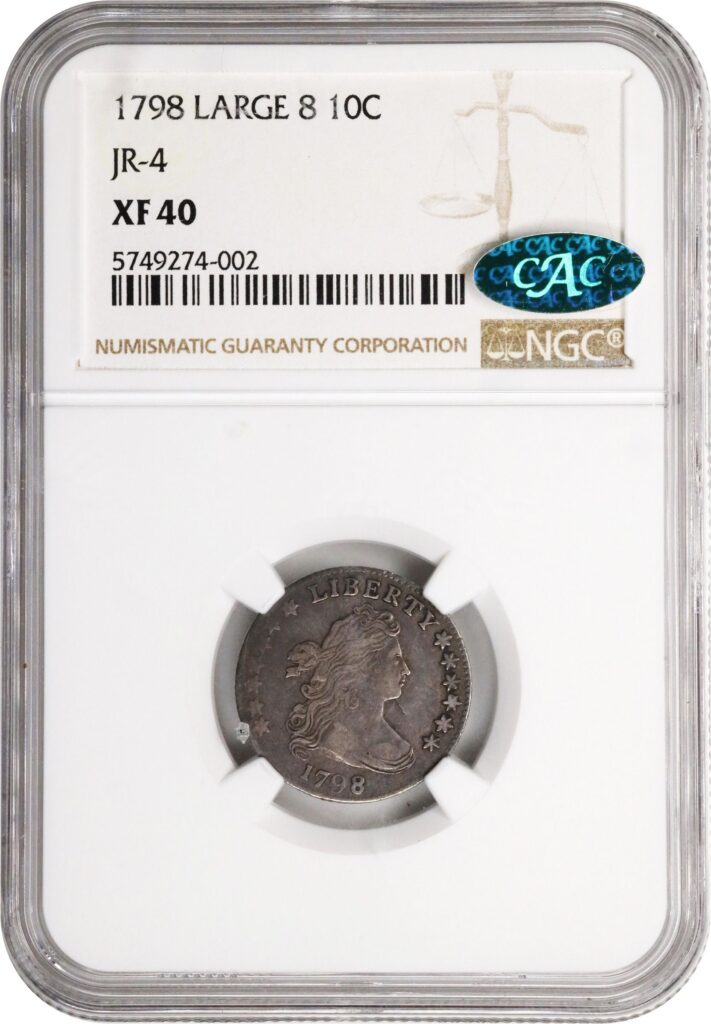
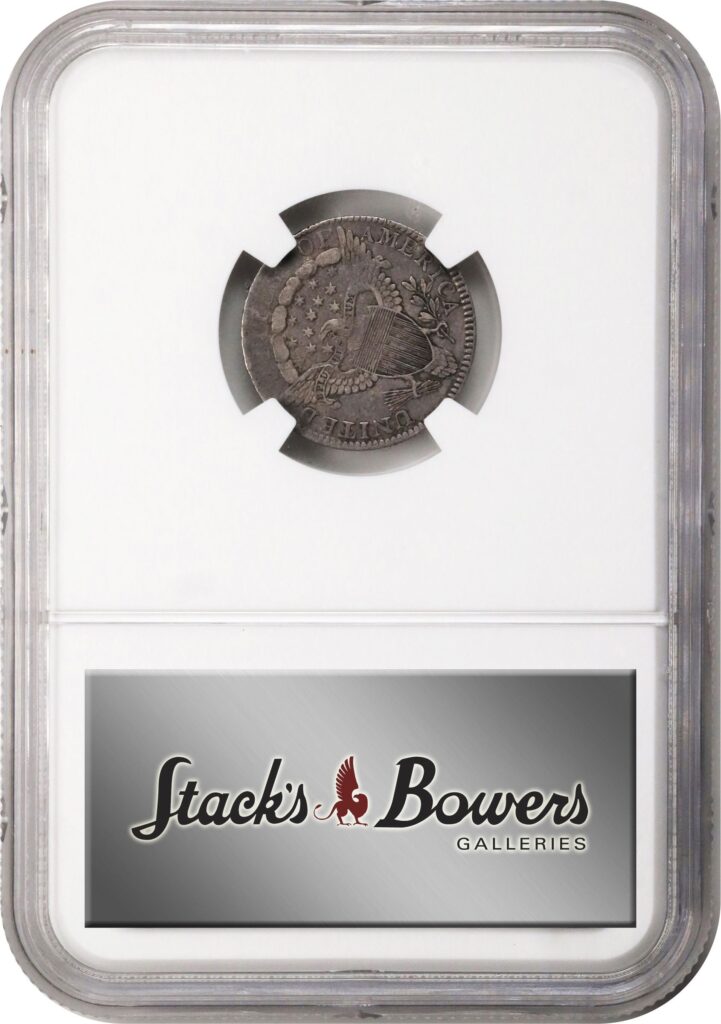
If I was assembling a set of Draped Bust dimes, I would purchase a carefully selected 1798 ‘Large 8’ dime and be content with it. I may never even consider a 1798 ‘Small 8.’ Given the readily apparent differences, though, I understand the viewpoint that these are two different dates of the same year. Collectors should make their own decisions as to whether to seek just one or both.
On Oct. 9, 2022, GreatCollections sold a CAC approved Good-06 grade 1798 dime for $1872.20. The CPG-CAC medium retail estimate for a VG-10 grade 1798 ‘Large 8’ dime is $3200. On Aug. 25, 2021, GreatCollections sold a CAC approved, PCGS graded XF-40 1798 ‘Large 8’ dime for $5066.60. On Nov. 14, 2025, Stack’s Bowers auctioned a CAC approved, NGC graded XF-40 1798 ‘Large 8’ dime for $6000. Equivalent 1798 ‘Small 8’ dimes may cost much more.
1800 & 1801
There are no 1799 dimes, or none that I have seen. The 1800 and 1801 are not among the rarest and are not the least scarce dates of the Draped Bust, Heraldic Eagle dime design type. They are in the middle in terms of scarcity and market values.
A CAC approved Good to Very Good grade 1800 would probably retail for an amount in the range of $1,000 to $2,000, if one was available. On April 14, 2025, Heritage sold a CAC approved Fine-12 1800 dime for $2,760.
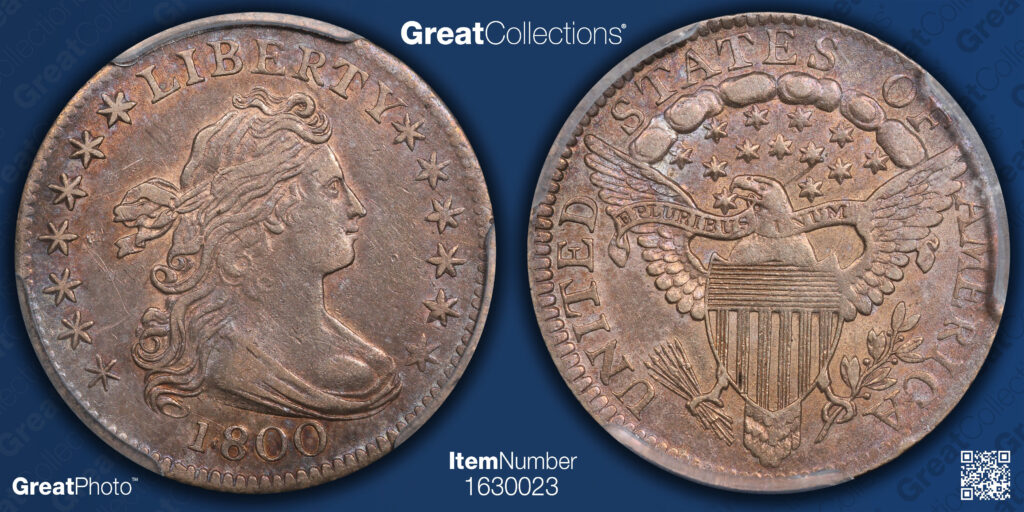
Dimes of this date that grade above Very Fine tend to cost multiples of those that grade below Very Fine. On Oct. 5, 2025, Heritage sold a CAC approved XF-40 grade 1800 for $7,800. Back on Nov. 22, 2021, Stack’s Bowers sold a CAC approved AU-50 grade 1800 dime for $10,800.
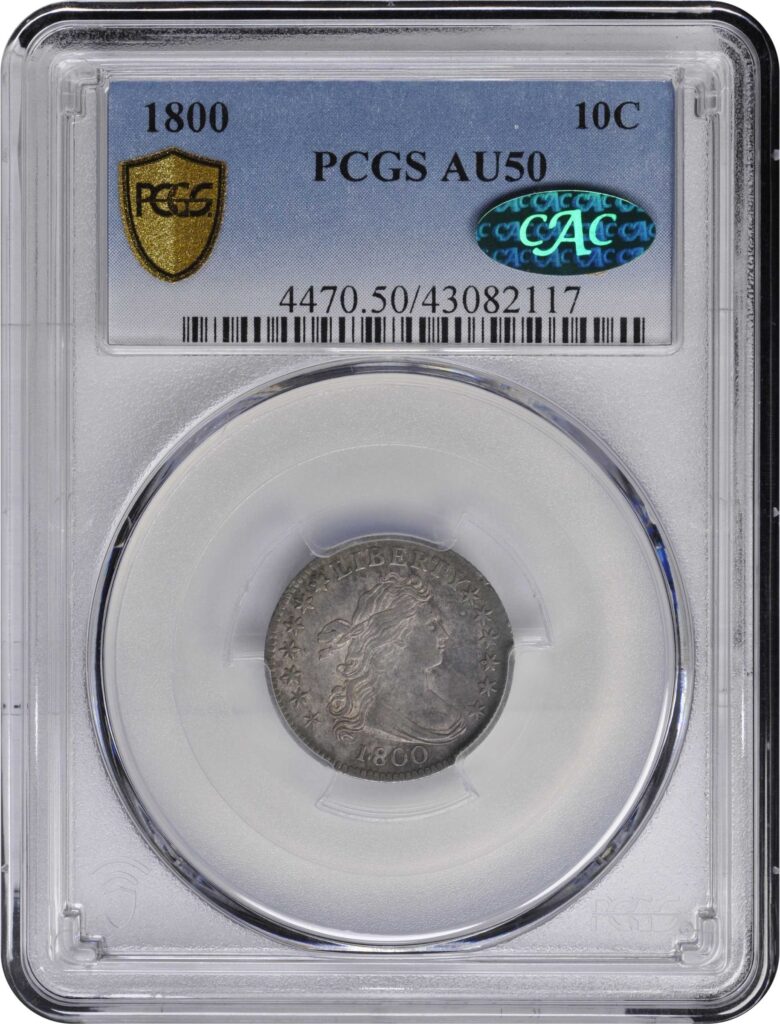
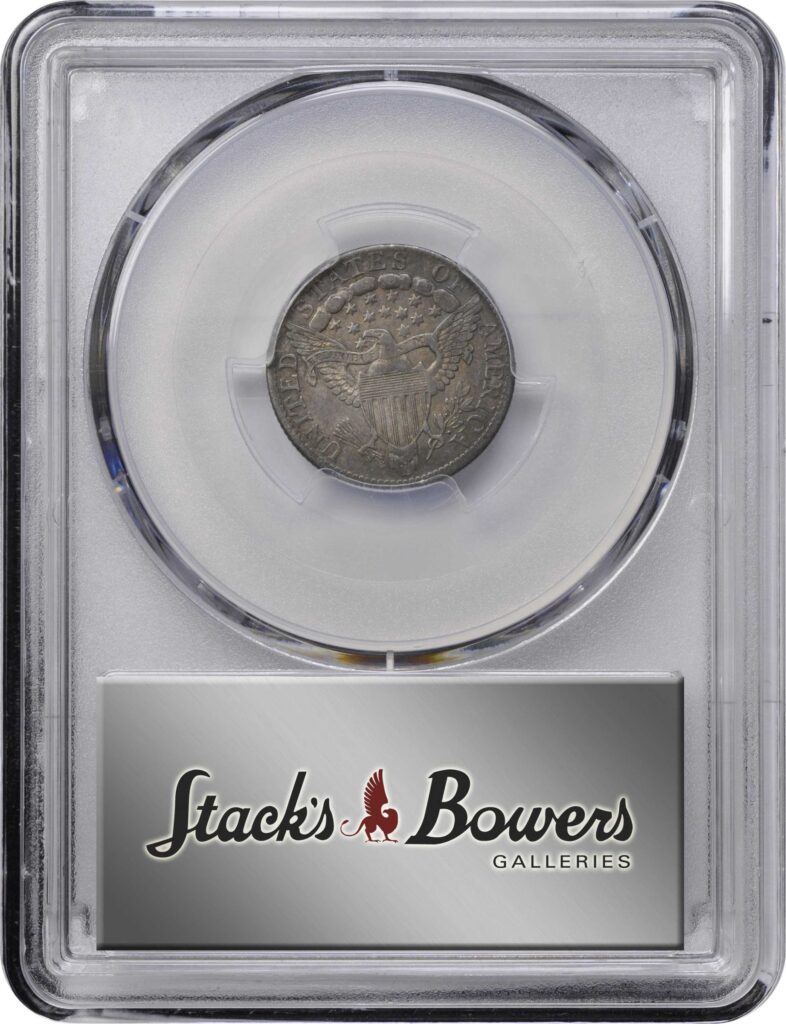
On Aug. 18, 2024, GreatCollections sold a CAC approved AU-53 grade 1800 dime for $16,503.30. For most collectors of circulated coins, Very Fine to Extremely Fine grade Draped Bust dimes are better values than those that grade in the AU-50 to MS-62 range. There is a fair chance that a collector could buy both an XF-40 or higher grade 1800 and an 1801 for less than the price of one AU-53 to -55 grade 1800. Additionally, there are a substantial number of Fine to Very Fine grade Draped Bust dimes that are acceptable to most interested collectors.
Of course, actual selections depend in large part upon the personality and budget of the respective collector. An important issue, however, is that collectors are often talked into buying relatively high grade coins that they can barely afford, yet slightly lower grade coins might cost dramatically less and be enjoyable to own.
On Dec. 14, 2021, Stack’s Bowers auctioned a CAC approved Fair-02 grade 1801 dime for $456. Even though this same coin might very well bring substantially more if auctioned in 2026 or 2027, it represents a relatively low cost way for a collector to own a CAC approved 1801 dime, a better date from the beginning of the nineteenth century. Curiously, this Fair-02 grade 1801 is not the ‘bottom pop’ for an 1801 dime.
CAC has approved two 1801 dimes as grading Poor-01, five as Fair-02, and five as AG-03. On Nov. 6, 2018, Heritage sold a CAC approved AG-03 grade 1801 dime for $528. That coin would almost certainly sell for notably more if auctioned in 2026 or 2027, though a small amount for an 1801 dime. On Aug. 2, 2020, during a relatively dark period of the pandemic, GreatCollections sold a CAC approved Good-06 grade 1801 for $1,156.10. On April 14, 2025, Heritage sold a CAC approved VG-08 grade 1801 dime for $2,880.
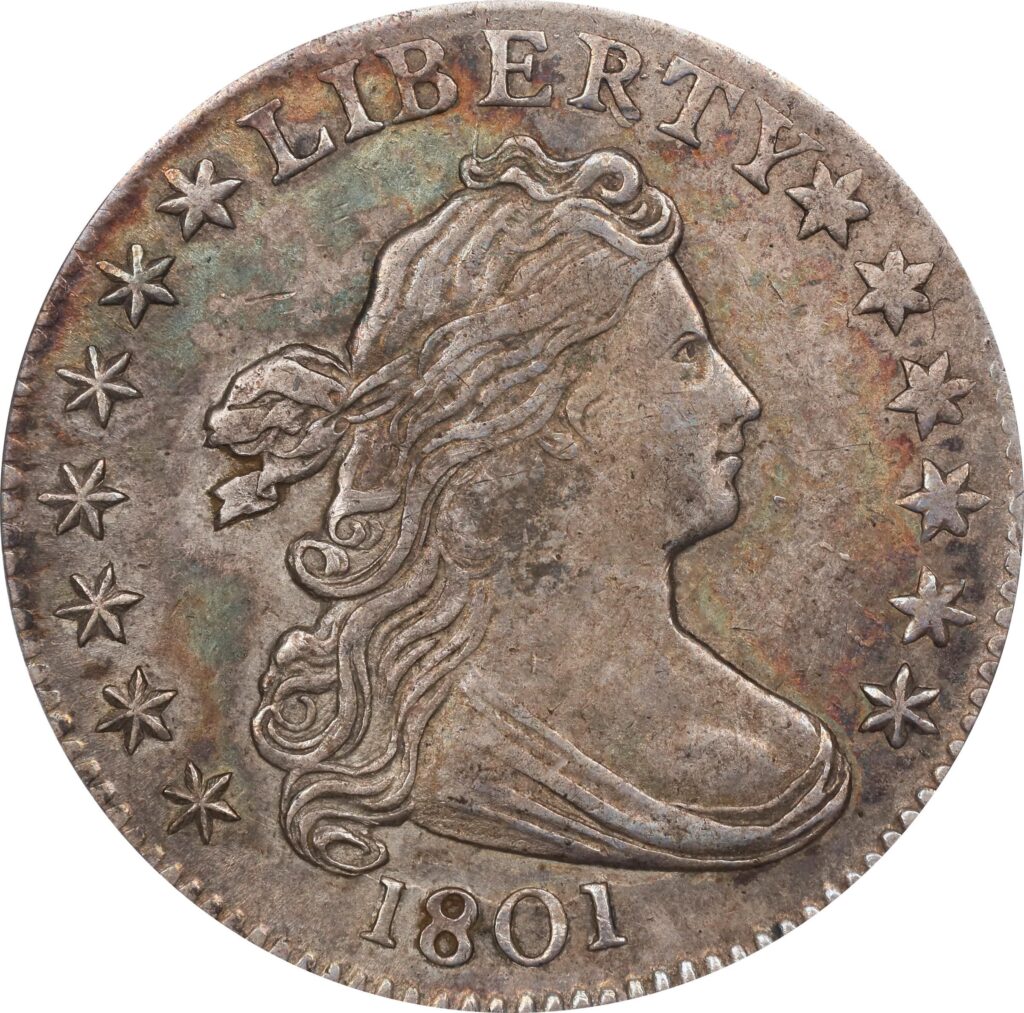
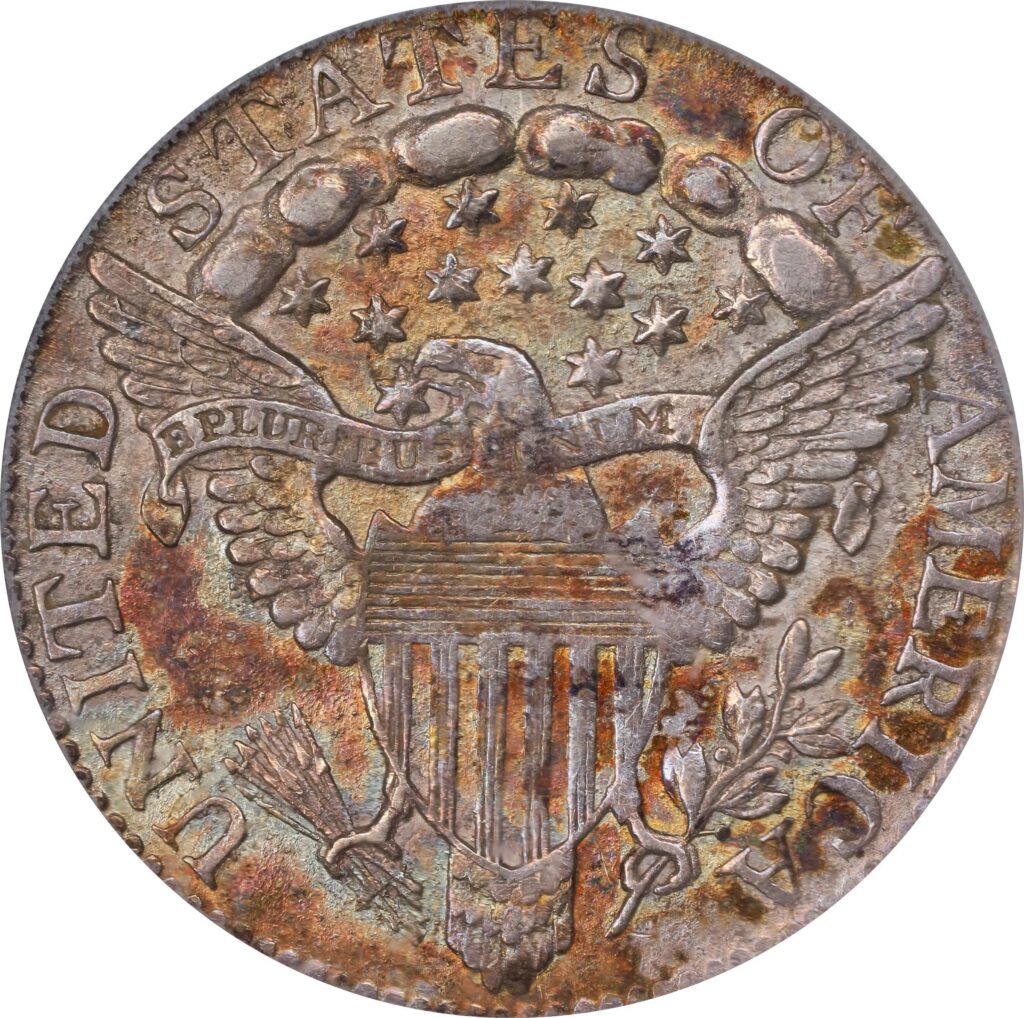
On Nov. 11, 2025, Stack’s Bowers sold a CAC approved AU-50 grade 1801 for $22,200, an understandably strong price. I examined this dime and found it to be appealing and entertaining, with really pleasant colors. I was not at all surprised that it brought more than the CPG-CAC medium retail estimate of $15,000.
1802 & 1803
Though not nearly as rare as an 1804, the 1802 is clearly a better date. There are probably around 215 1801 dimes in existence and I estimate that 180 or so 1802 dimes survive.
While interpreting population and other data, it is important to keep in mind that rarer and/or more expensive individual coins are more likely to be submitted or resubmitted than less rare dates of the same type, and are also more likely to be consigned to auctions. For example, a MS-62 grade 1916-D Mercury dime is much more likely to be consigned to an auction or submitted to a grading service than a MS-62 grade 1943-D Mercury dime.
The vast majority of surviving 1802 dimes are likely to have been certified, and more than a few were auctioned during the past half-dozen years. Back on March 19, 2020, Stack’s Bowers auctioned a CAC approved VG-10 grade 1802 for $2640. On Feb. 15, 2022, Heritage sold a CAC approved, NGC graded VF-30 1802 for $9000. On Aug. 18, 2024, GreatCollections sold this exact same coin for $10,450. By then, it was PCGS certified as VF-30 and again received a CAC sticker of approval.
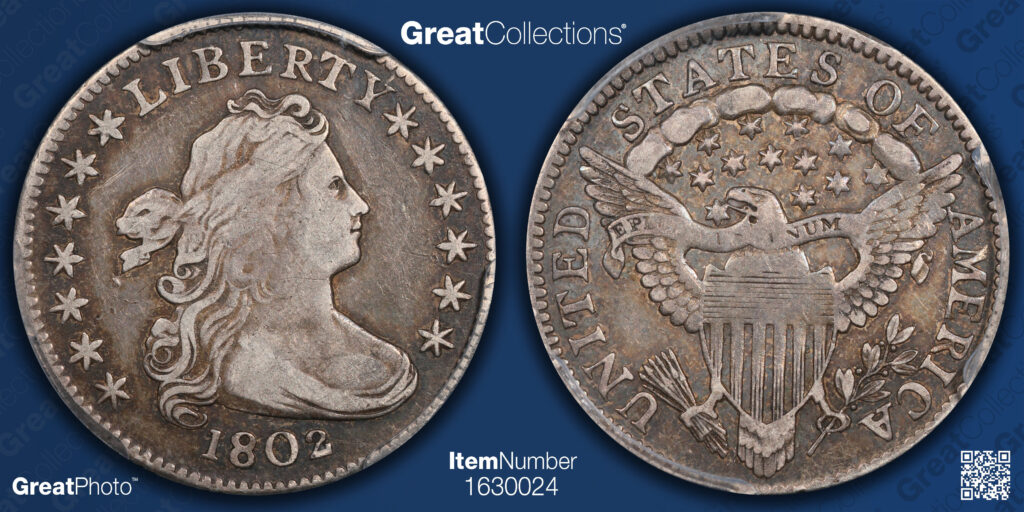
On April 3, 2025, Heritage sold a CAC approved XF-40 grade 1802 for $15,600. The just mentioned VF-30 grade coin might be almost as appealing. In many instances, I prefer lower-graded coins to higher-certified coins of the same date and type.
Although it is much rarer than the 1805 (4 berries) and the 1807, the 1803 is less rare and less costly than the 1802 in equivalent grades. On Nov. 20, 2022, GreatCollections sold a CAC approved AG-03 grade 1803 for $746.90. On Sept. 29, 2024, GreatCollections sold a CAC approved Good-06 grade 1803 for $1,321.10. On April 14, 2025, Heritage sold a CAC approved VG-08 grade 1803 for $2,400, a strong price. It is not difficult to acquire a relatively affordable 1803 dime.
The 1804
The key date is the 1804. Most references divide 1804 dimes into two major varieties, one with thirteen stars on the reverse and the other with fourteen stars on the reverse. The latter was a mint-caused mistake. Kentucky became the fifteenth state in 1792 and Tennessee became the sixteenth state in 1796. In 1803, Ohio became the seventeenth. Thirteen stars on at least one side of many U.S. coin designs are a tribute to the original thirteen states, not the number of states in the union at the time of a U.S. coin’s mintage. There would have been no reason to place fourteen stars in the reverse design of any U.S. dime or quarter eagle.
For most collectors of Draped Bust dimes, one 1804 is sufficient, whether there are thirteen stars or fourteen stars on the reverse. These stars are small and not comforting to count anyway. Both varieties each have thirteen stars on the obverse, which are notably larger than the stars on the reverse.
I maintain that more than one hundred 1804 dimes survive in total, possibly one hundred and fifty. They are not as rare as many interested collectors think of them as being. Though not as famous as 1804 dollars or 1804 quarters, 1804 dimes are famous. Unfortunately, most of them have serious problems.
CAC has approved just six of each variety, for a total of twelve. There are probably dozens of 1804 dimes that experts at CAC regard as ungradable. On March 22, 2023, Stack’s Bowers auctioned a CAC approved AG-03 grade 1804 13-Star reverse dime for $6600. On Jan. 15, 2025, Heritage auctioned a CAC approved Good-06 grade 1804 14-Star reverse dime for $11,400. On Jan. 29, 2021, Heritage sold a CAC approved VF-35 grade 1804 13-Star reverse dime for $26,400. Some collectors may wish to buy several other Draped Bust dimes and learn about the series before seeking an 1804.
1805 & 1807
I have never seen an 1806 dime. If anyone has, please tell me about it. There are two often recognized varieties of 1805 dimes, ‘4 Berries’ and ‘5 Berries.’ On the branch with leaves in the lower part of the reverse design, one reverse die has four berries interspersed among leaves and another reverse die has five berries. These berries are extremely small, almost microscopic. The berries varieties are inconsequential. Only one 1805 dime is needed for a set by date or by major variety of Draped Bust dimes, in my opinion.
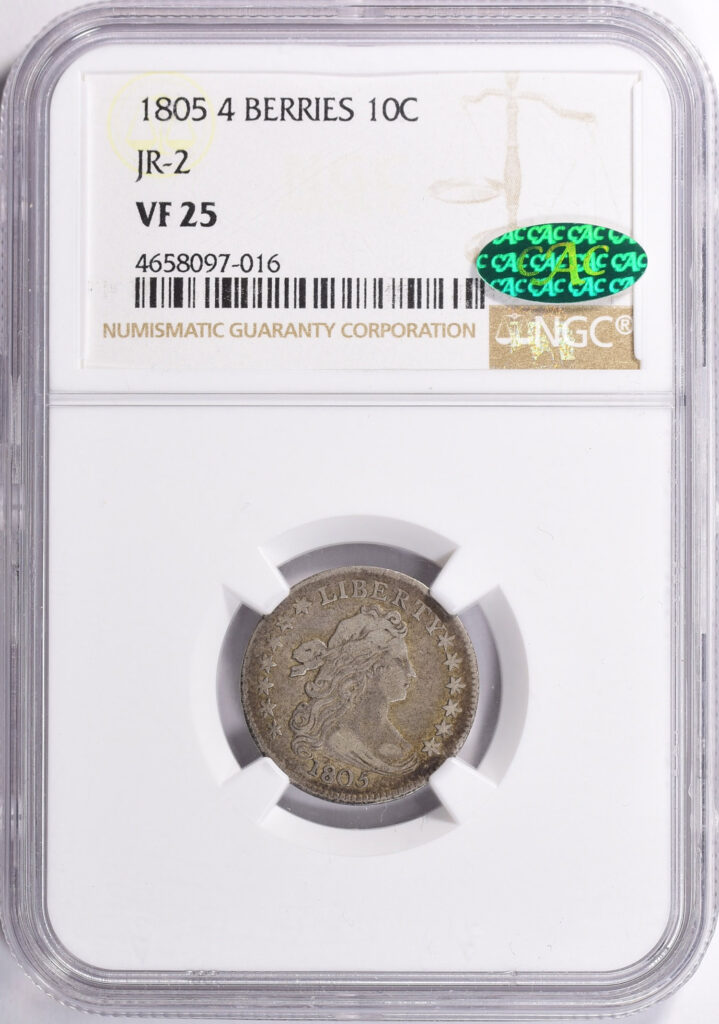
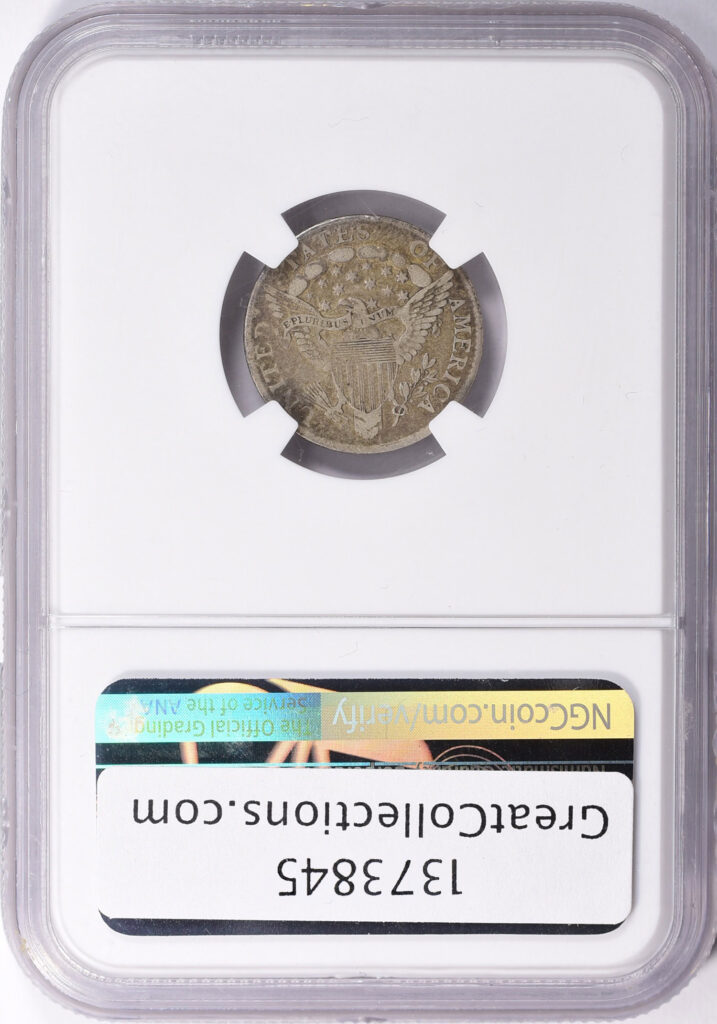
As the five berries variety is much rarer than the four berries variety, and tends to bring a mild premium, a budget-minded collector may wish to consider only 1805 ‘4 Berries’ dimes, not 1805 ‘5 Berries’ dimes. Most interested collectors would be pleased to acquire a pleasing, relatively original representative of either variety.
On Feb. 7, 2024, Stack’s Bowers auctioned a CAC approved Fair-02 grade 1805 ‘4 Berries’ dime for $432. On Oct. 13, 2025, Heritage sold a CAC approved Fine-12 grade 1805 ‘4 Berries’ dime for $1740. On May 28, 2023, GreatCollections sold a CAC approved, NGC graded VF-25 1805 ‘4 Berries’ dime for $2535.62.
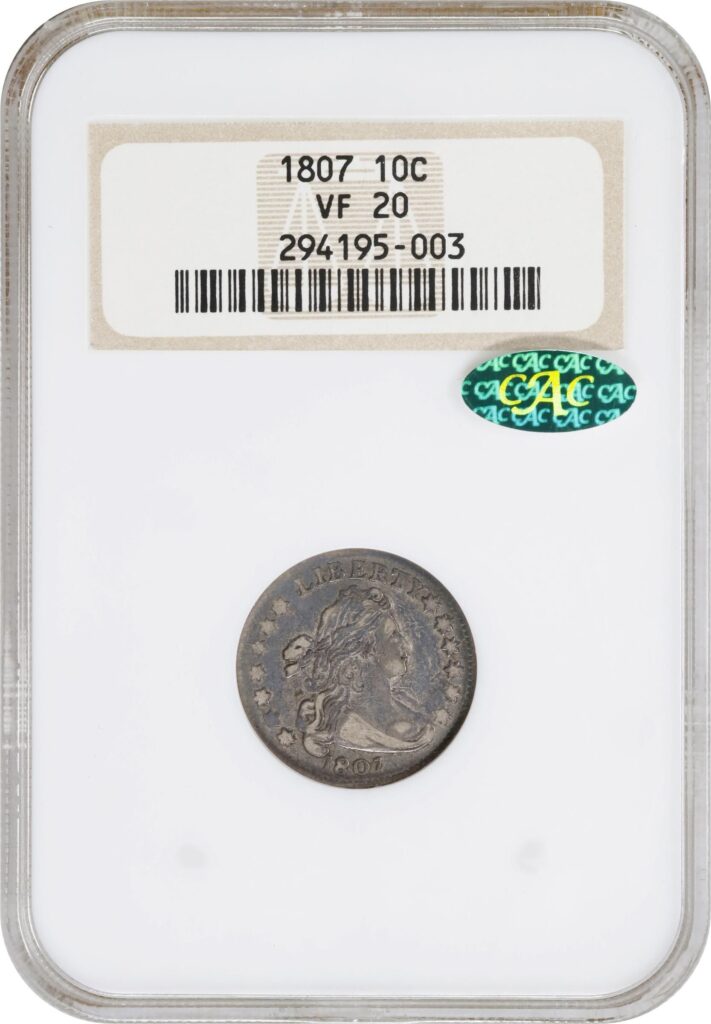
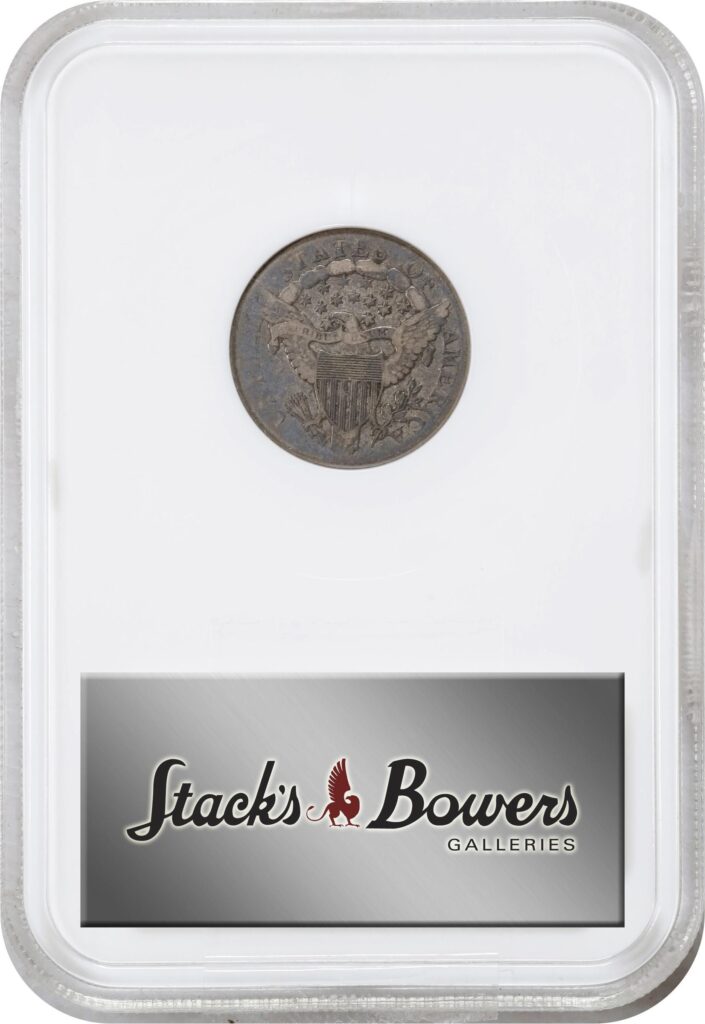
The 1807 is the least scarce date of the design type. It is easy to find one. On June 15, 2025, GreatCollections sold a CAC approved Good-04 grade 1807 for $924. On Oct. 13, 2025, Heritage sold a CAC approved VG-08 1807 dime for $1320. On March 23, 2023, Stack’s Bowers sold a CAC approved Fine-15 grade 1807 for $1440. On Nov. 19, 2024, Stack’s Bowers sold a CAC approved, NGC graded VF-20 1807 dime for $2640. On Nov. 20, 2024, Heritage sold a CAC approved AU-55 grade 1807 dime for $6001.20.
Closing Remarks
Other than the 1805 ‘4 Berries’ and the 1807, Heraldic Eagle dimes are truly rare coins. Even so, a CAC-only set by date is a practical objective. Given the rarity and historical importance of circulated Draped Bust, Heraldic Eagle dimes, market levels for these are reasonable.
Copyright © 2025 Greg Reynolds
Images are shown courtesy of GreatCollections and Stack’s Bowers Galleries.
About the Author
Greg is a professional numismatist and researcher, having written more than 775 articles published in ten different publications relating to coins, patterns, and medals. He has won awards for analyses, interpretation of rarity, historical research, and critiques. In 2002 and again in 2023, Reynolds was the sole winner of the Numismatic Literary Guild (NLG) award for “Best All-Around Portfolio”.
Greg has carefully examined thousands of truly rare and conditionally rare classic U.S. coins, including a majority of the most famous rarities. He is also an expert in British coins. He is available for private consultations.
Email: Insightful10@gmail.com
Suggested Articles