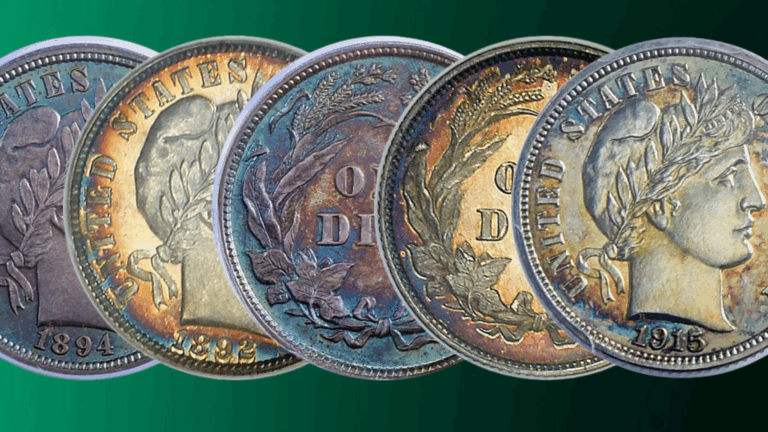
by Greg Reynolds
Liberty Seated dimes were minted from 1837 to 1891. All were specified to be 90% silver and to have a diameter of seven-tenths of one inch. Until 1853, they were mandated to contain 37.125 grains of silver, about 0.07734 Troy ounce or 2.406 grams.
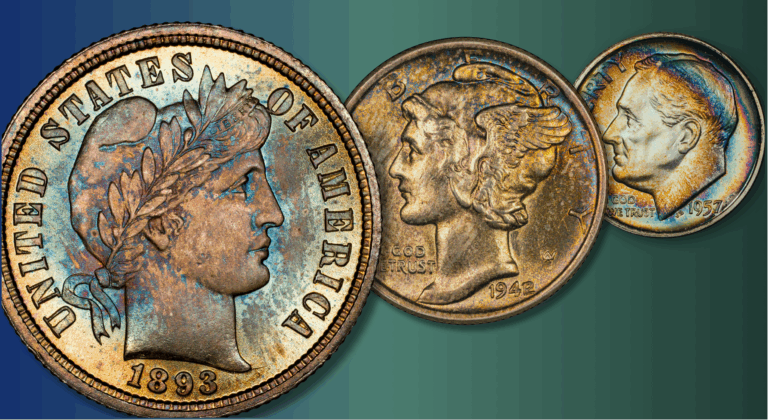
I repeat here a list of the thirteen design types of silver dimes. The obverse (head) is the front of a coin, and the reverse is the back or ‘tail.’
Six of these thirteen are Liberty Seated types. Here, types #5, #6 and #7 are covered, with emphasis upon relatively inexpensive coins. Choice to Gem Uncirculated Liberty Seated dimes will be the topic of a future discussion.
1. Draped Bust Obverse, Small Eagle Reverse (1796-97)
2. Draped Bust, Heraldic Eagle (1798-1807) — also called ‘Large Eagle’
3. Capped Bust, “Large” (1809-28) – design credited to John Reich
4. Capped Bust, “Small” (1828-37) – modified design & new minting technology
5. Liberty Seated, No Stars (1837-38)
6. Liberty Seated with Stars and No Drapery (1838-40)
7. Liberty Seated with Stars and Drapery (1840-1853, 1856-60)
8. Liberty Seated – Arrows & Stars on Obverse (1853-55)
9. Liberty Seated – Legend on Obverse (1860-73, 1875-91)
10. Liberty Seated – Arrows & Legend on Obverse (1873-74)
11. Barber (1892-1916)
12. Mercury (1916-45)
13. Roosevelt (1946-64) silver business strikes; silver Proofs from 1992 to the present
Of course, it would be fun to acquire representatives of all thirteen. Some collectors, though, like to focus on the nineteenth century or on Liberty Seated types in general. There are also Liberty Seated half dimes, quarters, half dollars and silver dollars. Although clearly inspired by Liberty Seated coins, the design of Twenty Cent pieces is notably different from the designs of Liberty Seated quarters or half dollars.
A type set of Liberty Seated dimes can logically fit into more than one kind of larger type set. A set of all types of U.S. dimes and a type set that includes multiple denominations of U.S. silver coins are two options among several. A type set representing all nineteenth century U.S. silver, copper (including bronze) and nickel U.S. coin series would be enjoyable to build and need not be expensive.
A collector could just focus on Liberty Seated dimes. After building a type set, he or she may wish to collect them ‘by date’!
A type set of Liberty Seated dimes can practically be the beginning of a larger collecting project, or it can be an end unto itself. The direction taken depends upon the personality and budget of the individual collector. Many collectors may wish to begin with limited type sets for fun and learning.
Type #5 – Liberty Seated, No Stars (1837-38)
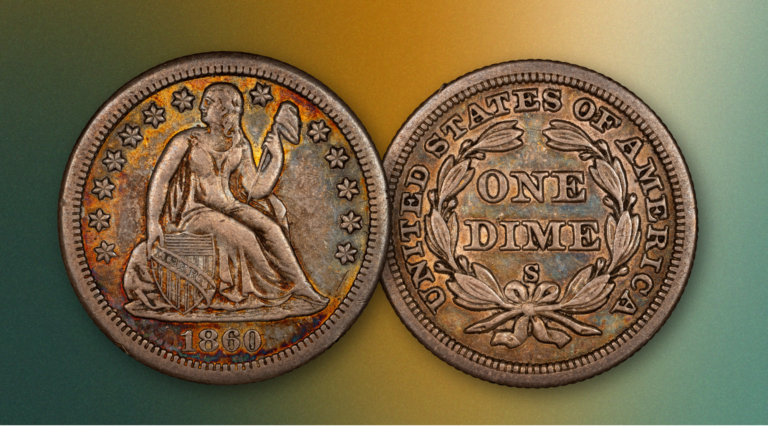
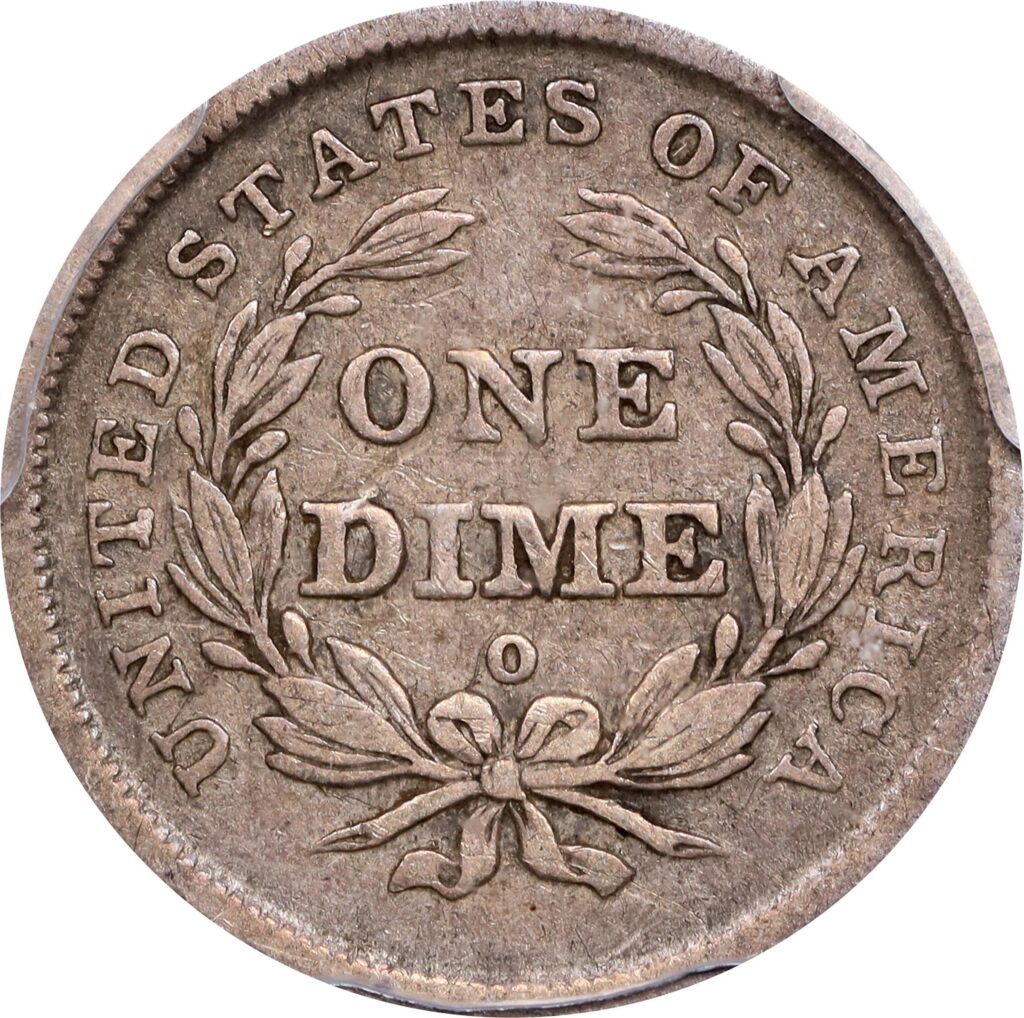
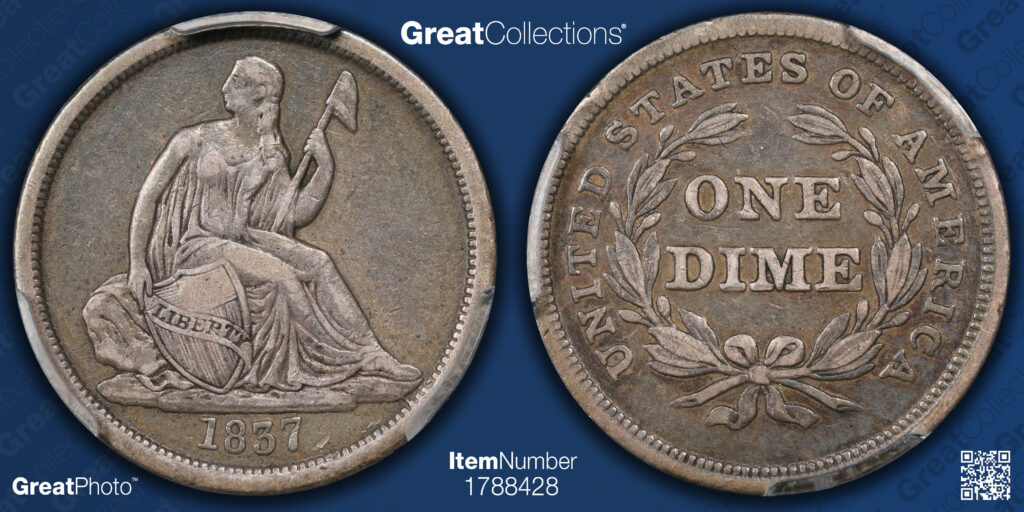
The designs of early Liberty Seated issues of half dimes, dimes, quarters, half dollars and silver dollars, are credited, probably fairly, to Christian Gobrecht. This design (type #5) does not include stars. Much of the obverse is empty space. The legend, ‘United States of America,’ and the denomination,‘One Dime,’ appear in whole words on the reverse.
There are just three dates of this ‘No Stars’ design: 1837 ‘Small Date,’ 1837 ‘Large Date,’ and 1838-O. Before the decision was effected to add stars to the obverse design, a pair of dies had already been shipped to or was in the process of being shipped to the New Orleans Mint for use during 1838.
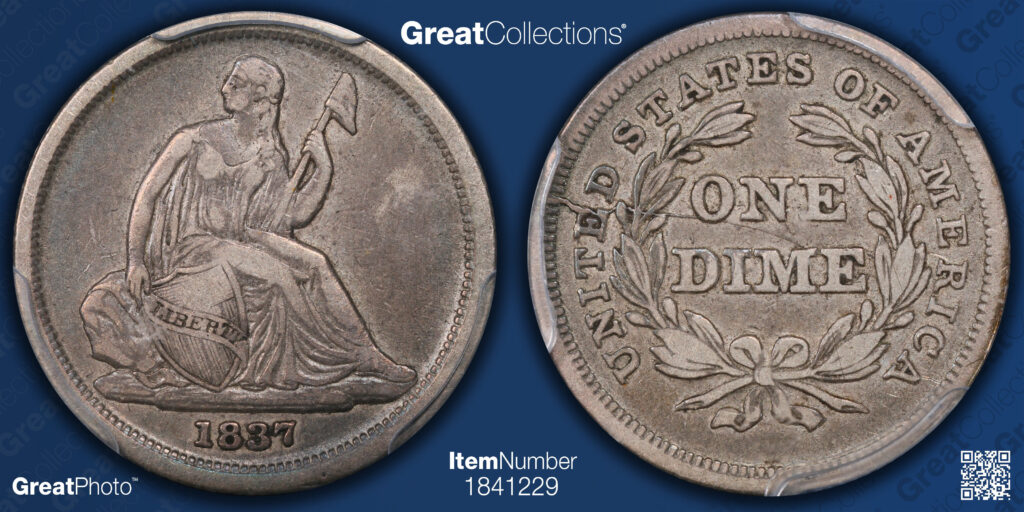
On average, the 1837 ‘Large Date’ is the least costly of these three dates, and is thus often a choice for a type set. The ‘Small Date’ 1837 is scarcer. The differences in prices, however, are not large, and either an 1837 ‘Large Date’ or an 1837 ‘Small Date’ No Stars dime is a sensible selection for a type set.
Public sale prices are listed here to provide an impression of the costs of building a type set of Liberty Seated dimes. Prices charged by dealers at coin shows may be higher or lower than auction prices. Also, I am not here recommending specific coins over others. I am encouraging coin buyers to learn about coins, gather some information about markets for coins and get an idea of collecting traditions.
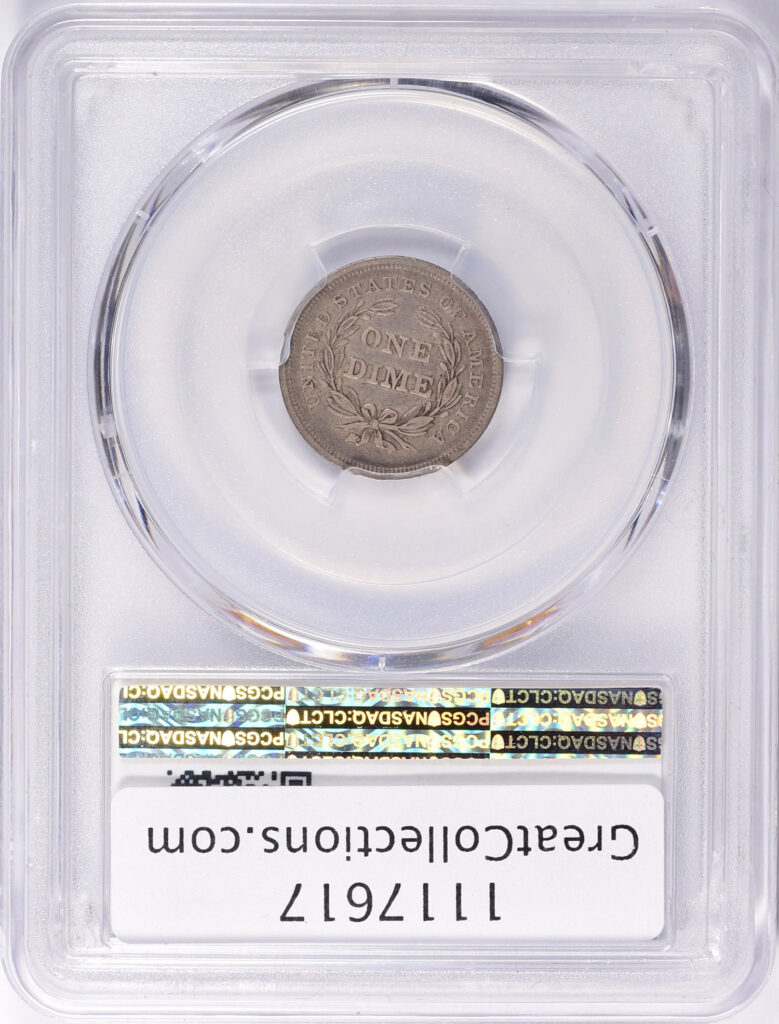
On March 27, 2023, Stack’s Bowers sold a CAC approved Fine-15 grade 1837 ‘Small Date’ for $312. On April 6, 2025, GreatCollections sold a CAC approved VF-30 grade 1837 ‘Large Date’ for $913. On June 15, 2025, GreatCollections sold a CAC approved VF-35 grade 1837 ‘Small Date’ for $892.10.
In my view, it would be fun to have a New Orleans Mint product of this design type, even though an 1838-O usually commands a premium over a somewhat equivalent 1837 ‘Small Date’ or ‘Large Date’ dime. On May 25, 2025, GreatCollections sold a CAC approved Good-06 grade 1838-O dime for $223.30. On April 9, 2024, Heritage sold a CAC approved VF-20 grade 1838-O for $432.
#6 Liberty Seated with Stars and No Drapery (1838-1840)
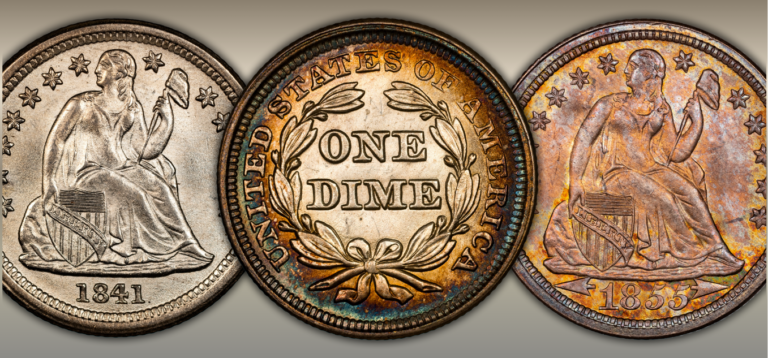
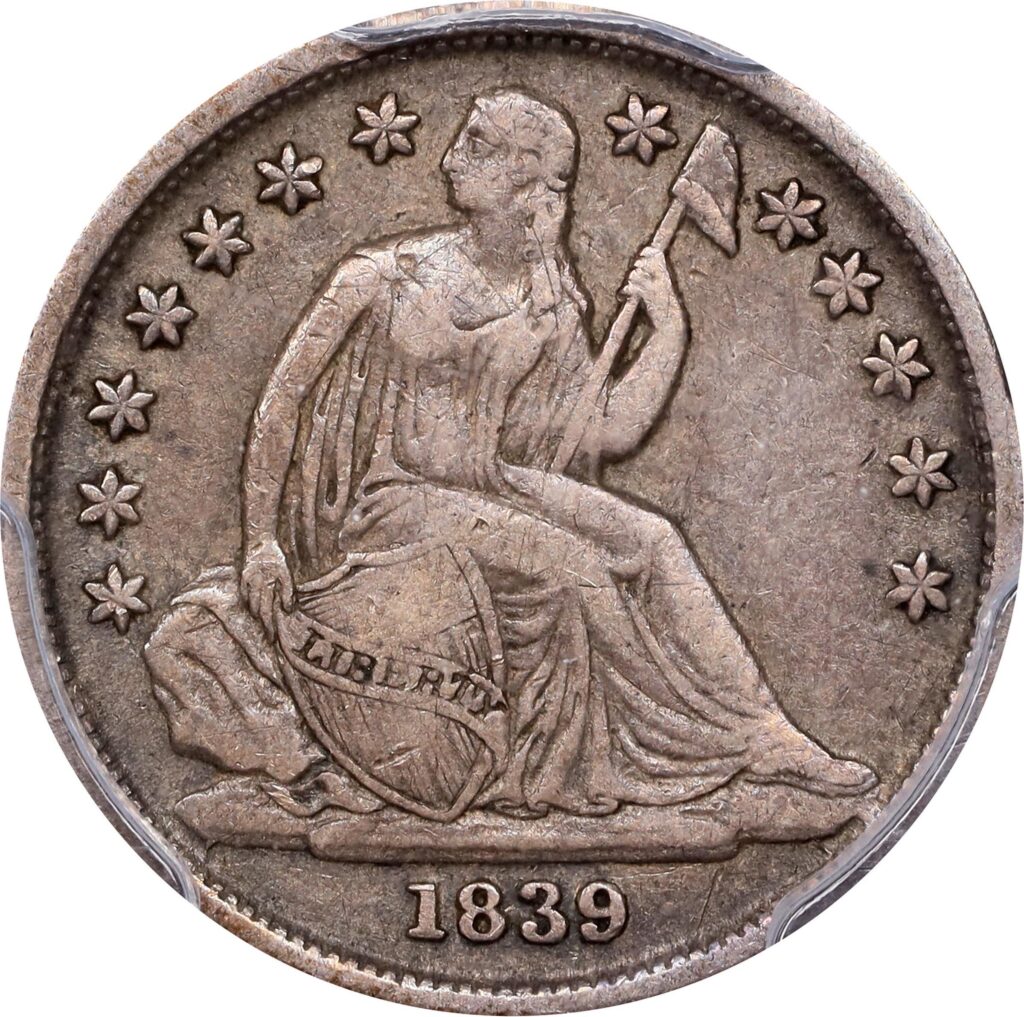
Dimes of both type #6 and type #7 feature stars on the obverse. Type #6 is often referred to as having ‘No Drapery,’ and is named ‘With Stars, No Drapery’! Other than the addition of stars, type #6 is very much like type #5. Thirteen stars were added to the obverse. There are many U.S. coins that include thirteen stars on one side, in honor of the original thirteen states, which declared independence from Great Britain in 1776.
Type #6 dimes are not rare overall. Many heavily circulated survivors have never received numerical grades from CACG, NGC or PCGS. Pleasant coins of type #6 with natural toning are notably scarce.

On Feb. 20, 2022, GreatCollections sold a CAC approved VF-35 grade 1839 for $150.33. On March 19, 2023, GreatCollections sold a CAC approved XF-45 grade 1839 for $315.70. On March 10, 2025, Heritage sold a different CAC approved XF-45 grade 1839 for $312.
The 1839-O is much scarcer than the 1839. Population reports do not provide an accurate impression of the difference in scarcity between 1839 and 1839-O dimes. Nevertheless, it is not very hard to find a really appealing, circulated 1839-O.
On Aug. 22, 2024, Stack’s Bowers sold a CAC approved VF-30 grade 1839-O for $216. On Oct. 27, 2024, GreatCollections sold a CAC approved XF-45 grade 1839-O for $434.50.
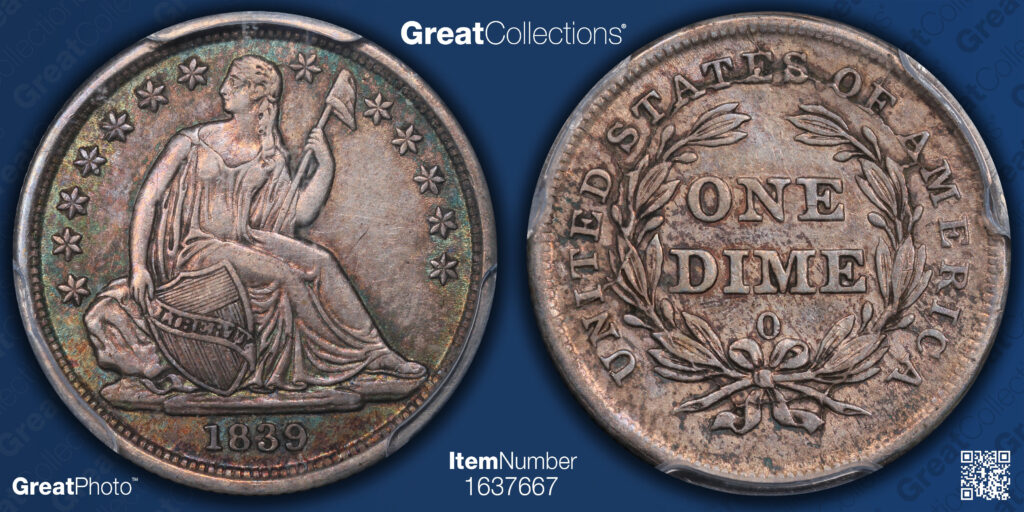
An 1840 of this design type could be suitable, too. There are enough Fine to XF grade 1839-40 ‘With Stars, No Drapery’ dimes around such that one could be found for a modest price in a reasonable amount of time. Collectors need not seize the opportunity to buy the first such coin that becomes available. These are more likely, though, to trade at coin shows than to sell in auctions.
#7 – Liberty Seated with Stars and Drapery (1840-1853, 1856-1860)
It is sad and counter-educational to refer to type #7 dimes just as having “drapery”! Of course, this is true that the design has added drapery. There is no doubt about it the presence of more drapery, as defined in the context of Miss Liberty’s clothes. Moreover, the use of the word “drapery” to name design types is traditional in the culture of coin collecting in the U.S. Even so, the ‘No Drapery’ and ‘Drapery’ names falsely suggest that the presence or absence of drapery is the primary or the only difference between type #6 and type #7 dimes.
There is material in or attached to Miss Liberty’s gown that seems to fall from her upper back. My impression is that drapery appears as excess material in women’s clothing, material that is not needed to cover her body and adds extra dimensions to a dress, gown or outfit. I have no knowledge of the fashion history or implications of drapery.
There is additional drapery to her right, to the left of a collector looking at a coin, between her arm and her torso. This additional drapery is not pertinent to the differences in design types, as it is apparent in the designs of six types of Liberty Seated dimes.
The drapery that is present on type #7, which is not present on type #6 dimes, is below her arm that is holding a pole with a cap. It is especially noticeable near her elbow, thigh, knee and upper calf. In reality, however, this right-side, which is her left side, drapery is a minor aspect of the design, and would not by itself indicate a new design type.
To grasp the primary distinction between type #6 and type #7, it is necessary to think about the whole of Miss Liberty, not just drapery in her clothes. Miss Liberty of type #7 is much different from the Miss Liberty of type #6, a whole different woman wearing similar clothes and posing in the same way.
Her face, her hairstyle, her arms and her chest are all notably different, though not blatantly so. Even the position of her upper body is different. Moreover, on the “No Drapery” types (#5 and #6), the shield tilts to the observer’s left, which is Miss Liberty’s right. On the ‘With Drapery’ coins, this shield is vertical. The stripes and banner in the shield are different, too.
The shapes of the visible portion of the boulder, on which she is sitting, are different as well. Clearly, the Miss Liberty of 1837 to 1840 and the Miss Liberty of 1840 onward are works of different artisans with very different styles and conceptions of Miss Liberty. Admittedly, though, it is hard to explain the differences. Collectors may learn about the differences by examining coins in actuality. Much can be learned by seeing coins ‘in hand’ rather than just viewing pictures.
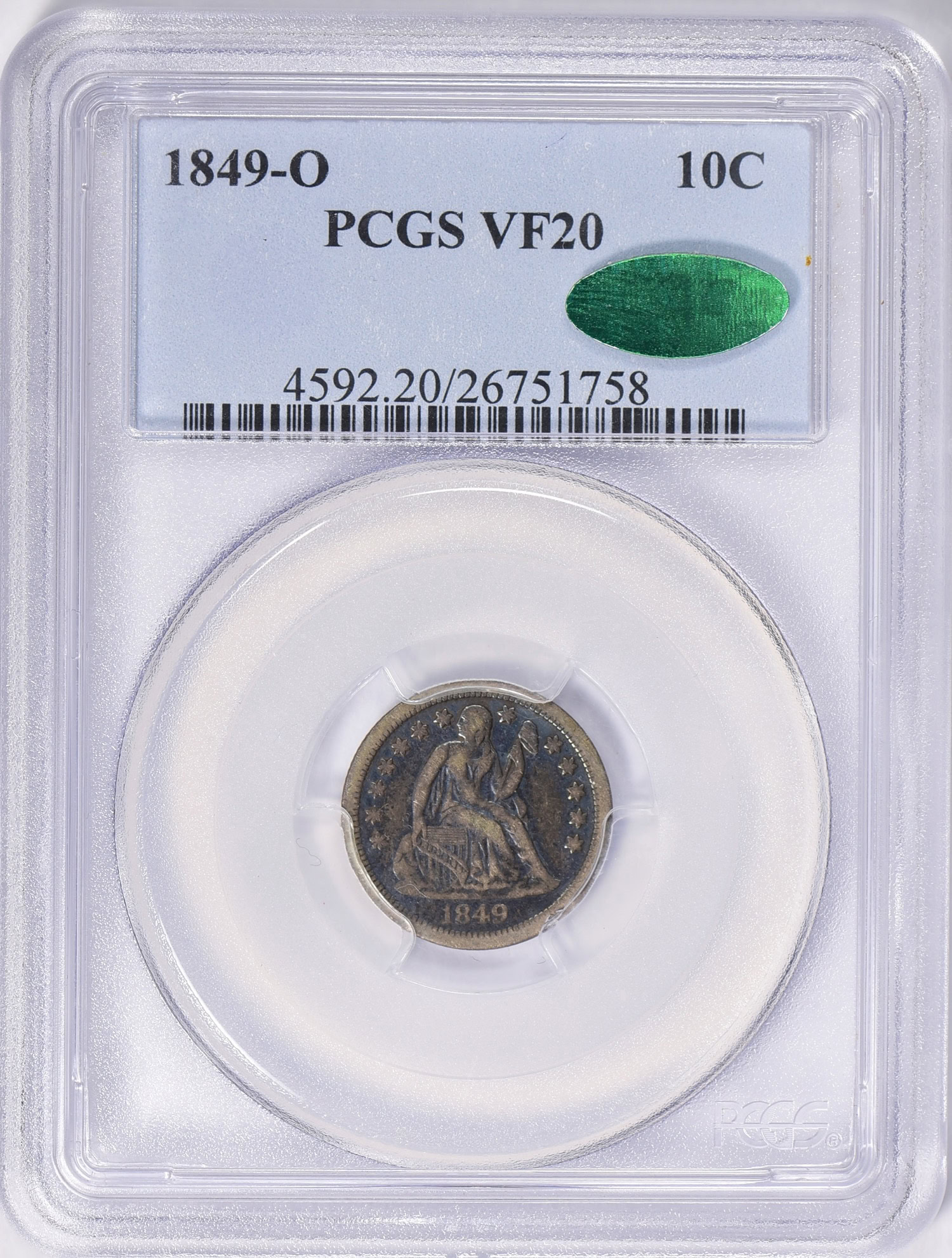
Researchers have said that Robert Ball Hughes is the artisan behind the Liberty Seated motif on dimes of the 1840 to 1859 period, plus the 1860-S, type #7. I do not have a reason to think otherwise, though I am unsure as to whether anyone alive now knows for certain who is responsible for the Miss Liberty “With Drapery” motif.
Circulated, type #7 Liberty Seated dimes dating from 1840 to 1853 are not difficult to find. Unfortunately, most dealers do not send many 1840 to 1853 “With Drapery” dimes to grading services. The least scarce dates are somewhat common in relatively low grades, and many would not qualify for numerical grades if submitted to grading services. Technically sound and naturally toned, circulated nineteenth century silver coins are scarcer than many collectors and dealers figure them to be.
A CAC approved XF-45 grade 1843 dime showed up in a Heritage sale on March 10, 2025. It realized $186, one dollar more than the CPG-CAC medium retail estimate of $185. The CAC population of 1843 dimes in XF-45 grade is three, with only nine lower.
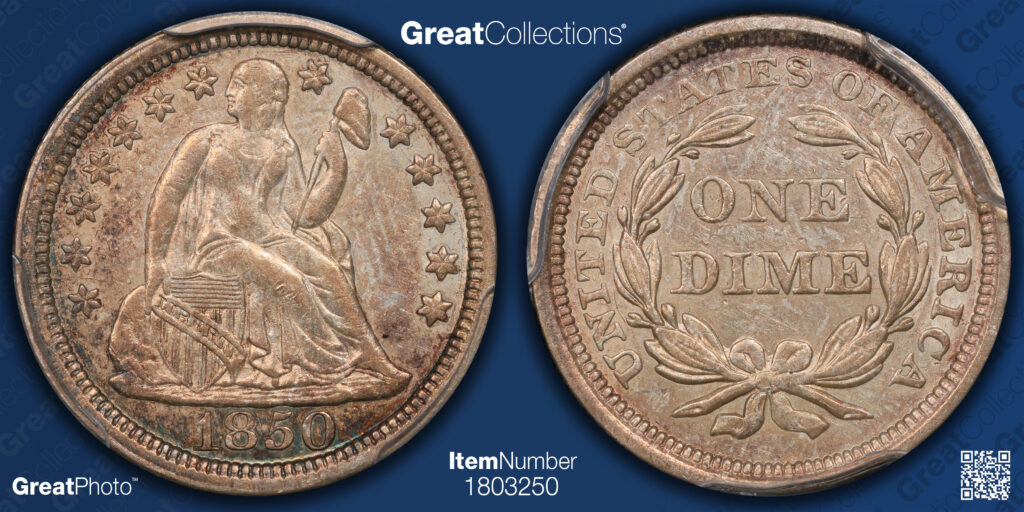
On April 20, GreatCollections sold a CAC approved AU-50 1850 dime for $236.50. Assuming that a collector rather than a dealer bought it, this result is consistent with the CPG-CAC medium retail estimate of $255. On Oct. 6, 2024, GreatCollections sold a CAC approved XF-40 grade 1850 dime for $126.50.
For several dates in the 1840s and early 1850s in VF-20 grade, the CPG-CAC retail estimates are in the range of $40 to $50. I suggest that these might very well sell for prices that are higher than the CPG-CAC estimates.
The least scarce dates of the type #7 dime design are the 1842, 1843, 1845, 1850, 1851 and 1852. On April 13, 2025, GreatCollections sold a CAC approved VF-20 grade 1852 dime for $182.60, more than four times as much as its CPG-CAC retail estimate of $40.
The CAC pop in circulated grades for each of the least scarce dates is very small, partly because many circulated representatives of the least scarce dates remain raw. The CAC pops for circulated Liberty Seated dimes could grow substantially as increasing quantities of raw coins are submitted to the CACG location in Virginia Beach, which opened in 2023.
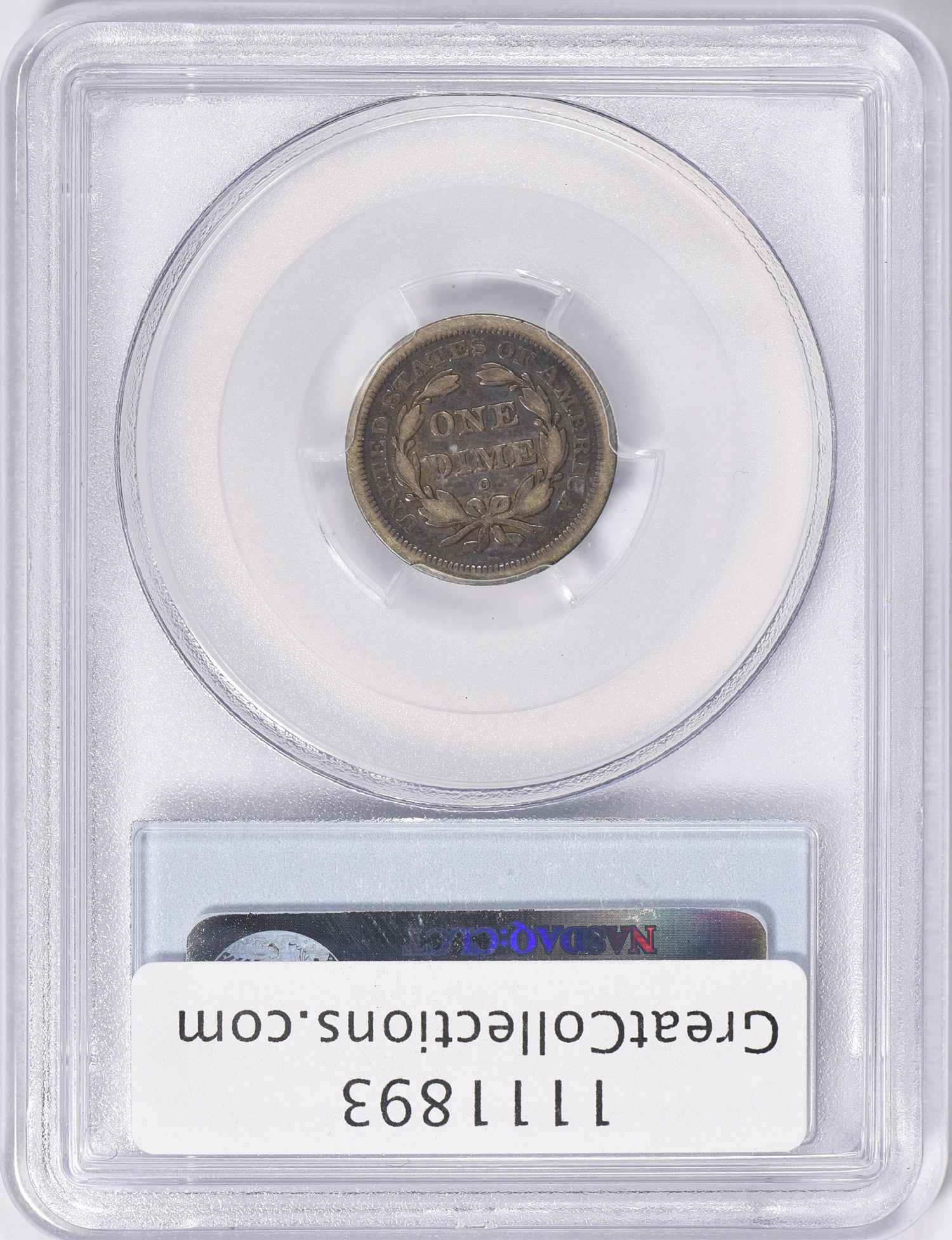
Back on Feb. 20, 2022, GreatCollections sold a CAC approved VF-20 grade 1849-O dime for $200.20. The 1849-O, though, is a ‘better date.’ Market levels of CAC approved representatives of the least scarce dates in VG-10 to VF-35 grades are unclear. CAC approved circulated dimes of this design type can practically be found, though considerable patience may be required.
An adventurous collector, who has some free time, may wish to buy Good to Very Fine grade, raw (uncertified) dimes of the least scarce dates of type #7, and send them to the CAC office in Virginia Beach. Very inexpensive type #7 dimes could be found in a matter of months, or weeks. There would not be much downside risk, even if all the acquired raw coins failed to receive numerical grades in Virginia Beach and ‘came back’ in ‘Details’ holders. The process of finding, purchasing and submitting them could be very educational.
It is not easy, though not too difficult, to find CAC approved or CACG graded representatives of the design types of Liberty Seated dimes. In my view, Very Fine to Extremely Fine (XF) grade representatives of these types are surprisingly scarce, not especially expensive, and enjoyable to collect.
Copyright © 2025 Greg Reynolds
About the Author
Greg is a professional numismatist and researcher, having written more than 775 articles published in ten different publications relating to coins, patterns, and medals. He has won awards for analyses, interpretation of rarity, historical research, and critiques. In 2002 and again in 2023, Reynolds was the sole winner of the Numismatic Literary Guild (NLG) award for “Best All-Around Portfolio”.
Greg has carefully examined thousands of truly rare and conditionally rare classic U.S. coins, including a majority of the most famous rarities. He is also an expert in British coins. He is available for private consultations.
Email: Insightful10@gmail.com
Suggested Articles